- Spring 2026
Implementation Corner: TDOT’s success with thicker thin overlays
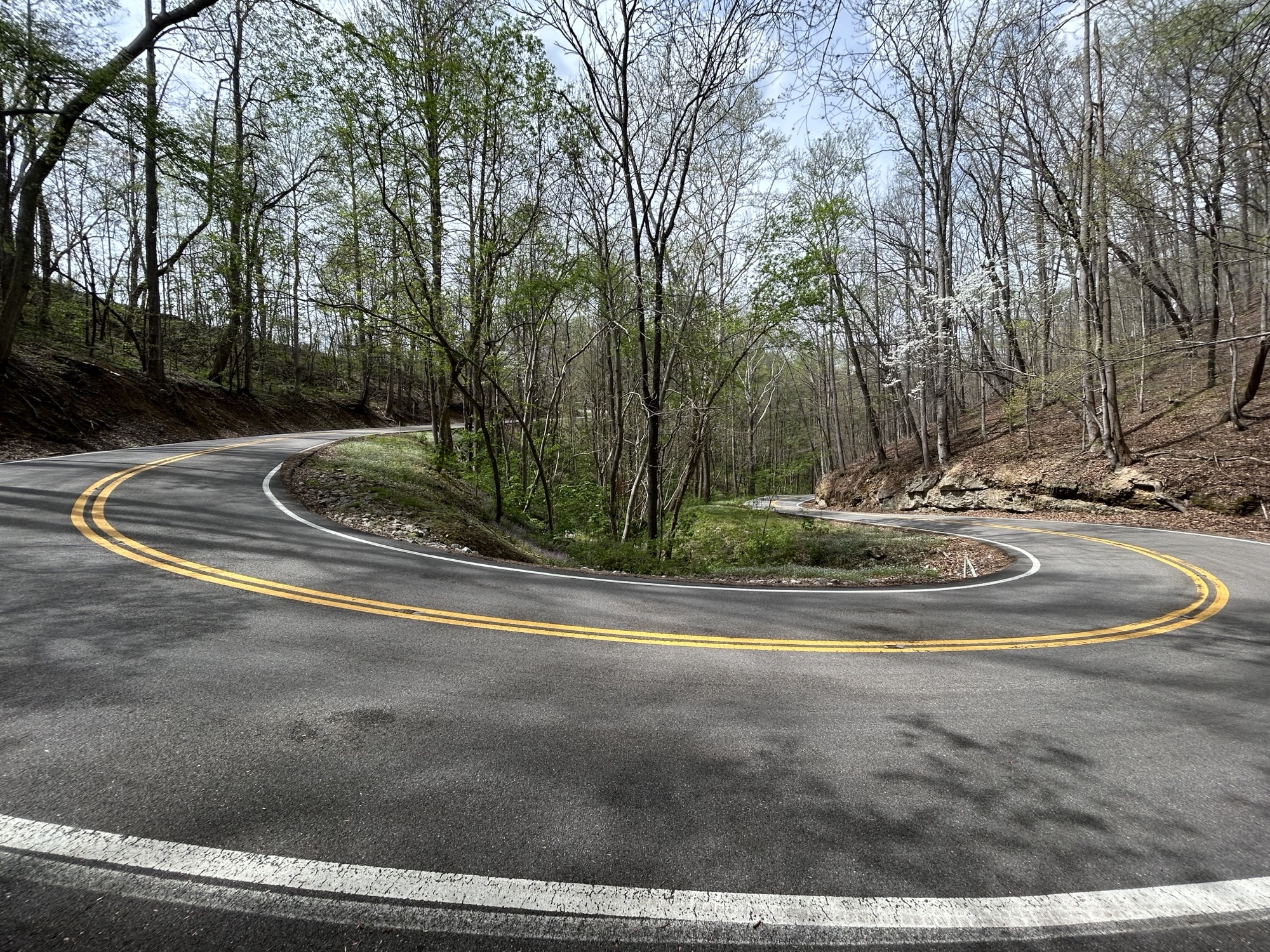
Thicker thinlay on SR98 in Tennessee
A preservation question
In the mid-2010’s, the Tennessee Department of Transportation (TDOT) asked a question that is faced by many highway agencies: how can we use more local materials while improving or preserving Tennessee roadways? Industry partners in Tennessee, particularly in the aggregate industry, were promoting thin lift asphalt mixtures to help balance quarry operations and reduce aggregate costs in certain regions. TDOT saw potential; if they could increase the longevity and durability of their roads while simultaneously using under utilized quarry products, it would be a win for the whole state.
At the time, the thinlay resurfacing approach often used overlays around ¾ inches thick with 4.75 mm nominal maximum aggregate size (NMAS) mixes, while overlays with a 16 mm (5/8”) NMAS mix were being placed around 1.25 to 1.5 inches. If the thinlay mix could provide equal or better performance at 1.25 inches, it could help balance material availability and reduce overall aggregate prices. When thinlay mixes are constructed at only ¾ inches, achieving a reasonable density is challenging.
However, when paved at thicknesses of 1.25 inches and above, they tend to be much easier to compact, potentially increasing the service life of the overlay. The challenge was confidence: could thicker thinlay mixes truly hold up under heavy traffic loading, where thicker overlays were typically being placed?
Drive toward implementation
During the 2015 NCAT Test Track cycle, TDOT sponsored a test section evaluating a 4.75 mm thinlay mix, constructed at approximately 1.25 inches thick, doubling the thickness of typical TDOT thinlays. The work examined both performance potential and practical constructability. Building upon prior work on thinlay mixes at NCAT, TDOT developed a draft specification and put it to the test at the Test Track.
During mix production for the test section, the gradation shifted from a 4.75 mm NMAS to a 9.5 mm NMAS because the #4-sized material increased by 15%, bringing the mix closer to the maximum density line. The final blend had 6.4% asphalt, a dust-to-binder ratio of 1.7, air voids of 2.6%, and VMA of 13.3% with unmodified 67-22 binder and 15% fine RAP. Although these changes alarmed TDOT representatives, they decided to proceed with paving the mix since it allowed them to evaluate a situation similar to what they had seen in the field. The resulting 1.5-inch overlay had an in-place density of 95%. With a 4:1 thickness/NMAS ratio, it was double the typical ratio of these mixes at the time in Tennessee.
Under accelerated loading at the Test Track between 2015 and 2017, the sections performed well, maintaining durability and smoothness. After 10 million equivalent single axle loads (ESALs), there was no cracking, less than 1.5 mm of rutting, and consistent smoothness. Most notable was the lack of rutting, especially given the higher asphalt content, high screenings content, and use of unmodified binder.
The results showed that preservation thinlays at thicker lifts could deliver meaningful structural and functional performance, even when real-world mix changes occur during production.
“We definitely had a lot of concern that the mix would rut. But we figured, let’s try it and learn something.” – Matthew Chandler, TDOT Materials & Pavements Manager

Thicker thinlay on SR98 in Tennessee.
From draft specification to deployment
Some Test Track experiments are designed to fail to validate threshold criteria or to push the limits of materials. Other experiments are designed for success that can quickly be mimicked and implemented. Findings from “success” experiments may not be perfectly optimized, but they can produce streamlined solutions that can be delivered back to the real world from research. The proven success of the Tennessee thicker thinlay on the Test Track proved that it was ready for implementation.
Armed with the Test Track results, TDOT moved quickly. Rather than waiting years for additional studies, TDOT developed new 9.5 mm and 4.75 mm thinlay specifications using a Marshall-based design framework. TDOT allowed the mixes to be placed at thicker lifts in lieu of typical overlay mixes and contractors could begin implementing them immediately.
This rapid transition reflected a defining characteristic of TDOT’s culture. More field projects soon followed. Thicker thin overlays were placed across multiple districts at 1.25 inches during early adoption.
The results mirrored Test Track findings: the smaller NMAS mixes provided durable surfaces and proved suitable for preservation applications in locations that needed thicker surface lifts.
“We have a problem – let’s go solve it,” Chandler said. “At some point, you stop researching and start fixing roads.”
Expanded benefits
The major outcome of this study was improved aggregate production balance. Quarries in portions of Tennessee had accumulated large stockpiles of screenings over many years, but the pace of the thick thinlay implementation quickly put them to use and helped balance aggregate production. In 2018, the first year of full implementation, the thicker thin lift mix was placed on 50 lane miles of Tennessee and totaled approximately 25,000 tons of asphalt mix. These mixes are comprised mainly of screenings and sand.
To date, over 180 miles of this mix type have been placed in Tennessee. Although this mix type is not used in all parts of the state, it is a real solution in regions where quarry imbalances affect pricing.
Learning beyond state lines
Heather Purdy, TDOT materials & tests division director, emphasized that their research funding provided value beyond the thicker thin-lift work. For example, TDOT took notice of open-graded friction course (OGFC) improvement research being funded by a neighboring state and adopted some of those findings for their own network.
“The value of our participation extends beyond our own test sections. Tennessee has gained significant insights from group studies and from the results shared from other states’ test sections. These efforts have directly contributed to the expansion of our mix design options, validation of our BMD framework, and increased pavement performance.” Heather Purdy, TDOT materials & tests division director, stated.
Purdy noted that TDOT's involvement in collaborative research has provided benefits far beyond a single project or test section. The ability to learn from other states' experiences has helped expand mix design options and improve pavement performance.
A culture of implementation
Perhaps the most important lesson from TDOT’s experience is cultural rather than technical. Successful implementation requires a willingness to try new ideas, a partnership between the agency and industry, and a commitment to move forward once evidence is sufficient. The “let’s try it” mentality among TDOT engineers captures the mindset that turned research findings into hundreds of lane miles of preserved pavement. Experiments like TDOT’s demonstrate the value of taking appropriate risks in a research environment to develop implementation-ready solutions for rapid deployment.
Want to know more about TDOT's success with thicker thin overlays? Scan the QR code to read about it in NCAT Report 18-04, chapter 11.


Contact Nathan Moore for more information about this research.