- Fall 2026
Implementation Corner: TxDOT's Road to Balanced Mix Design

"As we received updates on the Test Track sections through the years, it gave us confidence – not only the agency but also the contractors. The sections were doing so well that we decided to go to the next step by building test sections across the state." - Ryan Barborak, Materials and Tests Division Director, TxDOT
"We shared our successes, but also our failures, because what didn't go well is part of learning too. Buy-in is achieved when a lot of people participate and become familiar with the whole process." - Gisel Carrasco, Flexible Pavements Section Director, TxDOT
The Texas Department of Transportation (TxDOT) manages one of the largest highway networks in the nation, with more than 180,000 lane-miles across 25 districts. At that scale, small gains add up fast. A surface mix that lasts even just a single year longer, multiplied across thousands of lane miles paved each year, frees up real money for maintaining other roads.
That opportunity drove TxDOT toward Balanced Mix Design (BMD) and away from recipe-style, volumetric mixtures. The path from idea to specification ran through the NCAT Test Track, dozens of trial sections across Texas, and a deliberate effort to bring agency and industry along together.
A long head start
TxDOT has used mixture performance testing for decades. The Hamburg Wheel Tracking Test (HWTT) screened mixes for rutting and moisture damage, and the Overlay Tester (OT) measured resistance to cracking. Historically, OT results suffered from high variability, so researchers at the University of Texas at El Paso (UTEP) refined how OT test data are interpreted and developed two new cracking indices, the Crack Progression Rate (CPR) and Critical Fracture Energy (CFE), dramatically improving the test. The Texas A&M Transportation Institute (TTI) later developed the Indirect Tensile Asphalt Cracking Test (IDEAL-CT), a faster, simpler cracking test that is now the most popular cracking test nationwide. Each of these tests told TxDOT a great deal about its mixes in the lab, but they wanted evidence that the BMD tests and criteria would pay off under real traffic.
NCAT Test Track: BMD proving ground
To find out, TxDOT sponsored a BMD experiment at the NCAT Test Track. In the 2018 research cycle, two side-by-side sections compared a standard volumetric design (S11) with TxDOT's initial BMD design (S10). In 2021, a third section (N6) added another BMD mix designed just within the BMD specification limits, with a gradation, AC%, and VMA between the other two. All three started from a TxDOT-approved 12.5 mm SP-C surface mix with PG 70-22 SBS-modified binder and a 20% recycled binder ratio. Each was placed as a 2.5-inch mill-and-inlay over pavement with 15 to 20% lane area cracking, a deliberately tough but realistic test for a surface mix.
The BMD philosophy was simple: adjust the gradation to make room for more binder while holding air voids at 4.0%. The binder contents in S10 and N6 increased to 5.5% and 5.3%, respectively, compared to the volumetric control mix which was 4.7%. HWTT and OT were conducted on mix sampled during production and the results lined up perfectly with their intended targets: The first BMD mix, S10, passed both HWTT and OT easily, the volumetric mix, S11, failed OT but passed HWTT, and the second BMD mix, N6, landed in between these two and just above the proposed OT threshold. The performance space diagram in Figure 1 shows how N6 and S10 both passed the HWTT and OT in the “Sweet Zone.”
Growing confidence
Under accelerated traffic, the volumetric section began cracking at about 5 million equivalent single- axle loads (ESALs). It crossed the 20% cracking threshold at 14.4 million ESALs and was removed in June 2023. The initial BMD section didn't begin cracking until about 9 million ESALs and was still below the threshold at 28 million ESALs, nearly double the overlay life. N6 had performed even better, with less than 3% cracking after more than 18
million ESALs.
The economics followed. The S10 BMD mix would add approximately 6% to the initial construction cost. But over a 40-year life-cycle cost analysis window, it would reduce the schedule from three mill-and-fill cycles to one, lowering life-cycle costs by 32%. The life cycle assessment showed a similar trade-off: about 10% higher upfront environmental impact, but a 40% benefit over the pavement life.
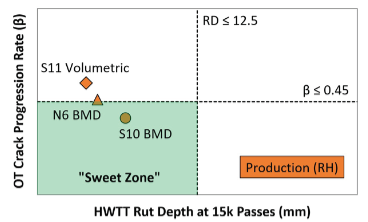
Figure 1. BMD performance diagram for TxDOT Test Track mixes.
The Test Track is only the beginning
The NCAT Test Track is a proving ground, but not an implementation site. Its value lies in giving agencies and contractors the confidence to try something on real projects. For TxDOT, it did exactly that.
TxDOT was already active in the national BMD conversation, and a statewide push toward performance-based specifications was underway. Contractors, though, had fair concerns: more testing with new equipment and uncertainty about test variability. Seeing Texas materials perform well on the Track during TxDOT's first attempt at a BMD design convinced TxDOT to continue pursuing a BMD specification.
Despite some unknowns, the biggest draw for contractors was opportunities for innovation. By setting performance requirements instead of recipes, BMD opens the gates for innovation in materials and mix design. Using more recycled material, which provides more materials options to contractors and supports a major initiative from TxDOT administration to increase recycled content, benefited both TxDOT and the asphalt industry.
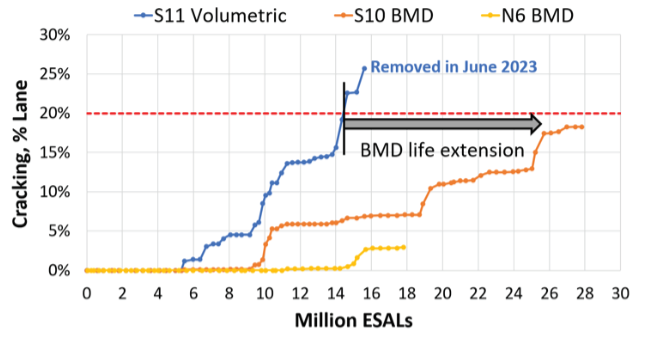
Figure 2. Cracking performance comparison for TxDOT BMD mixes vs. volumetric mix.
One phase at a time
TxDOT then took BMD to real projects, step by step. Rolling out BMD to mix production included multiple phases. TxDOT began Phase 1 by getting its feet wet. TxDOT drafted its first BMD specification using the IDEAL-CT for cracking and the IDEAL-RT for rutting. Rather than wait for new contracts, TxDOT asked districts for projects already let and awarded where producers would agree to run a BMD mix for a day. Six districts stepped up with nine projects. By varying materials within each, such as a softer binder in one section and higher RAP in another, they built 33 trial sections across the state. The basic question was, can the BMD mixes be produced and built in the real world?
"Phase 1 test sections allowed districts and contractors to gain hands-on BMD experience, but we didn’t have an implementable specification at that point," said Ryan Barborak. "The objective was to identify the challenges and build confidence as we progressed to a one-time use specification"
In Phase 2, TxDOT moved from single days to multi-day production runs to check variability from lot to lot, with four projects and eight mix combinations across four districts. During this phase, TxDOT formed a BMD Working Group of agency, industry, and academic members to review the data and develop the specification. Its proposals go to the TxDOT Forum, an existing body with a materials engineer or subject matter expert from each district, before going out to industry. That gives every district a voice.
Successes in the first two phases yielded a one-time-use BMD specification, Special Specification 3024, published in December 2025. It marked the first time TxDOT would let a project under a BMD-focused specification.
During production, contractors run IDEAL-CT and IDEAL-RT on every sublot, which is about four times a day, with the Hamburg and Overlay tests available as a check to see if the results look off. Districts nominated projects that were overlays of 10,000 to 20,000 tons and six pilot projects were approved for 2026 and 2027, to fine-tune sampling, testing, and criteria.
"Pilot projects give districts the chance to use BMD from the very beginning, from planning through letting and construction," said Gisel Carrasco, Flexible Pavements Section Director at TxDOT. "That way, the agency and industry gain experience with the new specification under real contracting conditions."
Start with buy-in
TxDOT's goal is a statewide BMD specification by 2028. Getting there has taken nearly a decade of steady, deliberate work: field validation at the Test Track, dozens of trial sections, multi-day production testing, and now pilot projects under a dedicated specification. At each step, TxDOT has continued to value buy-in from the industry.
That may be the most useful lesson for other agencies. The tests and the data matter, but implementation succeeds when people believe in it and each other. TxDOT used the Test Track to show what was possible, then used real projects to ensure contractors and districts were part of developing and refining the specification, not just receiving it. For any agency considering BMD, the first step isn't a new test. It's buy-in.