Xiao Qin's Research
Final Report
Project
NSF CAREER Award · CCF-0845257
Multicore-Based Disks for Data-Intensive Computing
Training and Development
3.1 · Training
Student Support
The project directly supported about eight students, including six doctoral students and two undergraduate students. It also contributed indirectly to about 17 graduate students who took COMP 7500 Advanced Operating Systems and 65 undergraduate students.
Year 1 (2009–2010): doctoral students partially supported
- Adam Manzanares
- Jiong Xie
- James Majors
- Zhiyang Ding
- Xiaojun Ruan
- Shu Yin
Year 2 (2010–2011): doctoral and master’s students partially supported
- Xiaojun Ruan (Ph.D.)
- Zhiyang Ding (Ph.D.)
- Shu Yin (Ph.D.)
- Jiong Xie (Ph.D.)
- Maen Al Assaf (Ph.D.)
- Yixian Yang (Ph.D.)
- Yun Tian (Ph.D.)
- James Majors (M.S.)
- Jianguo Lu (M.S.)
Year 1 (2009–2010): undergraduate students partially supported
- Joshua Lewis
- Tsukasa Ogihara

Figure 33: Our undergraduate research assistants helped build a cluster system.
Year 2 (2010–2011): undergraduate students partially supported
- Joshua Lewis
- Alfred Nelson
- Drew Pitchford
- John Barton
- Greg Poirier
- Alexander Luchs
- Bryant Haley
- Kathryn Catlett
- Riley Spahn
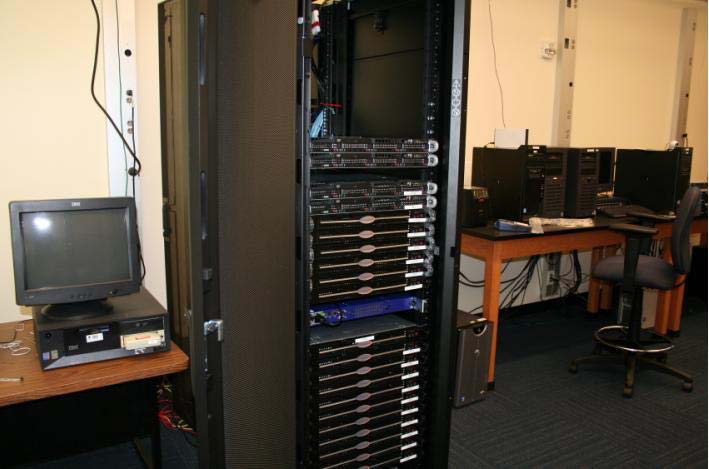
Figure 34: The cluster computing system built by our undergraduate research assistants.
3.2 · Training
Research Experience for Undergraduate Students
To recruit new undergraduate students, especially women and minorities, into storage-systems research, we designed a research program that gives undergraduates ample opportunity to do intensive research in data-intensive computing with the PI. Students and the PI work together on research experiments in high-performance storage systems. Figure 33 shows two undergraduate students, Tsukasa Ogihara (right) and Joshua Lewis (middle), building a cluster computing system from commodity off-the-shelf (COTS) hardware.
The cluster built by our undergraduate research assistants (Figures 33 and 34) serves as a high-performance computing platform for our computer security education. It supports security middleware services for secure software applications, and we use it to study how to improve the quality of security of software applications without adversely affecting performance.
3.3 · Training
Contributions to Courses
The project contributed directly and indirectly to these courses:
- COMP 2710: Software Construction
- COMP 4300: Computer Architecture
- COMP 4370: Computer and Network Security
- COMP 7370: Advanced Computer and Network Security
- COMP 7500: Advanced Operating Systems
- COMP 7970: Storage Systems