
Project Description
When RFID Meets AI for Occluded Body Skeletal Posture Capture in Smart Healthcare
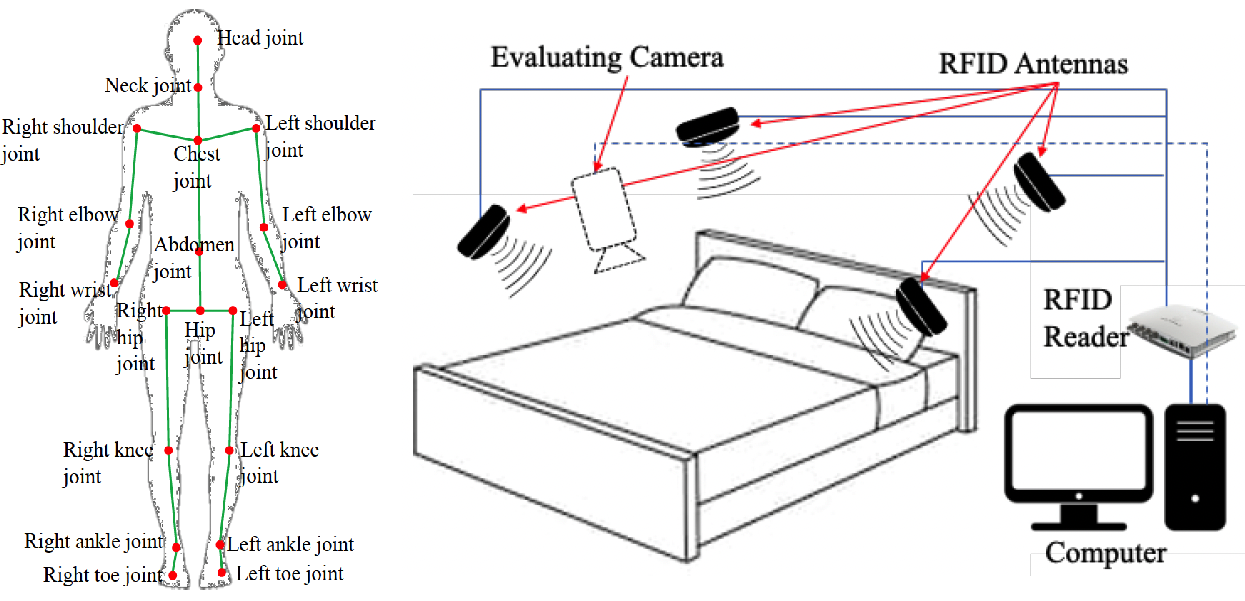
This project aims to develop RFID localization methods to obtain precise positions of attached RFID tags. The posture and motion of the body can be reconstructed by registering tags to a skeletal model. With the captured posture and motion of the body, an AI-based method shall be proposed to provide diagnostic information. The research agenda includes: (i) Create a prototype for the RFID posture scanner (RFPS); (ii) Enabling RFPS for a complex and large-scale environment; (iii) Developing an intelligent tool for extracting healthcare data. This project also includes a thorough integration and assessment plan to test how the proposed system can be used in a healthcare facility or home environment to monitor persons in need of preventative care.
Aug. 1, 2023 ~ July 31, 2027
Project Team
-
Xiangyu Wang
-
Bernard Amoah
-
Junwei Ma
-
Yongshuai Wu
-
Pritom Dutta
Related Publications (journal & magazine)
-
Bernard Amoah, Xiangyu Wang, Jian Zhang, Shiwen Mao, Senthilkumar C.G. Periaswamy, and Justin Patton, “Adaptive power control for dense RFID networks,” invited paper, Journal of Communications and Information Networks (JCIN), vol.10, no.2, pp.103-122, June 2025.
-
Yongshuai Wu, Jian Zhang, Shaoen Wu, Shiwen Mao, and Ying Wang, “ZAS-F: A zero-shot abstract sub-goal framework empowers robots for long horizontal inventory tasks,” IEEE Access Journal, vol.13, pp. 76400-76411, Apr. 2025.
-
X. Wang, J. Zhang, S. Mao, S. C.G. Periaswamy, and J. Patton, “A framework for locating multiple RFID tags using RF hologram tensors,” Elsevier/KeAi Digital Communications and Networks, vol.11, no.2, pp.337-348, Apr. 2025. [link]
-
X. Wang, J. Zhang, Z. Yu, S. Mao, S. C.G. Periaswamy, and J. Patton, “On remote temperature sensing using commercial UHF RFID tags,” IEEE Internet of Things Journal, vol.6, no.6, pp. 10715-10727, Dec. 2019.
Related Publications (conference)
-
Bernard Amoah, Xiangyu Wang, Jian Zhang, Shiwen Mao, Senthilkumar Periaswamy, and Justin Patton, “Resilient RFID networks: Securing decentralized neighborhood-aware protocols,” in Proc. IEEE RFID-TA 2025, Valence, France, Oct. 2025.
-
Kanchon Kanti Podder, Jian Zhang, Shiwen Mao, and Zhitao Yu, “Uncertainty-aware domain incremental learning for guesture recognition in robotic IoT systems,” in Proc. 11th IEEE World Forum on Internet of Things (WFIOT 2025), Chengdu, China, Oct. 2025.
-
Christopher Turner, Dheeraj Bhaskaruni, Xiangyu Wang, Jian Zhang, Shiwen Mao, Senthilkumar Periaswamy, and Justin Patton, “Digital twin of retail environment using RFID particle filter localization,” invited paper, in Proc. 2025 10th International Conference on Smart and Sustainable Technologies (SpliTech), special session on Innovative Antennas and Intelligent Systems: Shaping the Future of RFID Application, Split/Bol, Croatia, June 2025.
-
Bernard Amoah, Xiangyu Wang, Jian Zhang, Shiwen Mao, Senthilkumar Periaswamy, and Justin Patton, “DCA-KEAE: A dynamic context-aware key exchange and adaptive encryption scheme for secure RFID systems,” in Proc. IEEE ICC 2025, Montreal, Canada, June 2025, pp.380-385.
-
Bernard Amoah, Xiangyu Wang, Jian Zhang, Shiwen Mao, Senthilkumar Periaswamy, and Justin Patton, “RFIDNet: A network layer protocol for multiple RFID readers collaboration,” in Proc. IEEE ICC 2025, Montreal, Canada, June 2025, pp.6162-6167.
-
Yongshuai Wu, Jian Zhang, Shaoen Wu, and Shiwen Mao, “Enhancing the robustness of AI-driven robotic RFID inventory management using conformal prediction,” in Proc. IEEE ICC 2025, Montreal, Canada, June 2025, pp.3088-3093.
-
Bernard Amoah, Xiangyu Wang, Jian Zhang, Shiwen Mao, Senthilkumar Periaswamy, and Justin Patton, “MCSMARA: A MAC protocol for RFID systems,” in Proc. The 2025 IEEE International Conference on RFID (RFID 2025), Atlanta, GA, Apr. 2025.
-
Kanchon Kanti Podder, Jian Zhang, and Shiwen Mao, “Trustworthy hand signal communication between smart IoT agents and humans,” In Proc. IEEE 10th World Forum on Internet of Things (WF-IoT 2024), Special Session on AI-enabled Internet of Medical Things (AI2oMT), Ottawa, Canada, Nov. 2024, pp.595-600.
-
Shiwen Mao, “3D human pose tracking with RFID,” in Proc. 6th International Conference on Neurorehabilitation (ICNR 2024), Volume 2, Workshop About Human Kinematics Monitoring, La Granja, Spain, Nov. 2024, pp.730-734.
-
J. Ma, X. Wang, J. Zhang, S. Mao, S. Periaswamy, and J. Patton, “Navigating uncertainty: Ambiguity quantification in fingerprinting-based indoor localization,” invited paper, IEEE Annual Congress on Artificial Intelligence of Things (IEEE AIoT), Melbourne, Australia, July 2024.
-
K. K. Podder, J. Zhang, and Y. Wu, “IHSR: A framework enables robots to learn novel hand signals from a few samples,” in Proc. 2024 IEEE/ASME International Conference on Advanced Intelligent Mechatronics (AIM), Boston, MA, July 2024.
-
K.K. Podder, J. Zhang, Lingyan Wang, “Universal sign language recognition system using gesture description generation and large language model,” In Proc. The 18th International Conference on Wireless Artificial Intelligent Computing Systems and Applications (WASA 2024), Qingdao, China, June 2024.
-
J. Ma, X. Wang, C. Powell, J. Zhang, S. Mao, S. Periaswamy, and J. Patton, “Digital twin of retail stores with RFID tags localization,” invited paper, in Proc. The 9th International Conference on Smart and Sustainable Technologies (SpliTech), Split, Croatia, June 2024.
-
Y. Wu, J. Zhang, S. Wu, S. Mao, and Y. Wang, “CMRM: A cross-modal reasoning model to enable zero-shot imitation learning for robotic RFID inventory in unstructured environments,” in Proc. IEEE GLOBECOM 2023, Kuala Lumpur, Malaysia, Dec. 2023, pp.5354-5359. (Best Paper Award of IEEE GLOBECOM 2023)
Related Publications (others)
-
Jian Zhang, Shiwen Mao, Senthilkumar C.G. Periaswamy, and Justin Patton, “Standards for passive UHF RFID,” ACM GetMobile, vol.23, no.3, pp.10-15, Sept. 2019. DOI: 10.1145/3379092.3379098
We acknowledge the generous support from our sponsor
This project is supported in part by the National Science Foundation under Grants CCSS-2245608 and CCSS-2245607. Any opinions, findings, and conclusions or recommendations expressed in this material are those of the authors and do not necessarily reflect the views of the foundation.