

A need for speed
 Their names won't be carved into Auburn's sidewalks. Their accomplishments are
mere footnotes in Auburn University lore, tucked somewhere behind the feats of
football players, basketball greats and Olympic swimmers. But in the race car
world, the AU Formula Society of Automotive Engineers is a force to be reckoned
with.
Their names won't be carved into Auburn's sidewalks. Their accomplishments are
mere footnotes in Auburn University lore, tucked somewhere behind the feats of
football players, basketball greats and Olympic swimmers. But in the race car
world, the AU Formula Society of Automotive Engineers is a force to be reckoned
with.
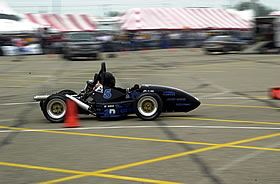
In a field of competition that spans across the globe, the FSAE has consistently ranked in the top five. They are a passionate group of students with one goal in mind: Building the perfect race formula cars. These cars, which look like muscle-bound go-carts, are built from scratch every year for competition. They run from zero to 60 in three seconds, making them faster off the line than a Porsche 911 Turbo.
These guys move fast too. Matt Zorn, the team's captain, is the quick-talking leader of this crew. He's a seasoned veteran among a 15-member team composed of novices and guys who've been around these cars for years. Soon or later, Zorn says they all get the racing bug, spending long hours in the workshop in search of a car that starts as drawing and ends up on a racetrack.
"I think everybody in here's a car nut," Zorn said. "Or they are by the time they get out of here."
Robert Wilmot, 21, has been a car nut for as long as he can remember. The son of an off-road racer, Wilmot isn't new to car culture. But Wilmot's not your average mechanic. He's an aerospace engineering major, with hopes he can contribute a more aerodynamic design to this year's car.
The crew took third place last year in Detroit, where 140 teams from institutions like Harvard and the Massachusetts Institute of Technology were all in the hunt for glory.
"When you break into the top ten, it's really hard to stay there," Wilmot said.
In the top 10, races come down to fractions of a second, and the smallest detail can be the difference between winning and losing. The crew started working out some of those details last week, using high tech equipment to help improve the car's design.
The team is concerned about more than just the speed of the car. They're concerned about safety, particularly with regard to a driver's ability to exit the vehicle quickly in the event of an accident. Thanks to new technology, the crew is able to examine in precise detail the exact dimensions the car will need to be to accommodate its tallest potential driver.
"Race cars catch fire," Zorn said. "And I'd like to be able to get out of it if it does."
Zorn is one of the taller drivers, so the team is anxious to learn exactly how much space he'll need to exit the vehicle in time to avoid injury. In a practice session last week, Zorn and others put on Lycra body suits covered in florescent markers. Once in the suit, they were filmed exiting the vehicle, and that film undergoes computer analysis.
Through computer analysis, the crew hopes to determine exactly how much space is needed to exit the car. They may learn less space is needed to exit the car than they thought, which would allow the team to reduce the weight of the vehicle, giving them a potential edge in races.
The motion-tracking technology used by the team may be new to the racing world, but it's not new to animators like Disney or video game designers. Tiger Woods, for instance, was placed in the same sort of suit to track the motion of his golf swing. Once that motion is recorded in a computer, designers can re-create Woods' swing for games like Tiger Woods Golf.
NOT JUST FUN AND GAMES
Race cars and video game technology may not sound like real homework, but AU is convinced the program places graduates in pole position when it comes to getting good jobs out of college. In fact, the Society of Automotive Engineers funds the program.
"It's a pretty selfish reason for doing it," concedes Cheryl Cobb, spokeswoman for AU's College of Engineering. "The automotive industry wants kids who know about cars."
So the industry sponsors the Detroit competition, and Cobb says winners are plucked up for post-graduate positions.
When these students come together to work on a car, however, you don't get the sense they're building a resume. There's a passion about the work, and a not-so-subtle level of competition within the team itself. Of the 15 or so in the group, only four will ever drive the car in a race.
So is there internal struggle about who will drive? "Are you joking?" Zorn quips. "All the time."
So an old fashioned battle to be the fastest lurks beneath the veneer of camaraderie. On the other hand, the team isn't about to let some Johnny Come Lately waltz in and take the wheel. Only those who've put in the hours building will be given a chance to race.
"If somebody's fast and they showed up yesterday, they're not going to drive," Zorn said.
The Detroit race is some eight months away, so one might wonder if it's too early to worry about who is going to take the wheel. Jerry Davis, the team's safety advisor, doesn't think so. "It's a serious game," he said.
On the web:
Media Contact: , cobbche@auburn.edu, 334.844.2220