

Manufacturing is the industry responsible for the production of finished goods which are then sold in various markets including food and beverage, pharmaceuticals, iron and steel, textiles, automobiles, aerospace, petrochemicals, and more. Before the industrial revolution, products were typically designed and created all by one person. After the industrial revolution, products designed by one individual began being built by many workers and machines on assembly lines and in manufacturing plants.
The design and manufacturing industry includes two categories of goods
Durable
Products with a long lifespan such as automobiles, airplanes and kitchen appliances.
Nondurable
Products with a short life span such as food and clothing.
Design is a sub-industry within manufacturing, focused on the creation of plans for how a product of system works.
Design Engineers shape every product we use, focusing on the functionality and cost of each product or systems and taking aesthetics into consideration.
There are four areas of design. Design engineers typically work within the industrial design area.
- Industrial
- Graphic
- Interior
- Landscape
Roles and Workforce Needs
Engineers who work in the manufacturing realm are responsible for
- research and development
- analysis
- planning and design
- surveying
- facility evaluation
- testing
- and more.
For engineers who work specifically in the design realm, responsibilities and pathways include:
- Design and refinement of products to be manufactured
- Design of machines and tools that make products
- Ensure the safe and effective production of diverse products and systems
- Work independently, for manufacturing companies, or for engineering firms
The design and manufacturing industry employers engineers of all backgrounds including electrical, mechanical, industrial, chemical, environmental, and systems backgrounds to ensure the safe and effective production of diverse products and systems.
Computer scientists are also becoming more important in this industry due to the increasing use of automated processes to build products.
Industry summary sourced from FirstHand Vault Guide.
Career Opportunities at a Glance
- Applications Engineer
- Controls Engineer
- Environmental, Health & Safety Engineer
- Distribution Engineer
- Industrial Engineer
- Mechnical Design Engineer
- Manufacturing Engineer
- Plant Optimization Engineer
- Project Engineer
- Process Engineer
- Quality Assurance Engineer
- Quality Control Engineer
- Software Developer
- Software Engineer
- Stress Engineer
- Structural Design Engineer
- Systems Engineer
- Technical Sales Associate
- Test Engineer
Sample job titles based on 2020 - 2025 Auburn Engineering graduates responses to the Auburn University First Destination Survey.
- American Cast Iron Pipe Company
- Armstrong World Industries
- Ascend Performance Materials
- Caterpillar
- Chevron
- Club Car
- Eastman Chemical
- General Motors
- Georgia-Pacific
- Goodyear Tire and Rubber
- Graphic Packaging
- Harris Corporation
- Honda
- Hyundai
- Ingalls Shipbuilding
- International Paper
- Kimberly-Clark
- Michelin
- Milliken and Company
- Oxy
- Packaging Corporation of America
- PepsiCo
- Procter and Gamble
- Rheem Manufacturing
- RoviSys
- Shaw Industries
- Starrett Bytewise
- Textron
- WestRock
Sample hiring organizations based on 2020 - 2025 Auburn Engineering graduates responses to the Auburn University First Destination Survey.
Pathways to Design and Manufacturing Experience
Search for opportunities with sample hiring organizations + companies recruiting through
Support for your co-op and internship search
- Interest to Industry Meetings: Navigating Your Co-op or Internship Search
- Meet with a career coach
- Complete a Professional Experience Interest Form
Confirmed an upcoming opportunity?
- Alabama Center for Paper and Bioresource Engineering
- Center for Microfibrous Materials Manufacturing (CM3)
- Center for Polymers and Advanced Composites
- Electronics Packaging Research Institute
- Interdisciplinary Center for Advanced Manufacturing Systems (ICAMS)
- Materials Research and Education Center
- National Center for Additive Manufacturing
- RFID Lab
Find out more about how to gain research experience.
Navigating the Hiring Process
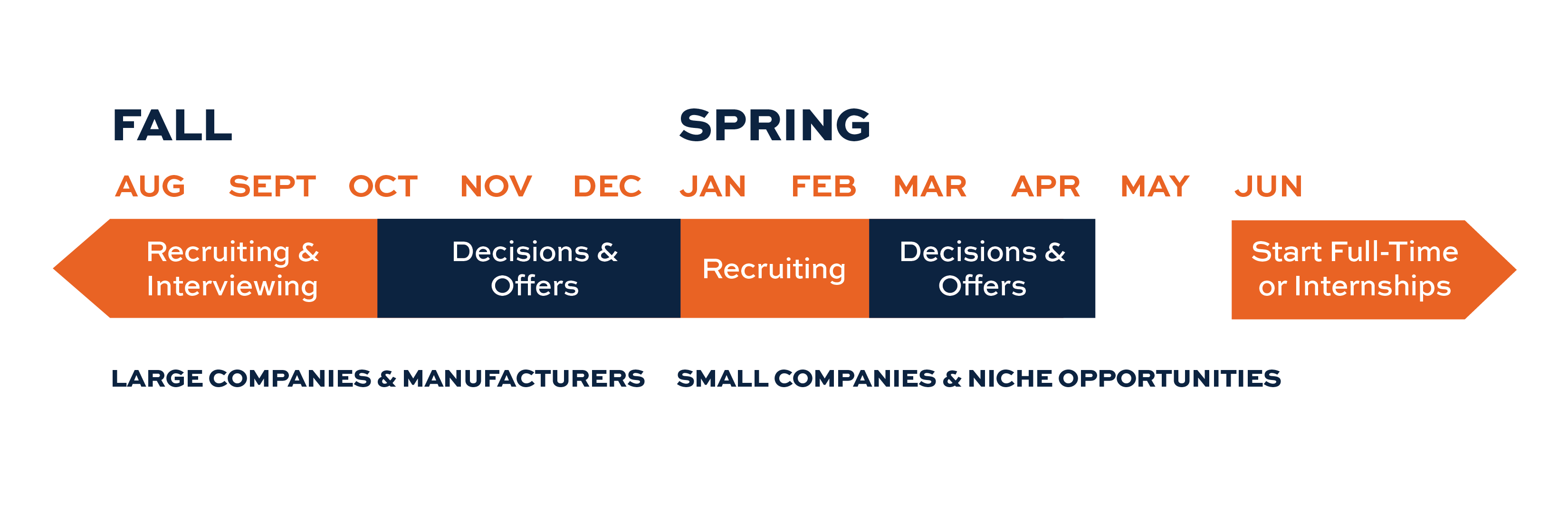
Depending on the type of employer and the role, the recruitment timelines vary. Governmental organizations, large companies, and manufacturers typically recruit more heavily in the fall. Opportunities still exist beyond the fall but are typically more niche opportunities with smaller companies. Additionally, companies will hire throughout the year depending on the needs and demands of their projects or government contracts.
Seek opportunities to connect with employers at fall events such as the fall Engineering Career Fair, as well as at employer table talks, employer-in-residence, Ask Alumni Anything chats, and student organization meetings. Search for posted opportunities on Handshake.
Alumni and Networking in the Industry
- Brody Matthews, '16 Materials | Supplier Quality Engineer | Mercedes-Benz
- Christopher Scheinert, '16 Chemical |Senior Consultant | Deloitte
- Conyers Coupland, '15 Biosystems | Lead Manufacturing Engineer | Outpost Technologies
- Corey Cooper, '04 Mechanical | CEO and Founder | BOTE Boards
- Devante Brown, '15 Mechanical | OProject Assurance Leader | Georgia Pacific
- Eddie Seay, '16 Wireless | Principal Team Lead | Chick-Fil-A
- Haley Huff, '12 Industrial & Systems | Industrial Engineer | RAPA Gruppe
- Mandy Ledkins, '02 Chemical | Containerboard Training and Development Manager | International Paper
- Marc Ivey, '92 Biosystems | District Sales Manager | Alamo Group Inc.
- Mark Plyler, '97 Biosystems | Director of Product Engineering | Madix, Inc.
- Michael Keyser, '15 Mechanical | Project Engineer | Southern Company
- Nicole Harris Odum, '02 & '10 Materials | NGOES Project Team Operations Technology Lead | ArcelorMittal Calvert
- Tariq Martin, '15 Mechanical | Regional Program Manager | Georgia Pacific
- Victoria DeBaets, '17 Industrial & Systems | Senior Manager, EV Supply Advanced Planning | Toyota Motor North America

You can access alumni such as these to learn about career paths, skills for the industry, and build your network through LinkedIn. Create an account and build your profile, then search for Auburn alumni by major, company, location, or other criteria on the Auburn University LinkedIn page. Chat with an Engineering Career Coach on strategies for networking and reaching out to connect.