 |
Our interest, however, lies in the use of a tag tracking algorithm which does not require
previous identifcation of myocardial contours, which we have termed the ML/MAP method, or
Maximum Likelihood/Maximum A Posteriori method. This technique can be decomposed
into three stages. Initially, a set of tag line centers are drawn accross the region
of interest based on a maximum likelihood estimate. Secondly, the MAP algorithm is used
to determine which regions of the image lie within and which lie without the myocardium.
When calculating displacement, spatial smoothness will not be taken into account outside
of this boundry. Finally, another MAP algorithm is used to 'prune' extraneous tags which
are scattererd throughout the image and are not clustered in either spacial or temporal
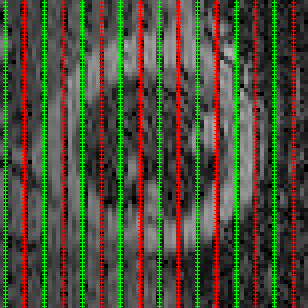
proximity to other tags. An initial image is show to the left.
|
|
The ML estimator estimates the center of a tag line from small subset of image
pixels. First, a slice of image
five pixels in length and perpendicular to the tagging direction is isolated. A likelihood function
is then calculated based on image parameters including myocardial intensity, non-myocardial intensity,
and noise. The ML center is estimated to be the minimum of the log-likelihood function. In
order to reduce the effect of noise and prevent two tags from occupying the same space, the log-likelihood
function is also minimized subject to spacial smoothness constraints and a constraint on tag separation.
|
 |
|
Once the set of inital tag lines is estimated, each tag line is tested with another set of MAP
hypotheses to determine if it is part of a tag line. This test uses a spatially varying threshold,
based again on image statistics. The threshold is then applied to the log-likelihood function.
If the minimum of the function lies below the threshold, it is considered to be on a tag line.
This removes tag centers within the myocardium that do not lie on a tag line.
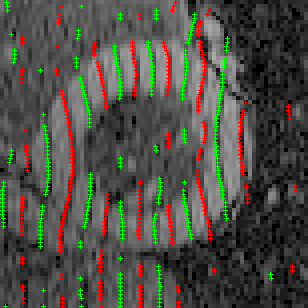
The image above shows the results of the tag center estimation and
detection process.
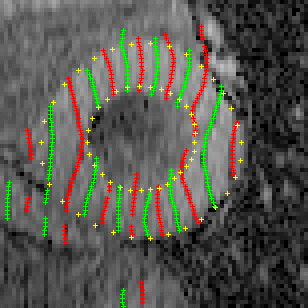
Note that there some false tag detections outside the myocardium. In most cases, these false tags occur in small isolated clusters that spontaneously appear and disappear in time. These tags can be removed with a pruning algorithm that
removes any tag points that do not have neighbors in a spatio-temporal neighborhood.
The image on the left shows the results of the tag pruining algorithm with
a set of user-defined contours (yellow +'s) for reference.
Note that the pruning algorithm, however, does not remove all the false tags.
Removing the remaining false tags would require user intervention, so instead we leave these false tag points in the dataset and account for them in the deformation and strain reconstruction process.
|
Previously, contour identification has been done through human intervention, taking a
significant amount of time and making clinical use of displacement and strain reconstruction
infeasible. Because we avoid contour detection altogether, however, we hope to
eliminate this costly step.