Students create mock web platform to help employees navigate dental coverage plan, win national hackathon
Published: Oct 28, 2026 8:55 AM
By Joe McAdory
 Computer Science and Software Engineering students created "Molar Money," a fictitious dental benefits platform designed to help employees navigate their insurance coverage and earned the Lincoln Financial codeLinc hackathon first-place prize of $5,000.
Corporate human resources needs a web application that can turn complex benefits information into clear, actionable answers for employees. Can you build it within 24 hours?
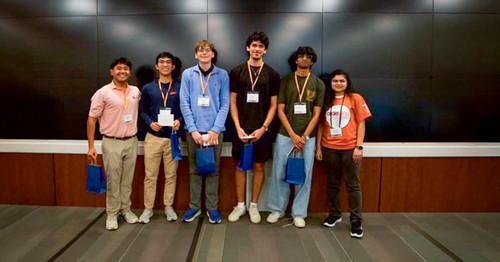
Five students in the Department of Computer Science and Software Engineering (CSSE) did and won first place among more than 40 other entries in Lincoln Financial’s annual codeLinc hackathon held Oct. 3-4 in Greensboro, North Carolina.
Wrigley Taylor (software engineering), Marc Alen Halog (software engineering), Ulisses Molina-Becerra (software engineering), Sai Nirmal Sarva (software engineering) and Caleb Abrantes (computer science minor) created "Molar Money," a fictitious dental benefits platform designed to help employees navigate their insurance coverage and earned the first-place prize of $5,000.
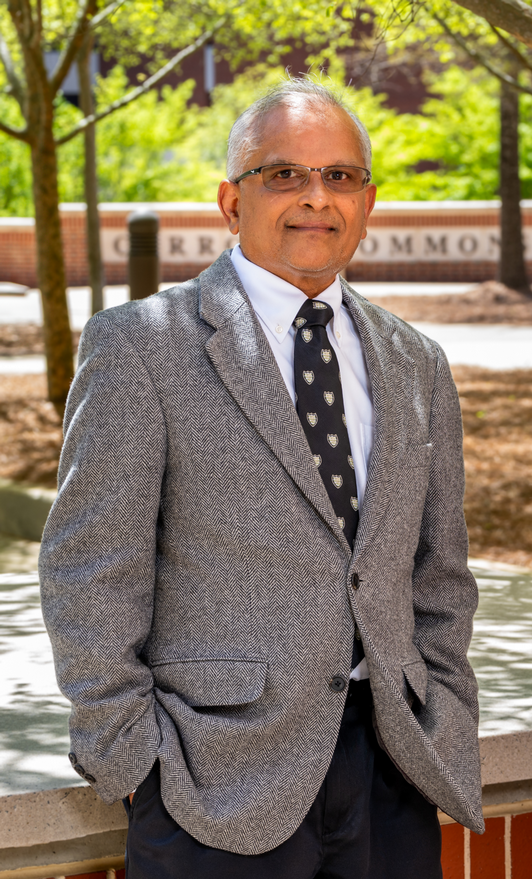
“Competitions like this give students the opportunity to apply what they have learned in the classroom to real-world challenges,” said Hari Narayanan, CSSE department chair. “Building a complex and fully functional applications like Molar Money in less than a day requires deep technical knowledge, outstanding software design skills, creativity under pressure, and excellent teamwork. This team's success is a testament to not only their technical expertise and teamwork skills, but also the quality and relevance of education CSSE students receive. I am so proud of them.”
For the past 11 years, Lincoln Financial has used codeLinc to challenge high school, undergraduate, and graduate students to solve tangible technology problems while working alongside the company's developers and industry mentors. Participants tasked with developing a complete software solution, submitting a working application and source code and demonstrating their creations for evaluation by a panel of industry judges.
Students had the opportunity to work alongside technical experts from Lincoln Financial, Amazon Web Services, Cognizant, Accenture, LTIMindree, IBM and Deloitte.
Teams arrived without knowing what problem they would be asked to resolve. Once organizers revealed the details, the CSSE team immediately began planning their approach.
“The concept was pretty daunting,” Taylor said. "What set us apart was that while everyone else was just taking notes, we took action by actively communicating with mentors and experts to make full use of their wisdom.”
Presented with a choice between creating a life insurance or dental insurance web platform that would help employees better understand and manage their benefits, the team chose dental and “Molar Money” was born.
Assignments were given at 1:30 p.m. and due the following morning. The result: a sleepless night.
Designed around the competition's focus on helping employees navigate insurance benefits, the creation of “Molar Money” combined several tools into a single platform. Users could view coverage information for themselves and their dependents through an interactive family dashboard, track preventive-care benefits, receive reminders about covered services and use an artificial intelligence-powered chatbot to get answers to coverage questions in plain language.
By combining multiple benefits-management features instead of concentrating on a single tool, the students created a comprehensive solution for employees trying to understand and use their dental insurance.
“Most of the other teams focused on the chatbot specifically,” Taylor said. “That was just a part of ours. I think our specific feature that stood out was an interactive chart for a policy holder’s dependents.”
This allowed users to move between family members under a plan and instantly view information tailored to each person's dental benefits.
Coding continued through most of the night as students developed features, tested functionality, and prepared for their final presentation.
“Most groups spent their night working purely on their product,” Halog said. “We did that too, but we made an emphasis to also work on the presentation. Half the battle is building the product, and the other half is pitching it.”
Talking about the development process, Abrantes said, “The weekend was a great way to disconnect from the classroom apply our classroom knowledge to a real-world scenario.”
“It felt like a compressed version of a real software job,” said Abrantes, a junior majoring in applied mathematics. “We brainstormed our product, ran sprints with stand-ups, deployed a live product and pitched it, all in 24 hours. We each started with our own prototype, found features from each prototype that we liked, and then merged our overall product after reviewing a feature matrix. The hardest part wasn’t writing code. It was getting five people’s work to fit at 2 a.m. and still run.”
When presentation time arrived, the team focused less on the technical details of the software and more on employee experience.
“We really wanted to make sure we homed in on how the employee would use it,” Taylor said. “Working as a team with a tight deadline is something you would have to do a lot in the field,” Taylor said. “Not necessarily competing against other people but competing against other companies.”
Sarva believes one of the groups's strengths was its “team dynamic.”
“We came into the competition with different experiences and perspectives, but we were able to bring those together around a clear understanding of what we wanted to build,” he said. "Even though we were stepping into a problem space that was new to many of us, having that shared vision allowed us to learn from each other, play to our individual strengths and create something we were proud of. The experience also showed us how well we work together and I wouldn't be surprised if you see this group collaborating on more projects in the future.”
The college’s Department of Computer Science and Software Engineering was recently ranked among the nation’s Top 50 undergraduate programs among public institutions by U.S. News and World Report.
“We have a lot of professors here that instead of just teaching us what we need to get through the class, they'll go beyond that,” Taylor said. “They'll teach concepts needed to go into the industry. Not just prepare us for the next class. That can really help you in your career. This competition was designed around what we might do beyond Auburn, and our results reflected what we learned here.”
Media Contact: , jem0040@auburn.edu, 334.844.3447