Mechanical engineering graduate student studies injury prevention for healthcare workers
Published: Oct 1, 2026 9:25 AM
By Rachel Wingard
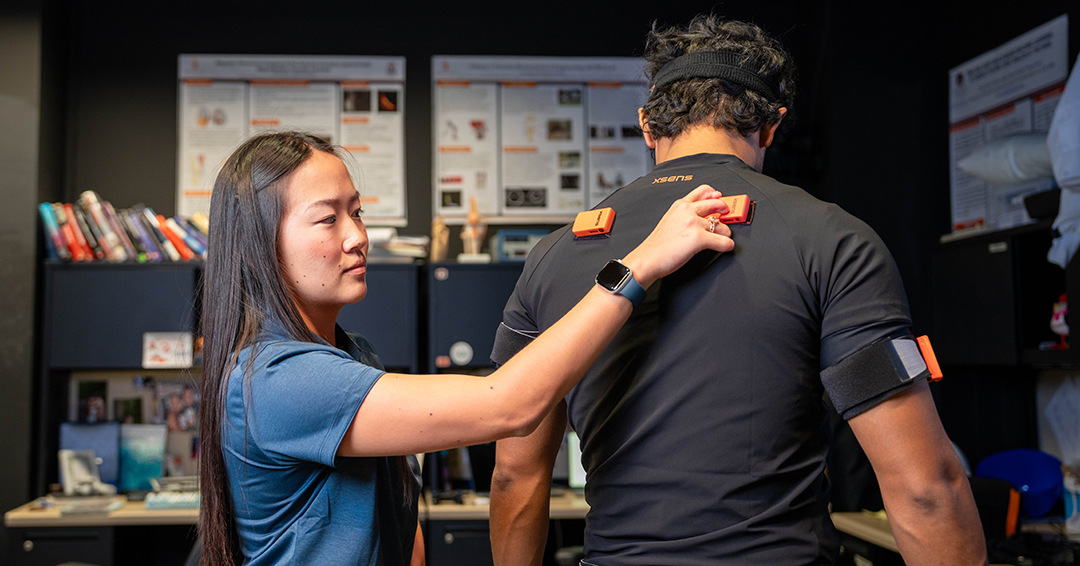
 AUBE Lab graduate students Matt Ferreira-Shornack, left, and Haley Evans demonstrate wearable motion capture technology used to collect movement data for research on injury prevention.
Healthcare professionals move patients every day, and one wrong movement can cause serious injury. Haley Evans, a master’s student in the Department of Mechanical Engineering, is identifying what tasks are most likely to cause harm in a real-world setting.
“What we’ve found is that healthcare workers get injured a lot because of the patient handling tasks they’re doing,” Evans said. “Lifting a human body is very strenuous on the lower back, especially, so they get a lot of lower back injuries. We wanted a way to get into a real-life setting and characterize that.”
Evans, along with a team from the Auburn University Biomechanical Engineering (AUBE) lab, partnered with the East Alabama Medical Center (EAMC) and Auburn’s Edward Via College of Osteopathic Medicine (VCOM) to get that real-world data.
Funded through the VCOM Seed Grant Program, the project brought together Auburn Alumni Engineering Council Associate Professor Michael Zabala, Industrial and Systems Engineering Department Chair Mark Schall, Nathan Douthit from VCOM, and Assistant Research Professor Ivan Nail-Ulloa, who served as research supervisor and mentor for the project.
“When the project was funded at the beginning of fall 2025, we needed a student who was willing to take ownership of a fairly ambitious field-based study, and Haley stepped up,” Nail-Ulloa said. “She quickly took the lead in understanding the technology, including inertial and video motion capture, as well as the other research methods involved.”
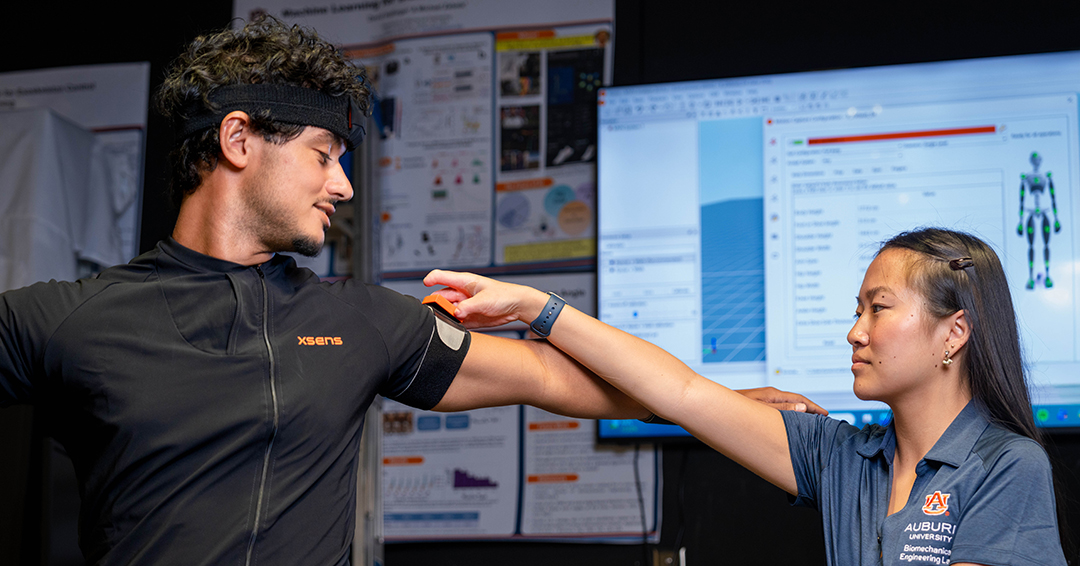
Using these wearable inertial motion capture units, Evans captured data while the healthcare workers went about their daily tasks as usual.
She said she’s been able to gather data from 12 healthcare workers, and the research has shed light on how different tasks affect lower back injuries.
“We’ve found that the specific tasks the workers were doing, as well as the patients’ ability or inability to cooperate, contributed to that injury risk level,” Evans said. “We learned that this is a lot more multi-faceted than current studies in a laboratory setting have shown.”
Evans' research goals include broadening the study to gather data in more clinical settings and ultimately, helping healthcare workers be better informed on best practices for lifting patients.
“I’m hoping that this study eventually produces a database that healthcare workers can use to determine which intervention methods — from mechanical lifts to belt gaits and slide boards — would work best for each situation,” Evans said.
Since March, Evans has presented her research at three graduate student competitions. She placed third at the first Auburn University ASSP Safety Convention in April. She also competed in the 2026 Auburn Research Symposium in March and in the recent Outreach and Engaged Scholarship Symposium in August, earning first place in both.
The first time she presented her research, Evans had only gotten one data point, and she was worried she might not even have that.
“When I signed up with my abstract, I had no data,” she said. “I just had an idea.”
Fortunately, that idea — and the data point she was able to collect — were enough to win her a first- and third-place victory. Both came as a surprise.
“I wasn’t really expecting to win,” Evans said. “But I’m glad that people really liked the partnership between Auburn, VCOM and EAMC, as well as the idea of where the project could go.”
Zabala, director of the AUBE lab, said Evans has a unique skill when it comes to presenting research.
“Haley has a rare ability to do both high-quality research and to communicate the results of her work clearly,” he said. “This will allow her to have a large impact on the field through the presentation of her important findings. I'm very proud of her as a researcher and as a representative of the AUBE Lab.”
On Aug. 26, Evans presented a more complete version of her project at the 2026 Outreach and Engaged Scholarship Symposium, where all the research presented centered on community outreach.
Once again, placing first came as a surprise.
“My favorite part of engineering is when it’s accessible and able to help people,” she said. “It was cool to win because it meant other people were recognizing how important this project is for healthcare workers. I really appreciated that.”
Media Contact: , dzd0065@auburn.edu, 334-844-2336