ASEL research aims to improve national steel bridge design provisions
Published: Sep 11, 2026 9:30 AM
By Dustin Duncan
 Heavy trucks are positioned on a bridge during a load test. Matthew Yarnold, director of the Advanced Structural Engineering Laboratory will use similar field testing to measure how loads are distributed across steel girders.
Tens of thousands of pounds at a time roll across steel bridges every day in the United States, but how do engineers determine how much of that weight each girder must carry — and could that process be made more accurate and efficient?
Matthew Yarnold, director of the Advanced Structural Engineering Laboratory (ASEL), is leading a $750,000, 30-month study evaluating live load distribution factors in national bridge design specifications maintained by the American Association of State Highway and Transportation Officials (AASHTO). The project is funded through the National Cooperative Highway Research Program (NCHRP), which supports transportation research of national significance.

The project will combine analytical modeling with field testing of six straight steel I-girder bridges across the U.S. and could lead to proposed revisions to national bridge design specifications. Straight steel I-girder bridges use multiple parallel steel girders to support a concrete deck.
Instead of building an elaborate three-dimensional computer model for every bridge, engineers can use a simplified method called line girder analysis, which analyzes one girder at a time. The challenge is determining how much of the bridge's total traffic load that individual girder should be designed to carry.
AASHTO specifications use live load distribution factors to estimate how much of that loading each girder must resist based on characteristics such as girder spacing, stiffness and bridge geometry.
“Bridge engineers just apply the factor,” Yarnold said. “Establishing that factor, though, is where the research comes in.”
Some of the current provisions have been studied and refined over decades, but questions remain about their accuracy in certain applications. However, Yarnold said that the project is not responding to evidence that bridges designed under the current specifications are unsafe.
“This isn’t like there was a mistake made and bridges are going to start falling,” he said. “There’s some areas that could be more accurate.”
The project will begin by reviewing decades of live load distribution research to identify what’s established and what remains in question. Researchers will use analytical modeling to study how different bridge characteristics affect load distribution and compare those results with measurements from actual bridges.

Auburn plans to conduct six field tests around the country, with preliminary locations including Alabama, Tennessee, the Northeast and Texas. The team will target bridge types without extensive data.
During testing, bridges will be temporarily closed and instrumented with sensors to measure deformation, displacement and rotation. Instead of using the large hydraulic equipment found inside Auburn’s structural engineering laboratory, researchers will apply known loads using heavy trucks.
State transportation agencies can provide maintenance trucks filled with gravel, which researchers will weigh — including individual wheel loads — and position at known locations on the bridge.
“We put them in known positions and then we can see how the load distributes throughout the actual structure,” Yarnold said.
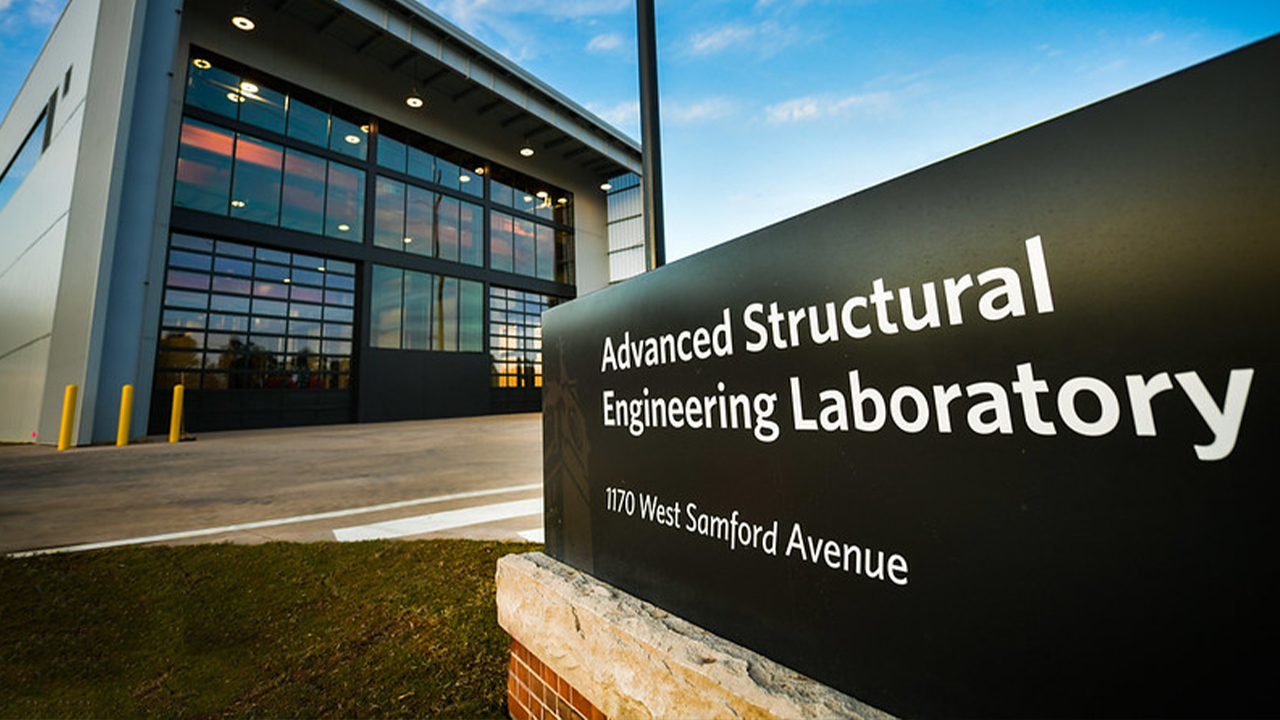
Field testing also reflects ASEL's broader capabilities.
“We’re not constrained by the walls of the lab,” Yarnold said. “We do a lot of controlled testing in a lab environment, but we also go outside the walls and conduct field testing on actual structures.”
Researchers will combine the tests with existing field data before developing draft language for potential revisions to AASHTO bridge design specifications.
The result could be national design provisions that more accurately reflect how modern steel bridges carry heavy truck loads while keeping the process practical for engineers.
“If this were to develop provisions for Alabama, there’s a lot of bridges — thousands of bridges in the state — great,” Yarnold said. “But when you’re talking NCHRP, you’re talking the goal of actually developing the requirements for the entire country.”
Media Contact: , dzd0065@auburn.edu, 334-844-2326