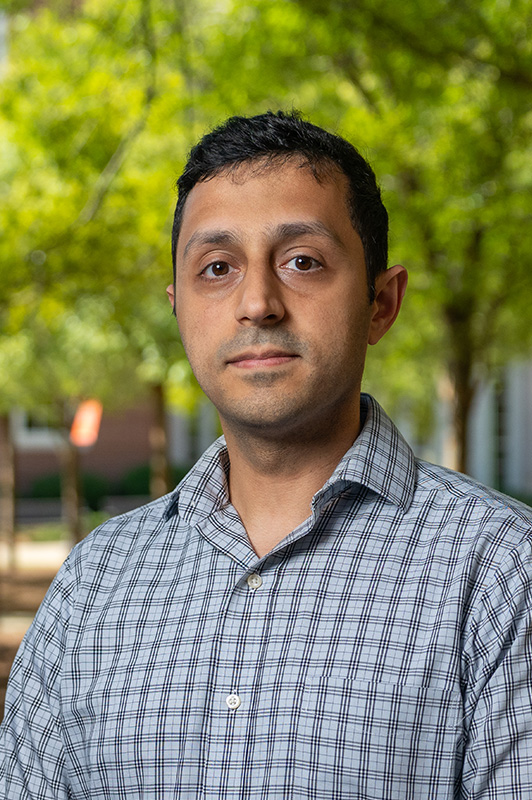
New Faculty: Assistant professor in ECE researching techniques to better understand computing systems and enhanced hardware security
Published: Sep 14, 2026 8:55 AM
By Staff Report
 Kaveh Shamsi
Modern computing systems are built from increasingly complex hardware, making it difficult to fully understand how circuits behave, what information they reveal and whether they function as intended. Researchers are developing new methods to analyze these systems, identify vulnerabilities and verify hardware integrity.
Kaveh Shamsi, a new assistant professor in the Department of Electrical and Computer Engineering, studies the intersection of hardware security, formal methods, artificial intelligence (AI) and circuit design. His research combines algorithms, machine learning and circuit-level analysis to better understand computing systems and develop techniques for building more secure hardware.
Learn more (below) about his research interests, his approach to teaching and what brought him to Auburn.
What are your research interests, and what drew you to this area of work?
My research sits at the intersection of hardware security, formal methods, artificial intelligence, and circuit design. I am particularly interested in understanding what can be learned about a computing system from its physical implementation and behavior, and how we can use that understanding both to identify security vulnerabilities and to build more secure systems. Much of my work combines algorithms such as SAT (Boolean satisfiability), SMT (satisfiability modulo theories), model checking and machine learning with circuit-level analysis. I was drawn to this area because it brings together fundamental algorithmic problems with very tangible questions about how real hardware behaves, what information it reveals, and how we can make computing systems more trustworthy.
Tell us about a current research project you’re excited about. What are you hoping to accomplish, and what impact could the work have?
One area I am especially excited about is developing automated techniques for learning and reverse-engineering the behavior of complex circuits from limited observations. This includes combining machine learning with formal reasoning and physical measurements such as side-channel information. The long-term goal is to create tools that can systematically understand hardware implementations that are too complicated to analyze manually. These techniques can help uncover vulnerabilities, verify that fabricated hardware matches its intended design, detect malicious modifications and improve our ability to evaluate the security of emerging computing technologies.
I am also increasingly interested in how new device technologies and computing architectures can provide security properties directly through their physical behavior, rather than treating security purely as a software or architectural layer added afterward.
What attracted you to Auburn, and what makes it a good place for you to pursue your research and grow as a faculty member?
Auburn offers a strong combination of expertise in electrical engineering, computer engineering, computing, and emerging hardware technologies. My research increasingly crosses traditional boundaries between algorithms, AI, circuits, devices and security, so being in an environment where collaborations can span these areas is particularly valuable. Auburn also provides the opportunity to build a research group around ambitious interdisciplinary problems while working closely with both graduate and undergraduate students. I see it as an excellent environment for expanding the experimental side of my research while continuing my work in algorithms and hardware security.
How would you describe your approach to teaching and mentoring students? What can students expect from you in the classroom?
I try to teach students not only how existing techniques work, but why they work and how they were developed. I emphasize building intuition from first principles and connecting mathematical concepts to actual computing systems. In the classroom, students can expect a combination of theory, problem solving and practical examples, with an emphasis on understanding rather than memorization.
In research mentoring, I want students to develop the ability to independently identify important problems, question assumptions and develop their own solutions. I encourage students to understand a problem deeply before choosing a particular tool or methodology, and I try to give them increasing independence as they develop as researchers.
What do you enjoy doing outside of your work at Auburn?
Outside of work, I enjoy spending time with my family, exploring Auburn and the surrounding area, working out, playing soccer and working on hands-on projects involving computers, electronics, robotics and other technology.
Media Contact: , jem0040@auburn.edu, 3348443447