From Twitter to GM, Auburn Engineer talks data and teamwork
Published: Sep 1, 2026 8:00 AM
By Nick Bowman
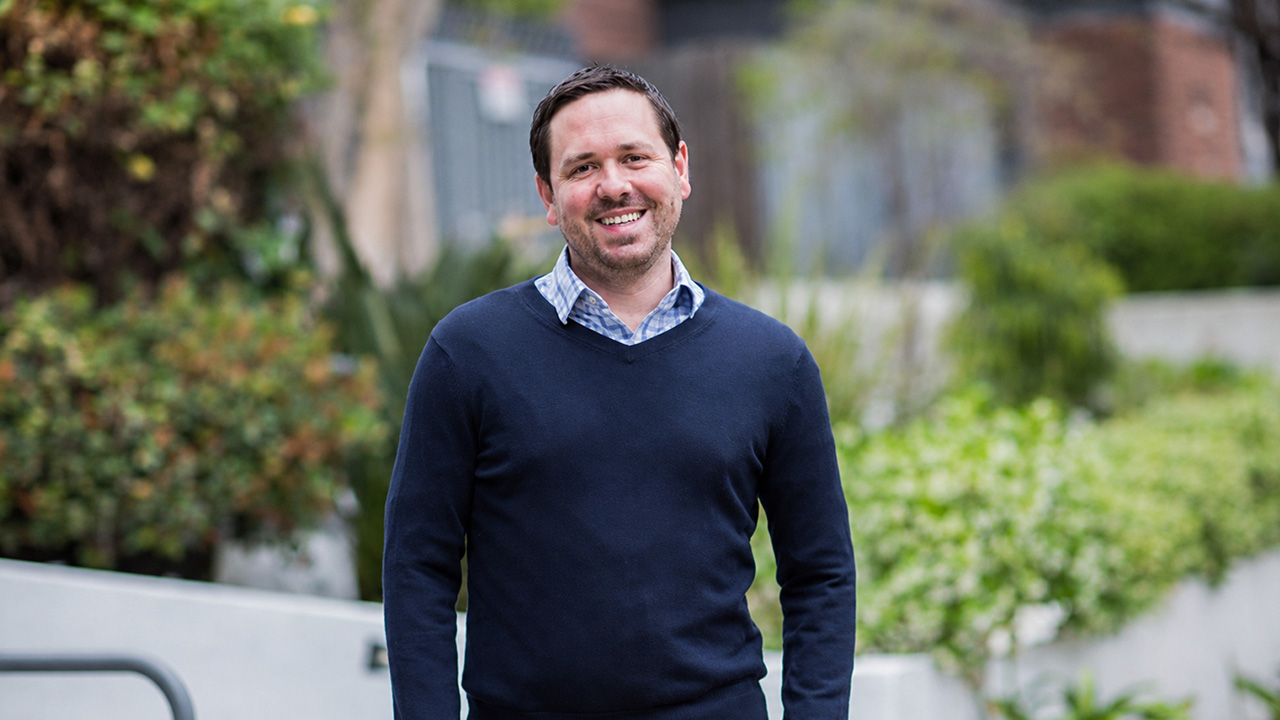 Marcus Hanson
Marcus Hanson had a big job: Hunting the Fail Whale.
Toted by eight little orange birds over the open sea, the white whale smirked against a blue background. The Fail Whale was big news. It was an event, if you were a certain type of news junkie, tech-adopter or social media entrepreneur.
The Fail Whale meant Twitter had buckled under the weight of its own popularity — too many users trying to access it at once, overloading servers and causing outages for the popular social media platform.
It was 2010, and Hanson was wrapping up several successful years at OPNET Technologies, a designer of performance management software for computer networks in Bethesda, Maryland. A friend working at Twitter recruited him to join the California startup.
Leveraging his software and networking background, he joined Twitter and took on a new assignment.
End the Fail Whale.
Happy Hunting
For Hanson, ’05 software engineering, his five years at Twitter were formative. The company allowed him to throw his Auburn Engineering education and his early work experience into the crucible of an intense startup environment.
Twenty-hour workdays. Incredibly challenging engineering problems. Enormous pressure to succeed.
It was perfect.
“It didn't really feel like you were working,” Hanson said. “It just felt like, hey, we're doing something amazing."
Now a director of engineering at General Motors out of Nashville, Hanson worked his way up at Twitter from software engineer to senior software engineering manager focusing on platform growth.
He landed at Twitter at a unique time — not just for himself, but for American technology, media and online culture.
Attention had begun to drift away from traditional media and toward the web. Smartphones were ascendant, but cloud computing was not yet the standard.
Taken together, this meant popular platforms like Twitter and its primary competitor, Facebook, were operating out of home-grown data centers that their employees were responsible for maintaining.
"There were cases where we were growing so fast on a week-by-week basis — like I'm talking, adding millions of users — that we physically couldn't put more hardware into the physical space of our data centers,” Hanson said.
When the demand outpaced capacity, those eight orange birds would take flight with their whale once again.
Because they couldn’t solve their demand issue with hardware, it became a rich environment for Hanson and his fellow software engineers to prove themselves.
"You're solving problems like: how do you take that caching technology and make it more efficient so you could put more users on the same boxes? Or how do you rewrite parts of computer languages to change how it allocates memory?” Hanson said. “Just crazy hard challenges where there's no single answer. There was a lot of ambiguity."
Despite the challenges, the engineering teams were successful. Twitter’s service was stable before the mid-2010s and, in 2013, Twitter’s VP of engineering, Chris Fry, announced the whale was grounded for good.
For Hanson, it was the bread-and-butter engineering he learned while studying at Auburn — working in a small team unified around tackling big challenges.
His team not only helped stabilize service at Twitter, but laid the foundation for the company’s success with a piece of tech that is ubiquitous in 2026: the mobile app.
“Companies were moving from web-first to mobile-first,” Hanson said. “Overnight, mobile apps became huge.”
He and his team’s work — only a handful of people, initially — would affect millions of people as soon as it was published at Twitter HQ. The social network’s app helped to push wider adoption of the app ecosystems on smart devices.
These were a few successes among many for Hanson at the company, and at the heart of it was a friendship that started more than 2,500 miles away — in a Parker Hall statistics class.
Teamwork = Dreamwork
Sean Cook always knew he was going to Auburn University. And not just that — he knew he was going to be an Auburn Engineer.
Cook, ’05 bachelor’s, ‘06 master’s in software engineering, grew up in an Auburn household. His dad graduated in electrical engineering, and Sean always wanted to follow in his footsteps.
Around the time Samuel Ginn was naming the College of Engineering, Cook enrolled in the college and, in 2004, he found himself in Parker Hall ready to knock out statistics.
He ended up sitting near a guy who had come to Auburn from Orlando. They got to know each other a little in statistics and — what are the chances? — hit it off when they saw each other again in software quality assurance.
“It was a relief to spot a familiar face on the first day,” Cook said.
He noted he was especially glad to see Hanson because it was a graduate-level course they both happened to enroll in as undergrads.
“Marcus struck me as smart, focused and remarkably grounded,” Cook said. “He was easy to talk to, with a steadiness that stood out even then. He clearly cared about doing things well, but he never took himself too seriously — friendly and approachable from the start.”
That Auburn friendship would shape the careers of the two engineers.
Hanson moved to the Washington, D.C., area after graduation in 2005. Cook visited while he was finishing his master’s and fell in love with the city. He took a job at a startup around the corner from Hanson’s office after graduating in 2006.
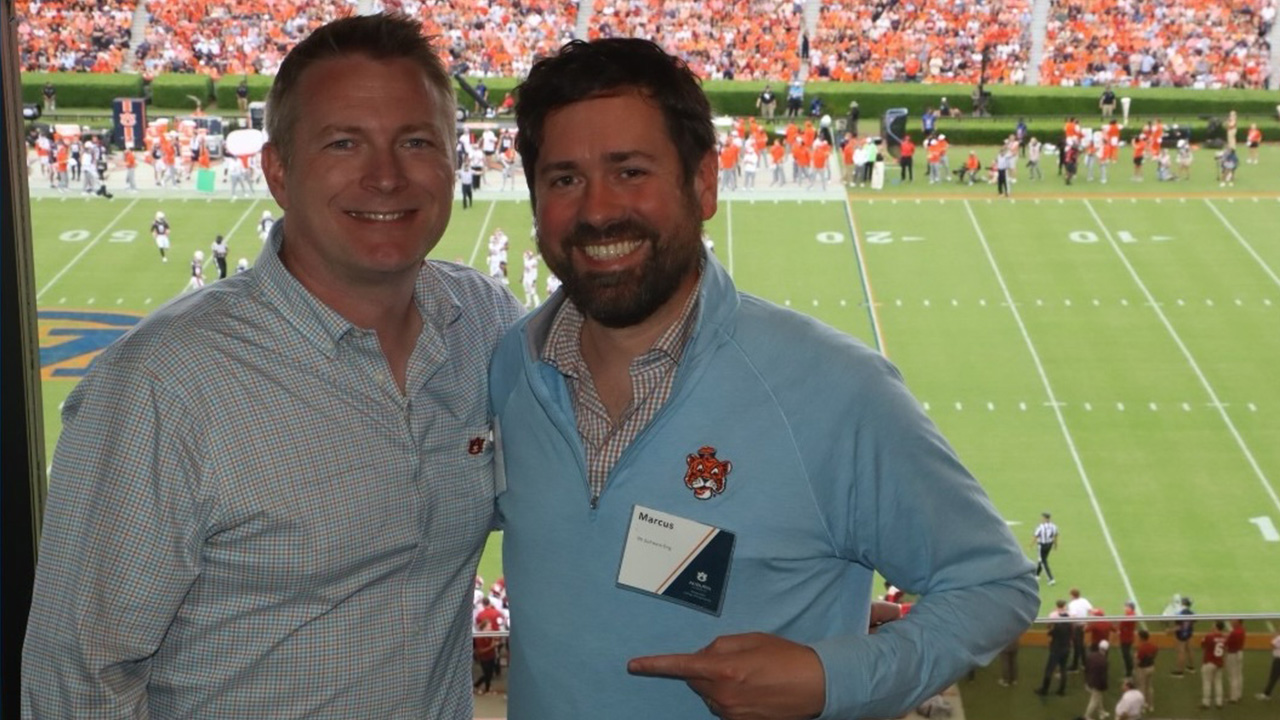
“Then, in 2009, I moved to California to work at Twitter,” Cook said. “I wrote to him about how remarkable the place was and told him I thought he'd love it — and eventually he joined. For the next five years, we got to share both the joy and the grind of watching a company grow into a household name.”
He added it was a friendship that “never felt temporary.” Hanson was the best man at Cook’s wedding, and the two remain close friends today.
Win Some, Lose Some
While Cook always knew he was Auburn-bound, Hanson knew no such thing.
Born in Little Rock, Arkansas, he moved to Florida’s Space Coast after his father took a position with NASA. His high school friends were committing to universities in Florida and Georgia. Hanson toured several engineering colleges in the Southeast and didn’t like what he was seeing.
At his mother’s recommendation, he swung through Auburn after visiting Georgia Tech.
“I remember very vividly going up College Street, and we got to the corner as you pass the president's house, and it felt right, and I can't really explain it,” Hanson said.
He was in the car with his dad, and he announced it: “I want to go here.”
And so he went. A nine-hour drive from home, none of his friends going to the same university — taking a risk on a gut feeling that he knew he was making the right decision.
Others would notice that confidence in himself at Twitter, where his tenure was marked by success, and at Mobcrush, where it wasn’t.
From Twitter, Hanson jumped in December 2015 into a startup aiming to be for mobile gaming what Twitch had become for streaming PC games — turning gaming into a marketable spectating experience.
The product had challenges, according to its former chief technology officer, James Hurley.
“Livestreaming was new, and we weren’t really aware of just how difficult it might be to compete in an ultimately niche, winner-take-all market,” he said.

As the startup struggled to earn revenue and attract new investment, management tried to push Mobcrush into new directions to remain viable.
“When it became clear that we did not have it and would run out of money if we could not find a solution, we spent many late nights working together to try to find a pivot we could make,” Hurley said. “Marcus was able to keep the team engaged through all this churn, and we were able to execute on a bunch of random ideas.”
Hanson, who Hurley described as “patient” and as having “the right temperament for people management,” joined Mobcrush as its vice president of engineering, was promoted to general manager one year into his tenure and shifted into an advising role as it floundered.
The trying period at Mobcrush has stuck with Hanson. When he’s recruiting young engineers now, he said he looks for evidence that they’ve also had challenges.
“Do they have something that's interesting about them where they've had to go through more trials and tribulations, or they've had to overcome things?” he said.
That’s because he’s looking for engineers who have learned to be curious. Engineers who have their own ideas and can rely on their own judgment in the face of ambiguity. Engineers with a mind for how to use data to create value.
Engineers like Joanne Zhu.
Joining the Convoy
In November 2018, Hanson started as director of engineering at Convoy, a Seattle-based startup founded by former Amazon executives. The company created a digital marketplace that connected independent truckers with companies that needed to move freight.
Imagine Uber or Lyft, but for freight. Hanson’s job was expanding the footprint of the mobile app used by truckers and fleet operators to connect them with freight.
“This was some of the most innovative work at the company, delivering many industry-firsts to our customers, which led to material impact to the growth of the business,” said Tim Prouty, who was vice president of engineering for Convoy and Hanson’s manager.
He credited Hanson with having a “deeply technical” mind that allowed him to lead his teams effectively.
Zhu was working as an engineer on the carrier side of the business — building the app and web tools used by truckers — when Hanson joined as director. When she was promoted, Hanson became her direct manager.
“Personally, he had a meaningful impact on my growth as a leader,” Zhu said. "He challenged me to move beyond simply identifying problems and to think about how I would solve them, how I would align others, and how I would drive progress. He asked thoughtful questions, provided useful perspective, and encouraged people to take initiative.”
Zhu said she still turns to Hanson for advice even now, years after they both departed Convoy.
When You Know, You Know
Today, Hanson is a director of engineering at GM overseeing commercial software, brand sites and marketing services.
His work is “off-vehicle,” meaning he builds company websites, apps and its commercial software. Under his purview is also the massive volume of data being generated by network-connected vehicles and infrastructure, including personal vehicles, rental car companies, fleets and powering businesses.
Hanson manages a team of about 200 engineers — the largest group he’s overseen so far in his career.
It also means the engineering work he’s doing is dramatically different than when he started out at OPNET and Twitter, focusing on people rather than the code. But he still stays up to speed on the technical side of what his team is doing.
“I think that it's important to be able to go deep, and when there are problems and issues, I can speak to them, I can understand them quickly,” he said.
But he’s not putting out code every day. He’s leading teams and challenging the engineers under him to do their best.
His former team members, managers and employers paint a picture of an engineer who couldn’t be more suited to the task, trusting himself and his team.
Even in the world of high-tech, where data is king, that trust in himself and others has served him well. From cross-country relocations to career shifts, Hanson has used the classic engineering mindset — combining the best data available with his own judgment — to chart a path forward.
It’s served him well in finding the startups to trust with his time, in identifying the right engineers to trust on his team, in passing through Auburn and knowing he was home.
“It was one of the very best decisions I’ve ever made, and I made it with very little information,” he said. “I kind of just knew."
Hanson said he often thinks about how he can use that natural, gut instinct as a leader to others. He encourages other engineers to take risks and don’t be afraid of a big move. Find out what you want and find out how to get there — and trust where that gut instinct is pointing.
He knows some data is needed but sometimes the answer is clear.
“When you know, you know,” he said.
“Certainly, I need to get some data, but — you know?” he paused.
“When you know, you know."