

Civil and Environmental Engineering professor seeks to make water service restoration safer, faster
Published: Sep 16, 2026 2:00 PM
By Dustin Duncan
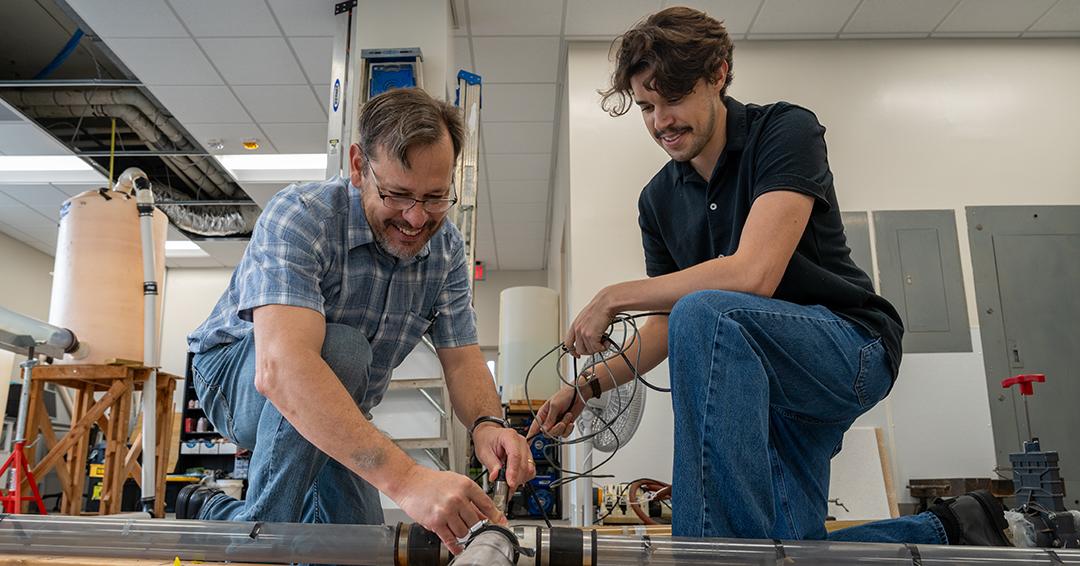
 Civil and environmental engineering doctoral student Maria Luisa Lobo, left, and Jose Vasconcelos, professor of water resources, work with experimental water infrastructure in an Auburn laboratory.
Restoring service after a broken water main is a balancing act.
Refill the system too quickly and water can compress trapped air, creating damaging pressure surges. Move too slowly and homes and businesses remain without water longer than necessary.
Jose Vasconcelos, professor of water resources in the Department of Civil and Environmental Engineering, is working to help utilities better determine how quickly they can safely refill water systems.
Vasconcelos received a $207,623, three-year National Science Foundation award for “Collaborative Research: Enabling Safe and Efficient Restoration of Drinking Water Systems through Multiphase Flow Modeling and Control.” The project is a partnership with researchers at the University of Texas at San Antonio and Vanderbilt University.
When a water main needs repair, utilities isolate and drain the affected section before putting it back into service. Refilling the drained lines while removing the air inside — a process known as priming — can create damaging pressure surges.
“If you’re taking the air very fast out of the system, the moment when the water actually slams against a hydrant or slams against an air valve, it is like a freight train,” he said. “And then you have just fixed the system and sometimes you can break it again.”
A faulty or blocked air valve can leave air trapped as water advances through the line. The trapped air can contribute to pressure increases severe enough to burst a pipe or damage other parts of the system.
Determining how quickly to proceed depends heavily on the experience of technicians and engineers in the field.
How do they know when they are going too fast?
“You don’t,” Vasconcelos said.
He said part of the problem is that engineers still lack a complete understanding of how air and water interact during refilling.
“As soon as the water starts pushing the air out, it becomes a gray zone,” Vasconcelos said.
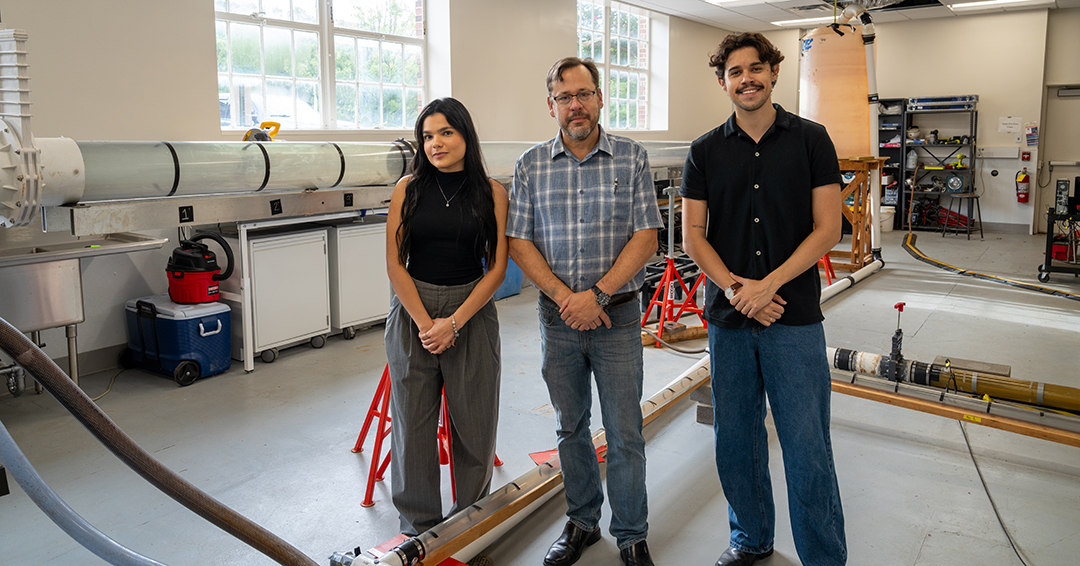
Auburn is leading the experimental work, using reduced-scale transparent pipelines to watch the filling process and collect data to improve the project’s computational models.
Those models will combine the physics of air-water flow with sensor data to estimate conditions in parts of the system where direct measurements are not available, including pressure, flow and the amount of trapped air.
UT San Antonio is leading the numerical modeling effort, while Vanderbilt is leading optimization, including AI-based methods to determine how the system should be operated during refilling.
Existing models can simulate air-water flow, but Vasconcelos said the simulations can take too long to be practical for utilities that may need to restore service within hours. The team is working to develop faster models that can give crews specific guidance, such as how far to open a valve and when to begin closing it as the system refills.
The research could also lead to smart hydrants and air valves that automatically respond as air leaves the system and water arrives. The broader goal is to give utility crews better information as they work to restore service as quickly and safely as possible.
“Experienced utility workers will remain very important, but what if we had something that gave us a better grasp of what’s happening and allowed us to make decisions more quickly?” Vasconcelos said.
Media Contact: , dzd0065@auburn.edu, 334-844-2326