Assistant professor of chemical engineering earns $1 million NSF grant to develop biohybrid robots that sense touch through living neurons
Published: Sep 16, 2026 10:35 AM
By Joe McAdory
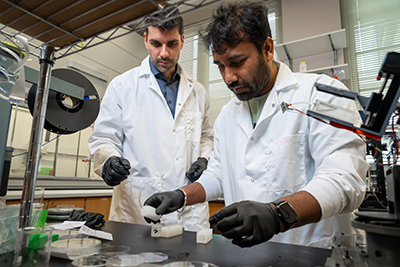
 Assistant Professor of Chemical Engineering Jean-Francois Louf, center, is exploring how engineered devices can communicate with living nerve cells.
Can a robot sense touch using some of the same physical and biological mechanisms found in living systems? Jean-Francois Louf is working toward making that possible.
Louf, an assistant professor in the Department of Chemical Engineering, is the principal investigator on a $1.04 million National Science Foundation project, “Biohybrid Soft Robots that Sense Touch Through Living Neurons,” exploring how engineered devices can communicate with living nerve cells.
The cross-campus, multidisciplinary research team includes co-principal investigators Michael Gramlich, associate professor and biophysicist in the College of Sciences and Mathematics; Daniel Kroeger, assistant professor of neurosciences in the College of Veterinary Medicine; and Yazhou Tu, associate professor in the Department of Computer Science and Software Engineering.
“For this project, our first goal is to connect biological tissue, advanced materials and robotic systems so they work together as one integrated system,” Louf said. “How can they talk? How can they communicate?”
The project builds partly on Louf’s research into how plants sense mechanical stimuli. Unlike conventional robotic skins that rely on arrays of electronic sensors at the point of contact, plants can transmit mechanical information through soft, fluid-filled tissues. Louf’s team is adapting that principle to robotics, using fluid-filled microchannels to carry pressure signals through a soft robotic sensor before converting those signals into a form that living cells can detect.
To create that biohybrid sensing pathway, Louf, Gramlich, Kroeger and Tu are developing and integrating several technologies into a single system. The team is designing:
* Soft elastic-hydraulic sensors that convert touch into pressure signals and transmit them over distance;
* Piezoionic hydrogels that convert those pressure signals into ionic signals;
* Living neurons that respond to and encode the mechanical information; and
* Artificial intelligence and physics-based models that combine touch with visual information so the robot can infer properties such as an object’s stiffness and adapt its behavior.
Louf said piezoionic hydrogels could provide a critical bridge between engineered materials and biological tissue.
“The nervous system communicates using ions, while conventional robots communicate primarily using electrons,” he said. “Piezoionic hydrogels give us a potential bridge between those two worlds. When the material is compressed, ions move through the hydrogel. Our goal is to use that mechanically generated ionic signal to activate neurons and ultimately encode information about touch.”
The hydrogels are designed so that mechanical deformation drives the movement of ions through their porous polymer network. One approach being explored uses mechanically generated sodium-ion flux to depolarize nearby neurons, converting a mechanical event into neuronal activity.
Researchers are testing the approach using cultured neurons and nerve-muscle preparations, measuring whether mechanically generated signals from the hydrogel can produce neuronal activity or muscle responses. In preliminary experiments, signals generated by compressing the hydrogel produced measurable muscle activity without requiring an external power source.
Generating a biological response is only part of the project.
The researchers ultimately want neuronal activity to carry useful information about what the robot is touching. Patterns of neural activity will be decoded and used to estimate mechanical properties such as pressure and stiffness, allowing the robotic system to distinguish between softer and harder materials, adjust its grip or probe an unfamiliar object.
Vision will provide another layer of information. Tu’s team is developing computational tools that reconstruct an object’s shape even when much of it is hidden from view. Because the relationship between force, deformation and stiffness depends on an object’s geometry, the robot can combine visual shape information with tactile measurements and contact mechanics to more accurately determine what it is touching.
Louf said the project could eventually help establish new ways for synthetic materials and living tissues to communicate.
“The immediate question is how you create an interface where a mechanical signal in a robot becomes a signal that living tissue understands, and then how that biological response can be used by the robot,” Louf said. “In the long term, those principles could have applications in prosthetics, neural interfaces and biohybrid robotic systems.”
He sees even more ambitious possibilities farther into the future.
“This is where it becomes a little science fiction,” Louf said. “If we eventually learn how to seamlessly connect engineered materials and living tissues, you can imagine artificial systems that replace or restore biological functions. Maybe one day you could imagine something like an artificial eye communicating with the nervous system through this type of interface. We are obviously a long way from that, but first we must understand how these two very different systems can communicate.”
Media Contact: , jem0040@auburn.edu, 3348443447