Aerospace Engineering professor receives NSF grant to rethink ‘engineered imperfections’ in lattice materials
Published: Aug 25, 2026 10:30 AM
By Phillip Tutor
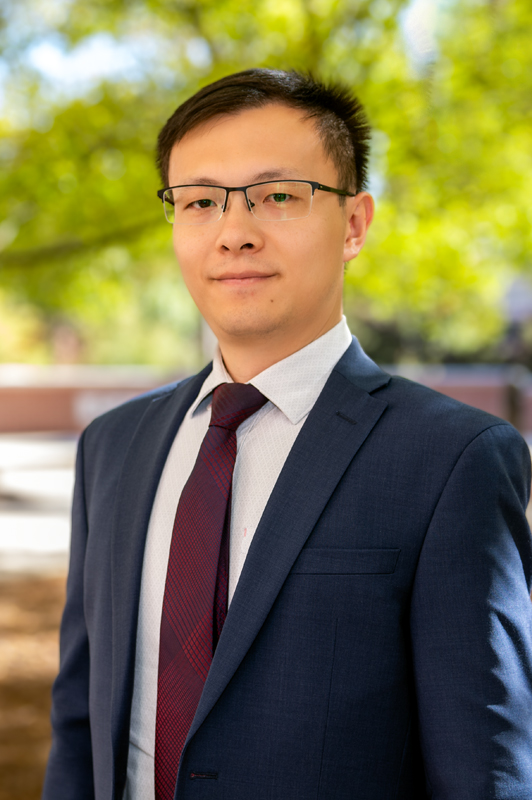
 Auburn professor Wen Luo
Spurred by his funded research into structural defects of additively manufactured lattice materials, Auburn’s Wen Luo wants to answer a compelling question.
“What if the very imperfections we engineer out could be the key to achieve unprecedented resilience?”
Luo, an assistant professor in aerospace engineering, has received a $391,940 National Science Foundation (NSF) grant that will allow him to use high-throughput tests and increase the number of samples that can be tested simultaneously in order to map fracture data for hundreds of structures.
To explain his research, Luo points out that architected materials such as lattice structures in biomedical stents and aerospace applications “are prized for their exceptional stiffness-to-weight ratio. They are the gold standard for structural efficiency.” Rising above the Champ de Mars in Paris, the Eiffel Tower and its lattice architecture offer another recognizable example.
Over time, researchers have believed that this structural efficiency isn’t infinite; specifically, that defects, such as missing struts or misaligned nodes, can compromise load-bearing capability.
Not so fast, Luo said.
“Our recent research turns this long-held assumption on its head,” he said. “We have discovered that imperfections are not just inevitable, they can be deliberately harnessed. By rethinking defects as a design lever, we have found that engineered irregularities can delay crack formation and enhance a structure's overall reliability.”
According to the NSF, Luo’s research findings “point toward a transformative paradigm in which engineered disorder is not a liability” and allow “architected materials with exceptional combinations of strength and reliability.
“The central hypothesis is that this transition constitutes a nonequilibrium phase transition governed by the interplay among lattice topology, geometric disorder and structural instability, and that these mechanisms can be systematically controlled to optimize structural resilience.”
Luo describes these mechanisms as “engineered flaws” that shouldn’t be systematically feared. Instead, his research harkens to a future in which lattice structures are lightweight, sturdy and predictably reliable in most applications. A few examples would be safer medical implants and more durable infrastructure, he said.
The outcomes of Luo’s research, the NSF posits, “are expected to provide predictive design principles for architected materials that intentionally exploit controlled randomness.” If successful, the research “would achieve unprecedented combinations of lightweight efficiency, strength, damage tolerance and structural reliability.”
Luo’s intention isn’t merely to conduct successful research through the NSF grant. It’s to affect meaningful future change in multiple engineering applications.
“I hope with the findings of this research, we won't just be fixing defects anymore; we are going to design with them,” he said.
Media Contact: , pot0004@auburn.edu, 334-844-3591