Civil and Environmental Engineering assistant professor receives $1 million EPA grant to recover nutrients from runoff
Published: Aug 12, 2026 3:00 PM
By Dustin Duncan
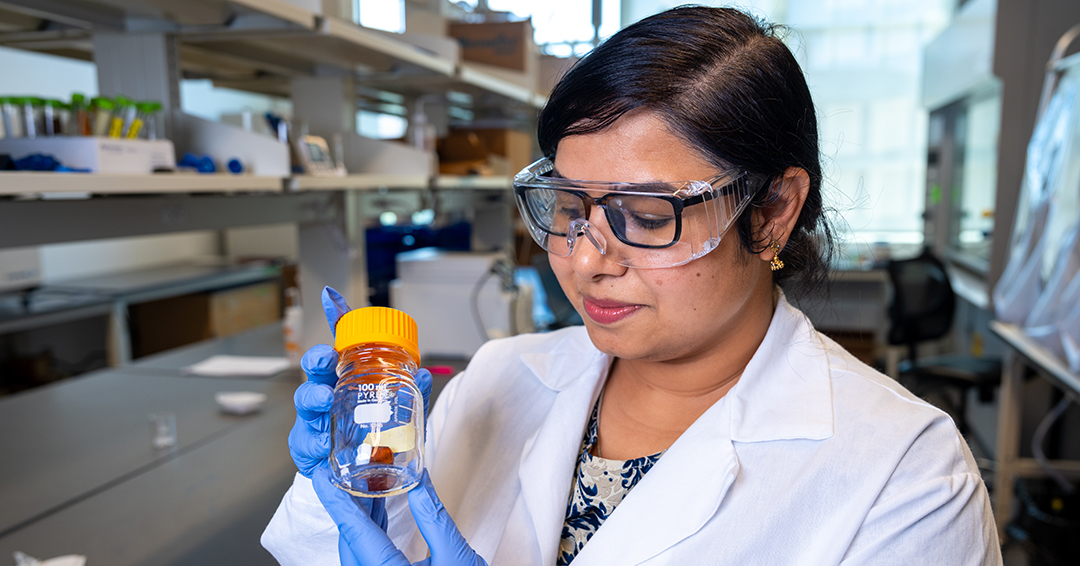 Civil and Environmental Engineering assistant professor Neha Sharma examines a sample in her laboratory as part of her research into materials designed to capture and recover nutrients from water.
Neha Sharma, assistant professor of civil and environmental engineering, has received a $1 million grant from the U.S. Environmental Protection Agency to develop reusable polymeric nanosheets that capture excess nutrients from agricultural runoff and stormwater so they can be reused as fertilizers.
The three-year project, “Engineered Polymeric Nanosheets for Sustainable Nutrient Recovery,” will focus on capturing ammonium and phosphate before they reach rivers, lakes and coastal waters, where harmful algal blooms can form.
“These nutrients are not inherently harmful,” Sharma said. “The problem is when more nutrients are applied than crops can use and the excess is washed from the soils during rainfall.”
Sharma said the nanosheets will be embedded with iron oxide and other metal oxide nanoparticles that bind to the targeted nutrients.
Bryan Beckingham, the Uthlaut Family associate professor of chemical engineering, and Lauren Beckingham, the W. Allen and Martha Reed associate professor of civil and environmental engineering, are collaborating on the project. Bryan Beckingham provides expertise in polymeric materials, while Lauren Beckingham contributes expertise in environmental transport and material characterization, helping the team design nanosheets that are selective, durable and reusable under real-world conditions.
Sharma’s project will test the nanosheets directly in drainage ditches, retention ponds, stormwater systems or agricultural soils.
“Most nutrient-removal technologies are designed for wastewater that flows through a defined treatment system,” she said. “Agricultural runoff and stormwater are spread across a much larger area, so we need a material that can be deployed where that runoff occurs.”
Sharma said existing nutrient-capture materials often come as small beads that are difficult to deploy in fields or drainage systems. Other porous materials can capture a broad range of substances, making it difficult to isolate and recover ammonium and phosphate efficiently.
Sharma’s team will develop a selective and reusable material.
To do this, sheets installed in drainage systems can be removed after capturing nutrients, folded and transported to a nearby treatment location. Chemical solutions can then release the ammonium and phosphate, allowing the recovered nutrients to be reused as fertilizers.
“We are not interested in simply moving the nutrients from one waste stream to another,” Sharma said. “The goal is to recover them as useful products and create a more circular nutrient economy.”
The sheets could also be placed below the soil surface to capture excess nutrients before rainfall washes them away, creating what Sharma called a “reservoir of nutrients” that crops could draw from later.
The team will first test the nanosheets with controlled nutrient solutions and then evaluate them using municipal wastewater and agricultural drainage. The researchers will examine whether the material remains selective and reusable through repeated capture-and-recovery cycles.
Materials will then be evaluated under different rainfall intensities and flow conditions at Auburn’s Stormwater Research Facility before the team begins field demonstrations.
“Developing a material in the lab is only the first step,” Sharma said. “We also have to understand whether it remains stable, durable and effective under real environmental conditions.”
If successful, Sharma said the project could also provide a foundation for developing materials designed to capture other contaminants from stormwater and agricultural runoff.
“This project begins with nutrient recovery, but the larger goal is to create a technology that can be adapted to address other water-quality problems,” Sharma said.
Media Contact: , dzd0065@auburn.edu, 334-844-2326