New Faculty: Assistant professor of civil and environmental engineering takes aim at ‘forever chemicals’
Published: Aug 31, 2026 9:00 AM
By Staff Report
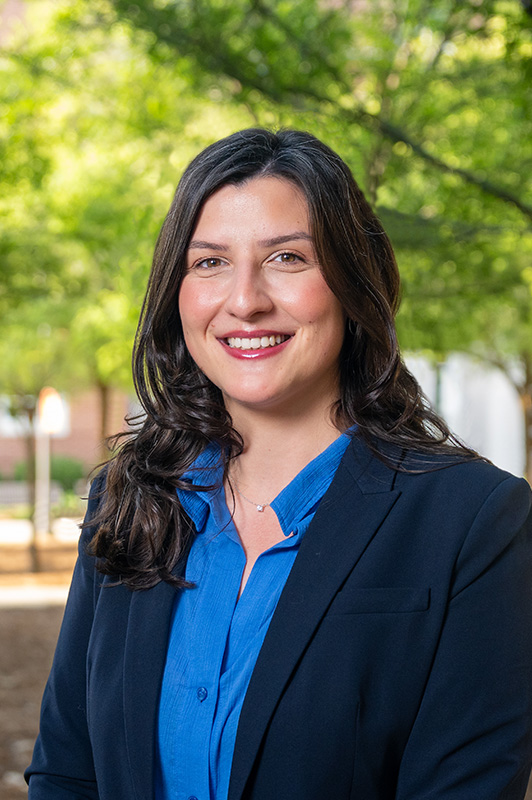
 Dilara Hatinoglu, assistant professor of civil and environmental engineering, develops sustainable approaches to removing and destroying PFAS, commonly known as “forever chemicals,” in water.
Dilara Hatinoglu knows that removing per- and polyfluoroalkyl substances (PFAS) from water is only part of the solution. If the persistent compounds—commonly called “forever chemicals”—remain trapped in used filters, they have merely been transferred from one place to another.
Hatinoglu, a new assistant professor in the Department of Civil and Environmental Engineering, is developing an approach that combines improved carbon-based filtration with thermal treatment methods designed to destroy captured PFAS and regenerate the filtering material for reuse.
Learn more about her research, her approach to teaching and what brought her to Auburn.
What are your research interests, and what drew you to this area of work?
My research focuses on emerging contaminants in water and developing sustainable approaches to water treatment, with a particular emphasis on PFAS, commonly known as "forever chemicals." Addressing PFAS contamination is a national priority, and there is an urgent need for sustainable and energy-efficient treatment strategies. I am driven by the opportunity to develop solutions that not only remove PFAS from water but also help break the "forever chemical" cycle.
Tell us about a current research project you’re excited about. What are you hoping to accomplish, and what impact could the work have?
I am particularly excited about improving carbon-based filters for PFAS removal while also addressing what happens to these materials once they become exhausted and contain concentrated PFAS.
My research investigates thermal treatment technologies that can destroy the adsorbed PFAS while regenerating the activated carbon for reuse. Ultimately, I hope this work can contribute to a more circular approach to PFAS treatment, where we are not simply transferring these persistent chemicals from water into another waste stream.
What attracted you to Auburn, and what makes it a good place for you to pursue your research and grow as a faculty member?
What attracted me most to Auburn was its strong research infrastructure and opportunities for interdisciplinary collaboration, combined with its commitment to serving communities through its land-grant mission. I was also drawn to Auburn's strong sense of community. I see Auburn as a place where I can build a meaningful, long-term research program and make an impact both in Alabama and beyond.
How would you describe your approach to teaching and mentoring students? What can students expect from you in the classroom?
My goal is to help students connect fundamental principles to real environmental engineering challenges. I bring examples from my research into the classroom to make concepts more tangible, strengthen critical thinking and spark students' interest in research and graduate education.
As a mentor, I want students to develop independence and confidence as researchers while having the support they need along the way. Research rarely works perfectly the first time, so I believe learning to troubleshoot, ask good questions and learn from unexpected results is just as important as getting the "right" result.
What do you enjoy doing outside of your work at Auburn?
Outside of work, I love outdoor activities, especially hiking, kayaking, camping and biking with my husband. Since moving to Alabama, we have been enjoying exploring the area and finding new trails, lakes and parks. I also enjoy traveling and spending time with friends, family and our two cats.
Media Contact: , dzd0065@auburn.edu, 334-844-2326