Graduate student scanned her brain each week to track how a night’s sleep shapes the next day’s chemistry
Published: Jun 3, 2026 10:20 AM
By Joe McAdory
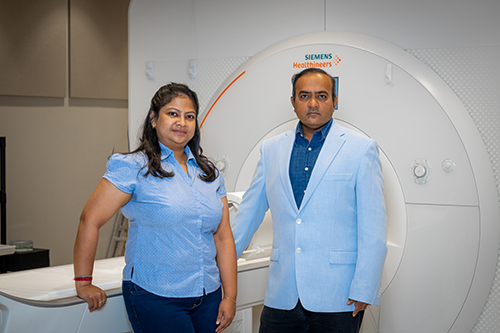
 Joshita Majumdar, right, a graduate student in the Department of Electrical and Computer Engineering, and Gopikrishna Deshpande, the Godbold Professor in the Department of Electrical and Computer Engineering, used equipment at the Auburn University Neuroimaging Center, including the 7-Tesla MRI scanner, to study glutamate levels in the brain.
How well you sleep tonight may be written into your brain’s chemistry tomorrow. In a year-long experiment, Auburn Engineering researchers tracked the link between a person’s nightly sleep and her levels of glutamate — the brain’s main “go” signal — and found the two move together.
Joshita Majumdar, a graduate student in electrical and computer engineering (ECE), underwent 104 MRI scans over 18 months to better understand how her nightly sleep patterns shaped the next day's brain chemistry. She wore a sleep‑tracking ring every night and entered the 7‑Tesla MRI at the Auburn University Neuroimaging Center the following day for a 90-minute scan that included a spectroscopy session.
Each scan was paired with the previous night’s sleep metrics, allowing researchers to compare sleep patterns directly with next day’s glutamate levels.
The pattern: across the year, nights with less deep sleep and more light sleep tended to be followed by higher next-day glutamate, while her deeper, more restorative nights tracked with lower levels. Majumdar said the relationship held up statistically across the full set of scans, though, as with any single-person study, it pointed to a consistent link rather than proof that one directly causes the other.
“When we get a good night's sleep, the brain flushes out the byproducts that build up during all our active, wakeful moments,” Majumdar said. “You wake up with a fresh mind. But if that process is blocked, it’s going to hamper you the next day.”
Majumdar was not subjected to artificial sleep deprivation, and that set the study apart, said Gopikrishna Deshpande, the Godbold Professor in the Department of Electrical and Computer Engineering and Majumdar’s faculty mentor.
“This was not a lab experiment where you deprive someone of sleep and then measure what happens,” he said. “This is a person living her life, going through normal ups and downs and we are seeing how brain chemistry responds to that. That's what makes this dataset so powerful. It's not artificial. It's not forced. It's real.”
Deshpande said the capabilities of Auburn’s 7‑Tesla MRI, the first commercially installed FDA-approved 7T scanner and capable of parallel transmission, were essential to the study’s precision.
“Having the 7T let us pull apart the chemical signals far more cleanly than a 3T scanner could so we could measure glutamate on its own, instead of lumped together with closely related compounds,” he said. “That precision was a real advantage.
“Studies like these are only possible when you have a 7 Tesla scanner and the freedom to use it repeatedly. Most places don't have that combination. We are incredibly thankful to Dr. Thomas S. Denney Jr., director of the Neuroimaging Center, for creating such conditions and wholeheartedly supporting this study.
“We talk a lot about personalized medicine, but you can’t personalize anything unless you understand how a person's brain changes over time. This study is a step in that direction. It shows that if you track someone long enough, you can see how their sleep, their behavior, their physiology, all of it, ties back to brain chemistry.”
Majumdar logged everything she ate, tracked her physical activity and kept consistent scan times to control for outside variables.
“I quickly learned the dos and don'ts about going into the scanner,” she said. “You should not have a heavy meal just before the sessions. During my initial days, I used to get a little dizzy. But after two weeks or so, that wore off.”
She is joined on the project by Deshpande, Adil Bashir, associate professor of ECE, and graduate student Nguyen Phuoc Huynh.
Majumdar presented the research, “Deep Phenotyping reflects multivariate association between sleep metrics and Glutamate: A 7T longitudinal investigation,” at the annual meeting of the International Society for Magnetic Resonance in Medicine on May 11 in Cape Town, South Africa.
“That was an incredible opportunity,” said Majumdar, who also presented at the 2025 Organization for Human Brain Mapping annual meeting in Brisbane, Australia. “Seeing peer students and researchers’ genuine interest in our work was especially gratifying. I am also grateful for the support I received not just from the Auburn University Neuroimaging Center, but also from Dr. Mark Nelms, chair of the Department of Electrical and Computer Engineering.”
Deshpande said this research could one day help build a diagnostic framework for sleep‑related disorders, including depression, PTSD and schizophrenia.
“When we have a normal variation of how sleep pans out over a year, then we can see if we have any disorders and we can see where they are with respect to that normal variation,” he said. “That's the ultimate goal.”
Media Contact: , jem0040@auburn.edu, 334.844.3447