

Graduate student in biosystems engineering earns Tau Beta Pi honor society’s Centennial Fellowship
Published: Jun 25, 2026 3:50 PM
By Joe McAdory
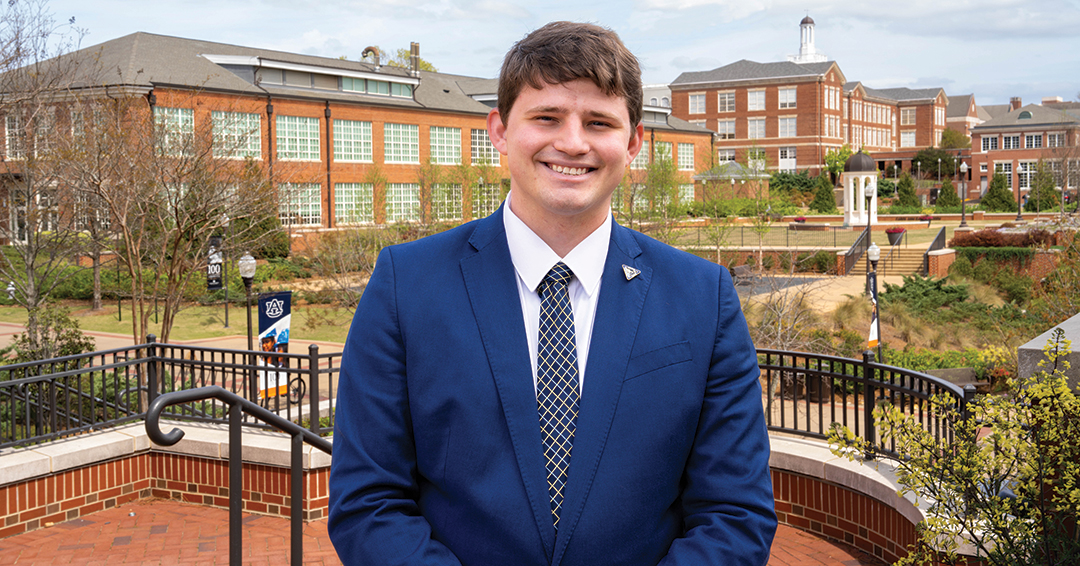 Ayden Kemp earned the 2026 Tau Beta Pi Engineering Honor Society Centennial Fellowship and was named a Goldwater and Astronaut Scholar in 2023.
Not only is Ayden Kemp one of 31 Tau Beta Pi Engineering Honor Society fellowship winners for 2026, but the graduate student in biosystems engineering also earned the organization’s highest distinction.
Kemp was awarded the Centennial Fellowship, commemorating the society’s 100th anniversary, given exclusively to the most outstanding fellow selected by the organization’s board. He was also named a Goldwater and Astronaut Scholar in 2023.
“Ayden is the epitome of the Auburn Engineering graduate student,” said Maria Auad, associate dean for graduate studies and faculty development. “He excels academically and pushes the boundaries of research that reflect the very best of this college. When our students combine his rigor, innovative thinking and strong personal character, they don’t just succeed, they elevate Auburn’s reputation on the national stage. Ayden is a clear example of that.”
Chosen from a national pool of 453 applicants, Tau Beta Pi fellows receive cash stipends of $10,000 for advanced studies. Fellowships are awarded based on scholarship, leadership, service and promise of future contributions to the engineering profession, according to the honor society.
Kemp’s research focuses on improving the sustainability and cost‑efficiency of producing biochar, a carbodense material created when biomass is heated without oxygen. Because biochar has applications in batteries and electronics, asphalt and plastics, agriculture and wastewater treatment, lowering its production cost is a key challenge.
Kemp aims to reduce costs by utilizing the gaseous byproducts (volatiles) released while heating raw biomass to form biochar.
“Think of it like a big circle,” said Kemp, who earned a bachelor’s degree in biosystems engineering with a bioprocess focus in 2024 and bachelor’s degree in aerospace engineering in 2025. “First, heat biomass to produce biochar and volatiles. Second, burn the volatiles to make more heat… and the cycle continues. The issue is that volatiles aren't a typical fuel, so we need to engineer combustion systems to burn them efficiently and safely.
“That is where my research comes in. I use a combination of experimental and computational techniques to explore different design choices and how they affect volatiles combustion to ultimately select an optimal design.
“Research opportunities like this at Auburn are plentiful and allow students to get started with research as early as their freshman or sophomore years.”
Kemp is completing a work‑study assignment connected to his earlier fellowship from the Alabama Space Grant Consortium, working with Amentum at NASA’s Marshall Space Flight Center in Huntsville.
“I am bringing my biosystems engineering and computational modeling expertise to help develop simulations of the carbon dioxide scrubbers on spacecraft that are part of the system to provide astronauts with breathable air,” he said. “What I’m developing will help contribute to the next generation of air revitalization systems that will be used on the surface of the moon.”
Kemp is not the only Auburn Engineering representative among Tau Beta Pi’s Class of 2026 Fellows. Hu Zhao, who earned a bachelor’s degree in civil engineering in 2021, was awarded the society’s Matthews Fellowship.
Media Contact: , jem0040@auburn.edu, 334.844.3447