

Rising senior in electrical and computer engineering among six Alabama Launchpad Technology Division finalists
Published: May 1, 2026 1:50 PM
By Joe McAdory
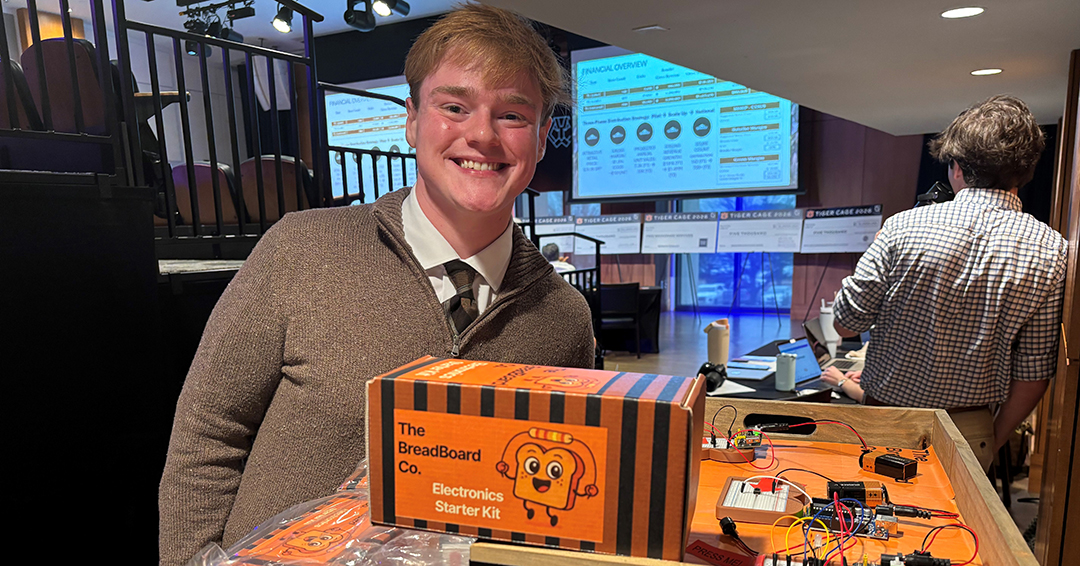 Joseph Rusk, founder of The BreadBoard Company, created a kit designed to make learning electronics simpler and fun for children.
Joseph Rusk wanted to make learning electronics easier for beginners, so he did something about it.
Rusk, a rising senior in electrical and computer engineering, created a redesigned circuit breadboard and paired it with clearer, kid‑friendly instructions and snap‑on templates that show beginners exactly where each component should go. Breadboards are reusable platforms for building and testing circuits without requiring soldering.
“A breadboard has hundreds of holes, and if you don’t already know how the rows connect on the inside, it can be intimidating,” said Rusk, a volunteer and director of STEM Education at TigerWings, a nonprofit with an after‑school program. “When I started making templates that cover the holes that aren’t being used, it made it a lot easier for a kid to understand.”
Just like that, The BreadBoard Company was born.
After months of pitch competitions on campus, including Ideas Jam, the Halloween Pitch Competition and Tiger Cage, Rusk is taking BreadBoard on the road.
Alabama Launchpad. The Show. The granddaddy of all statewide pitch competitions.
Rusk will compete among five other startups for $75,000 on Thursday, May 7, in Birmingham, in Alabama Launchpad’s 2026 Cycle 1 Technology Division finals. Chemical Engineering Professor Elizabeth Lipke and graduate researcher Yuan Tian will represent Auburn in Alabama Launchpad’s Life Sciences Division final round on May 14 with their startup, VivoSphere.
A program of the Economic Development Partnership of Alabama, Alabama Launchpad is the state’s most active early‑stage seed fund, providing entrepreneurs with mentorship, expert guidance and the chance to compete for funding that helps turn early‑stage ideas into successful startups.
Competitors are given 15 minutes to pitch their business ideas before industry‑professional judges, followed by a 40‑minute question‑and‑answer round.
The pitch‑tested Rusk said he’s ready.
“Other competitions have helped me a lot,” he said. “Every pitch competition I’ve been in has helped me improve explaining my story and refining the idea, and each round has made me more confident in what BreadBoard can become.
“Auburn Engineering has also played a huge role in this. We use breadboards constantly in my classes — I’m literally building a radio on one right now. Courses like electric circuit analysis helped me understand how circuits and components function.”
Long term, he hopes BreadBoard becomes a way to strengthen children’s electronics literacy and make hands‑on STEM feel accessible from an early age.
“We’ll start with beginner‑friendly kits that teach kids how to use a breadboard and basic components like resistors, capacitors and transistors,” Rusk said. “From there, I want to add a kit that introduces coding on an Arduino, which is basically a small board that lets you control different parts of a circuit. Eventually, I’d love to offer our own branded parts — motors, sensors, everything — and even Lego‑style robotic kits built around fun themes from Marvel or DC.”
Media Contact: , jem0040@auburn.edu, 334.844.3447