

Auburn Engineering-based startup one of four Alabama Launchpad Life Sciences Division finalists
Published: May 6, 2026 9:00 AM
By Joe McAdory
 Elizabeth Lipke, left, the Uthlaut Endowed Professor in the Department of Chemical Engineering, and Yuan Tian, who earned a doctorate in chemical engineering from Auburn in 2020, co-founded VivoSphere.
Auburn Engineering-based startup VivoSphere is one of four finalists advancing to the Alabama Launchpad Cycle 1 2026 competition Life Sciences division finals on Thursday, May 14 in Birmingham.
Co-founded by former Auburn graduate student researcher Yuan Tian (PhD ’20, chemical engineering), and Elizabeth Lipke, the Uthlaut Endowed Professor in the Department of Chemical Engineering, VivoSphere is developing a tissue-engineered platform for 3D tumor modeling designed to improve how cancer drugs are tested before reaching clinical trials.
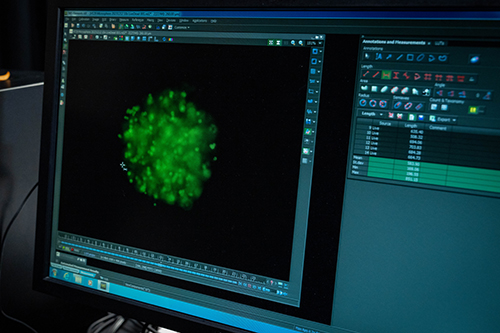
“Being selected as a finalist is exciting, but what matters most is what it represents,” said Lipke, who was recently selected as an American Association for the Advancement of Science Fellow. “There is a real opportunity to improve how we evaluate new cancer therapies. By creating models that more accurately reflect the tumor environment, we can help move the most promising treatments forward faster and more efficiently.”
Presented by the Economic Development Partnership of Alabama, the competition will award up to $100,000 in non-dilutive funding to winning startups. Finalists will compete within their designated industry tracks, pitching their ventures to exclusive investor committees in a private setting designed to prepare them for future conversations with investors or customers.
Six other startups will compete Thursday, May 7, in a separate Alabama Launchpad Cycle 1 final — the Technology Division — including The Breadboard Company, founded by Joseph Rusk, a junior in electrical and computer engineering.
“Alabama Launchpad exists to help promising founders turn great ideas into scalable companies,” Estes Hughes, vice president of innovation and talent at EDPA. “These finalists represent the type of innovation and entrepreneurial drive that strengthens Alabama’s economy and positions the state as a leader in technology and life sciences.”
What began in the Lipke Lab as exploratory graduate research has evolved into a platform aimed at solving a costly and persistent problem in drug development: the failure of traditional preclinical models to accurately predict how tumors behave in the human body.
VivoSphere’s platform is designed for use by pharmaceutical and biotechnology companies seeking more predictive preclinical testing tools.
VivoSphere’s technology uses a specialized 3D hydrogel combined with a microfluidic encapsulation device to produce uniform, high-density tissue microspheres. These models are designed to better replicate the tumor microenvironment while maintaining the consistency and scalability required for high-throughput drug screening, helping researchers identify ineffective drug candidates earlier and reduce expensive late-stage failures.
“This work is critical because it addresses longstanding inefficiencies, reduces cost and increases the success rate of new developments,” Tian said. “With the support of key funding, we can move beyond theoretical progress and bring practical, high-quality solutions to market.”
Lipke said the platform blends the strengths of existing systems and reflects years of research in tissue engineering aimed at recreating the tumor microenvironment.
“Vivospheres combine the reproducibility and consistency of 2D cell culture models with the tool sets from tissue engineering and can recapitulate, or reproduce, the patient tumor microenvironment and the patient tumor cells that are present in other 3D models like organoids,” she said.
Since launching in 2022, VivoSphere has steadily built momentum. The startup won $25,000 in the 2023 Alabama Launchpad Concept Stage, secured a $350,000 National Institutes of Health-backed NSF Small Business Innovation Research grant in 2024 and was nominated for the Ignite Award at the Society for Laboratory Automation and Screening.
“I want our research to have meaningful impact,” Tian said. “We don’t want to just add to recent research publications. At VivoSphere we are taking what we have built and transforming it into an actual and beneficial product.”
Media Contact: , jem0040@auburn.edu, 334.844.3447