

Auburn Design Build Fly team finishes No. 9 globally, tops among SEC schools
Published: May 13, 2026 2:00 PM
By Dustin Duncan
 Members of Auburn Engineering’s Design Build Fly team pose with their competition aircraft outside of Davis Hall after finishing ninth overall internationally and first among Southeastern Conference schools at the 2026 AIAA Design Build Fly competition in Wichita, Kansas.
A week before Auburn Engineering’s Design Build Fly (DBF) team left for Wichita, Kansas, for the international competition hosted by the American Institute of Aeronautics and Astronautics, its aircraft crashed during testing.
The crash destroyed Auburn’s primary competition aircraft and forced students back into the lab for long nights of rebuilding, redesigning and testing. Days before departure, they were still replacing key components — including new passenger restraints inspired by a 7 a.m. Walmart run for a memory foam mattress topper students cut into custom inserts.
A week later, Auburn finished ninth overall internationally and first among Southeastern Conference schools.
The finish marked the highest placement in program history for a team that only a few years ago struggled to consistently qualify for competition.
Hosted annually by AIAA, Design Build Fly challenges university teams to design, manufacture and fly remote-controlled aircraft through multiple flight and ground missions. This year’s competition featured 98 teams.
“This year validated all the work we put in,” said Ryan Holman, 26 aerospace engineering and DBF chief engineer. “We had a rigorous testing campaign. We changed a lot.”

Building toward a breakthrough
Holman, Josh Robinson, ’26 mechanical engineering and DBF president, and Logan Phillips, ’26 aerospace engineering and flight sciences lead, have all been members of the organization for most of their time on the Plains.
In 2024, Auburn posted what was then its best finish in competition history at 20th. In 2025, multiple crashes during competition contributed to a 60th-place finish despite stronger technical report scores.
The experience exposed weaknesses in Auburn’s testing process.
“We had not rigorously tested those systems,” Holman said. “This year we had a very rigorous testing campaign. We changed a lot.”
Before the 2024 competition, Auburn had not qualified for the event’s flight portion since 2020.
Preparation for the 2026 competition began in May 2025 when Robinson and Holman took over leadership roles. When the competition parameters arrived in late August, the team was already off the ground.
Holman and Phillips built a MATLAB optimization algorithm to determine the aircraft’s most competitive configuration while balancing payloads, banner size, battery limitations and flight endurance requirements.
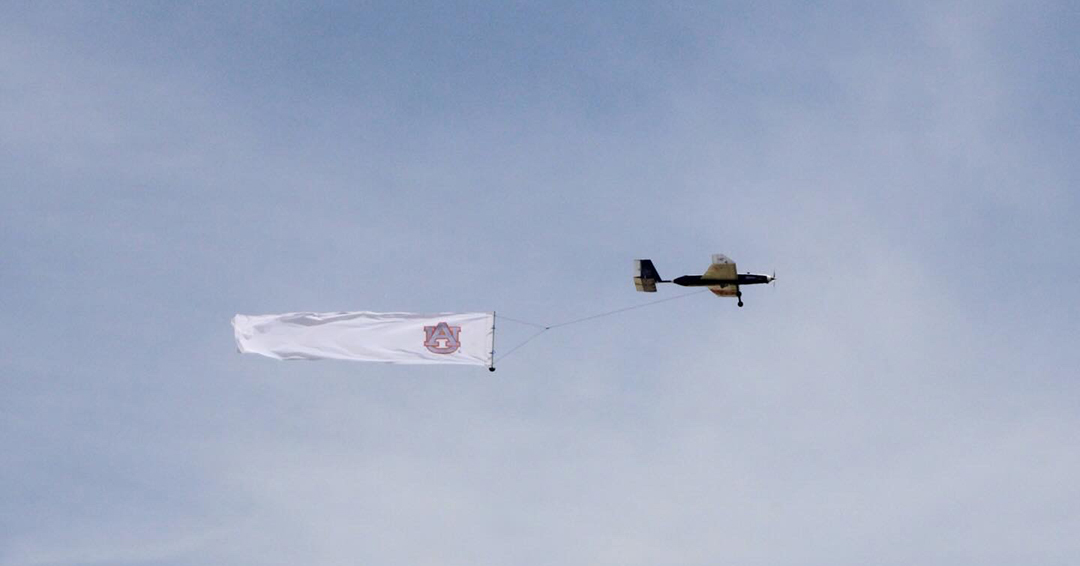
The team also redesigned its banner deployment mechanism roughly two weeks before competition.
The team built six aircraft during the season and suffered two crashes along the way. Each aircraft cost approximately $2,500.
Then came the week before competition.
Holman said students realized late Sunday night that Auburn’s internal payload mechanisms needed to be redesigned entirely. The redesigned restraints were used to secure 12 rubber ducks and four hockey pucks carried during competition missions. At 7 a.m. Monday morning, he drove to Walmart to buy a memory foam mattress topper that became the basis for new passenger restraints.
“We had to change all the mechanisms two days before competition,” Holman said. “That’s a scary thing when something isn’t going to be flight tested, but you know it’s better for the team’s success.”
Even after arriving in Wichita, problems continued.
The team discovered a loose control-surface linkage just 15 minutes before its scheduled flight window. Missing the slot would have forfeited the attempt.
Students ripped open the aircraft’s tail section and completed repairs moments before takeoff.
“There was a lot of last-minute stuff,” Holman said. “To be honest with you, we got kind of lucky. But I think you have to put in enough work to be lucky at a certain point.”

Time to Fly
According to Phillips, mission one does not separate teams, but missions two and three are where preparation and optimization matter most.
Weather delays later shut down flights from 1:30 p.m. until 6 p.m. Friday, limiting Auburn’s opportunities to compete. Because the team had performed well in proposal and technical report scoring earlier in the year, Auburn secured the 15th flight position entering competition.
Phillips said Auburn initially slipped from roughly a top-10 position into the low teens after mission two.
“We took a balanced approach to our design, hoping to get more points in the second mission than we thought,” Phillips said.
The team entered mission three nervous about the strong Kansas winds and Auburn’s large banner deployment system. Meanwhile, several highly ranked teams suffered failures involving banner deployment and release systems.
Auburn’s testing process ultimately paid off.
“Once we got in there, we flew that mission and got a great mission-three score,” Phillips said. “We were over the moon.”
The result pushed Auburn roughly 10 spots up the standings and secured a top 10 finish.
More than a competition
By Sunday evening, the students were exhausted. Robinson said most of the team had left Auburn at 3 a.m. Tuesday before operating on minimal sleep throughout competition week.
“Our goal from the beginning was top 10,” Robinson said. “We got top 10. But at the same time, we hunger for more. We want to go back next year and be top five, top three. The job’s not done.”
The students said DBF became one of the defining parts of their Auburn experience.
Phillips said the club helped him build lifelong friendships while applying classroom concepts through hands-on engineering work.
“This club has been everything for me,” Phillips said. “It became exactly what I wanted engineering to be.”
Robinson said DBF evolved into far more than a student organization.
“It’s truly become a full-time job,” Robinson said. “But teaching the next generation of leaders is what’s rewarding.”
Auburn brought its largest competition group to date to Wichita, including two freshmen and four students expected to move into leadership roles next season. Robinson said donor support helped make the trip possible and allowed younger members to gain firsthand competition experience before stepping into larger roles.
Holman said the experience changed his understanding of what Auburn Engineering could offer students willing to fully invest themselves.
“You won’t realize how much Auburn can do for you unless you put yourself into the school and try to better the programs,” Holman said.
Even after graduation, several seniors said they plan to continue mentoring younger members during the summer as Auburn prepares for next year’s competition season.
“There’s a high bar now,” Robinson said. “Last year that high bar was top 20. Now it’s top 10.”
Media Contact: , dzd0065@auburn.edu, 334-844-2326