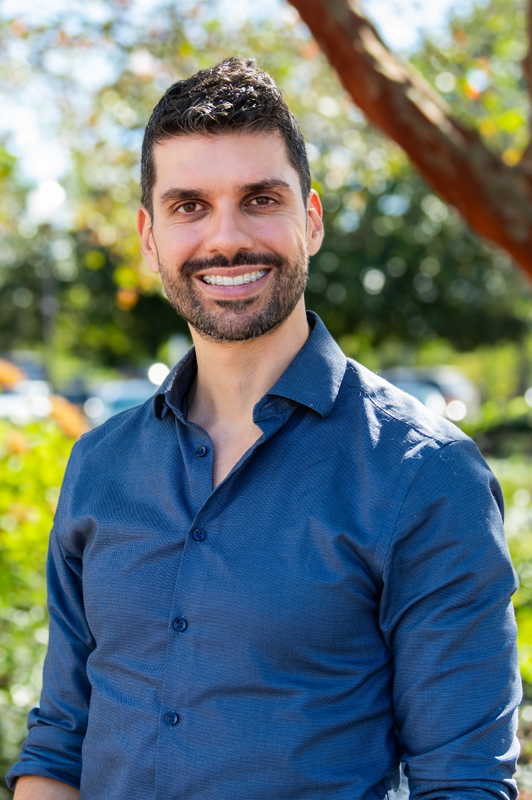
Assistant professor featured in Royal Society of Chemistry's Emerging Investigator Series for nanoscale, soft matter research
Published: Apr 3, 2026 8:50 AM
By Joe McAdory
 Jean-Francois Louf's research contributions to the Royal Society of Chemistry's Emerging Investigator Series includes "Interfacial mechanisms in the freezing of polymer solutions" and "Physical effects of hydrogel coatings on seed germination."
Jean‑François Louf, an assistant professor in the Department of Chemical Engineering, earned two placements in the Royal Society of Chemistry’s newly released Emerging Investigator Series, recognizing separate studies.
His contributions include, “Physical effects of hydrogel coatings on seed germination,” in the Soft Matter Emerging Investigator Series themed collection and, “Interfacial mechanisms in the freezing of polymer solutions,” in the Nanoscale Emerging Investigator Series themed collection.
“It’s an honor to be included with peer researchers,” said Louf, who earned a National Science Foundation CAREER Award in 2025. “Being an emerging investigator means you’re at a point where your work is starting to open new questions and create possibilities that didn’t exist. You’re still early in your career, but you’re building the foundations of what your research program will become, and people are beginning to see the direction and potential.”
The Royal Society of Chemistry (RSC), an international professional society and scientific publisher, uses its Emerging Investigators Series to highlight early‑career researchers. Each series is curated by journal editors and features invited contributions from scientists selected for the significance of their recent research.
“Having two papers selected at the same time reinforces that the problems we’re working on matter and that the community is paying attention to where this research is going,” Louf said.
In one study, Louf showed why seed coatings, widely used in agriculture to retain moisture, produce inconsistent germination outcomes. He offered three findings:
- Water uptake is not a problem: Coated seeds absorb water at the same rate as uncoated seeds.
- Coating firmness plays a role: Softer coatings let the seed break through more easily, while firmer ones slow that first step of germination.
- Oxygen access sets the pace: When coatings restrict airflow to the seed’s breathing sites, germination slows even when hydration is sufficient.
“What matters to me is understanding the physics behind these systems,” Louf said. “Seed coatings are used everywhere, but without knowing which processes control germination, you’re designing in the dark. By identifying the real limiting mechanisms, whether they’re oxygen, mechanics or hydration, we can build coatings that help seeds instead of unintentionally slowing them down. That’s the kind of insight that opens new questions and creates new possibilities for how we design materials that interact with living systems.”
Louf’s work with hydrogels is supported by a $298,000 grant awarded in January from the U.S. Department of Agriculture’s National Institute of Food and Agriculture to better distribute water through soil and support plant growth.
In a second paper, Louf explains how polymer solutions behave in freezing conditions.
“People working in this area needed a framework that connects the nanoscale interactions to the material you end up with,” said Louf, who earned a two-year, $110,000 grant from the American Chemical Society Petroleum Research Fund in 2024 to establish new guidelines for designing resilient polymer solutions in hopes of preventing pipeline damage.
“Laying out those regimes helps researchers see where their system fits and what to expect. Freezing sounds simple, but once you look closely, the physics behind this becomes incredibly rich. Polymers crowd, they get excluded, they reshape the interface and all of that determines the structure you end up with.”
Louf found that as ice advances through a polymer solution, several distinct mechanisms emerge:
- Polymers are excluded from the ice: They can’t fit into the crystal, so the growing front pushes them ahead and the chains pile up in the liquid.
- Accumulation thickens the boundary layer: Rising concentration slows diffusion and increases viscosity.
- Some polymers briefly adsorb to the interface: These brief contacts can snag the freezing interface and make it uneven.
Louf said that being selected for both Series “reflects recognition of a research program that connects ideas across disciplines.”
“It shows that people recognize that you have expertise on polymers across scale,” he said. “To be invited to write papers at both levels is very nice. It’s recognition that my research is known globally, and that’s a very good feeling.”
Media Contact: , jem0040@auburn.edu, 334.844.3447