Aerospace engineering seniors create next-gen fighter jet concept, win Capstone Design Showcase
Published: Apr 8, 2026 1:00 PM
By Joe McAdory
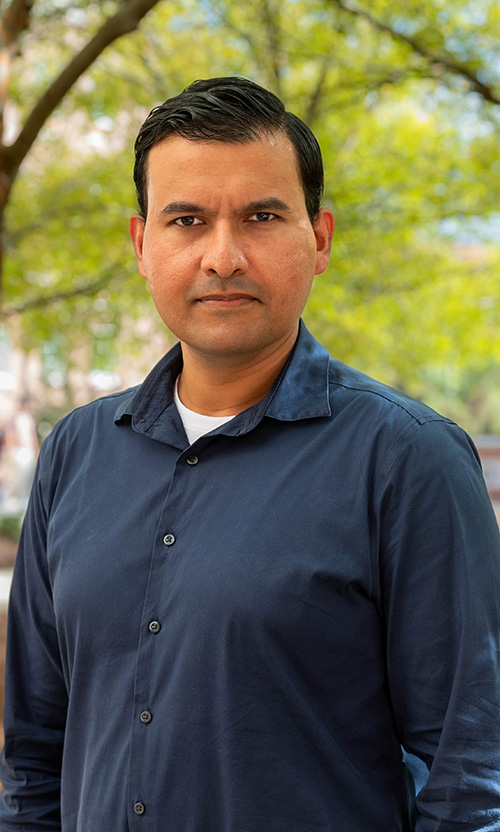
 Aerospace engineering seniors and Project Leviathan team members, from left, Walker Shankle, Robert Hudson and Logan Phillips with Dean Hendrix, associate dean for undergraduate studies and program assessment.
Seven seniors in aerospace engineering developed a conceptual design for a next‑generation stealth fighter jet — proving they could integrate major aircraft subsystems into coherent, feasible designs the way an industry contractor would.
This wasn’t your ordinary senior design project. This is what industry giants such as Northrop Grumman, Lockheed Martin and Boeing do.
“Some primary goals in this project include expanding the combat radius, advancing our stealth capabilities and maintaining proper technology readiness levels so that this isn’t a completely out‑of‑scope function,” said Logan Phillips, who led the project’s aerodynamics and software work. “We designed a concept show of force that our military is dominant, and we can operate in the Pacific Theater with just as much potential as adversaries.”
No wonder faculty, staff and industry professional judges awarded Robert Hudson, Ryan Holman, Walker Shankle, Ethan Mallory, Brendan Craig, Albert Salcedo and Phillips first place in the third Capstone Design Showcase on Thursday, April 2, for their work, “Project Leviathan.”
A record 465 students presented projects in a two‑hour poster session, the largest annual student research competition at the college.
“There's a line in the Auburn Creed that says, ‘I believe in education, which gives me the knowledge to work wisely and trains my mind and my hands to work skillfully,’ and that's exactly what a capstone experience really is,” Dean Hendrix, associate dean for undergraduate studies and program assessment, told students at the program’s awards luncheon. “It brings together knowledge and skill into something real and makes a difference. Today, we saw that on full display.”
Students began senior design project work in the fall, an effort that required them not only to meet technical objectives but also to communicate their proposals and results effectively through poster presentations.
Second place went to mechanical engineering seniors Alex Bardo, Andrew White, Daniel Miller, Ian Mockaitis and Will Anderson for their project, “ALTEC Boom Welding Automation.”
Third place was the aerospace engineering team of seniors Devlin Day, Eirik Mulder, Henry Nguyen, Robert Smith and Chase Taylor for their project, “COATL.”
Department winners included: Lon Hickman for “Launch Vehicle Design Group 1” (aerospace engineering); Fran Mann, William Neville, Michael Rodgers and Sally Wingard for “Montgomery Zoo Rain Garden Design” (biosystems engineering); Maddox Decker, Kailee Foutz, Katie Pennell and McKenna Walker for “Hydrogenation of Carbon Dioxide” (chemical engineering); John Lieb for “Sphero Design” (computer science and software engineering); and Gavin Lewis, Charles Koenig, Conley Rogers and Grant Hull for “MECH Battlebauts.”
Why are aerospace engineering seniors at Auburn designing upgrades to the F‑18, F‑18 Super Hornet, F‑14 and even the F‑35? A simple request for proposal from the American Institute of Aeronautics and Astronautics (AIAA).
“Every year AIAA releases an RFP (request for proposal) — basically a mock request for proposal with a set of parameters and mission requirements,” said Hudson, who led the team’s mass properties and structures work. “They give us a direction, and that’s what we go from. We have a code base. We get numbers, but the numbers can be fairy dust unless you make sure the plane works.”
With the mission requirements defined, the team worked toward making the concept physically viable.
“My job was making sure the airplane we were designing could actually exist,” said Walker Shankle, who led the internal configuration work. “You can get great performance numbers out of a code base, but if the fuel system, weapons bay, landing gear and avionics don’t physically fit, then you don’t have an airplane — you have a spreadsheet. Feasibility is where the design becomes real.”
The team’s work didn’t stop at feasibility. Once the internal layout came together, they had to prove the aircraft could perform its mission.
“There were weeks where we were buried in this project,” said Ryan Holman, who led mission analysis and performance. “You’d look up and realize you’d been tuning parameters or running simulations for hours. That’s just what it takes to make a design like this hold together.”
The team credited Imon Chakraborty, the Walt and Virginia Woltosz associate professor in the Department of Aerospace Engineering and their project faculty mentor.
“He asks the right questions and that forces you to explain why you made a choice and what your design philosophy is,” Hudson said. “If something didn’t make sense, he wouldn’t fix it for you. He’d make you walk him through your reasoning until you either proved it or realized you needed to rethink it. Every time we thought we had a clean solution, he pushed us to defend it. That’s what made the design better. That’s what made us better engineers.”
Media Contact: , jem0040@auburn.edu, 334.844.3447