Civil and environmental engineering professor awarded $350,000 for pedestrian safety research
Published: Mar 25, 2026 3:30 PM
By Dustin Duncan
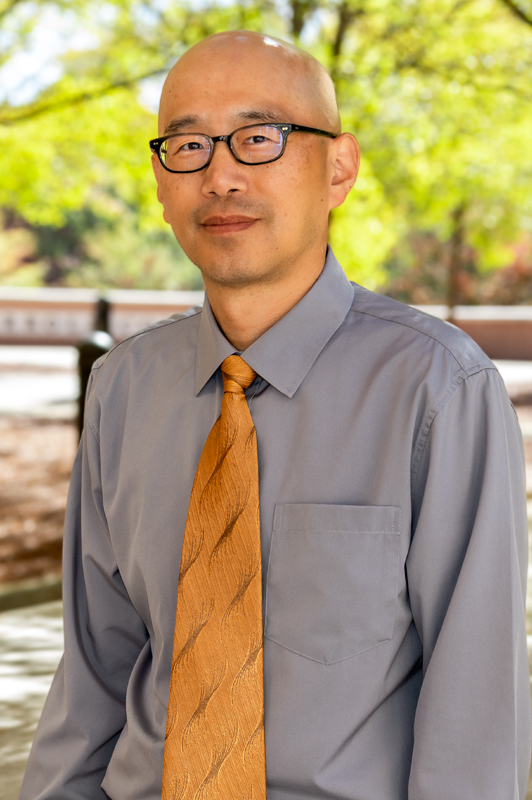
 Huaguo Zhou, professor of civil and environmental engineering, stands near a pedestrian crossing on Auburn University’s campus.
Huaguo Zhou is leading a national effort to improve pedestrian safety by addressing a critical gap in roadway design.
Zhou, the Elton Z. and Lois G. Huff Professor of civil and environmental engineering, has been awarded $350,000 from the National Cooperative Highway Research Program to develop a standardized method for evaluating sight distance at pedestrian crossings — the distance a person needs to see to cross the street safely.
“Most people decide when to cross the street by asking a simple question: ‘Do I have enough time to get across before a car reaches me?’” Zhou said. “This project is about making sure pedestrians can see far enough down the road to answer that question safely.”
Current roadway design standards are largely based on the driver’s perspective, focusing on how far a driver must be able to see to stop or avoid a collision. Zhou said there is no consistent national guidance for how much visibility pedestrians need to judge traffic and make safe crossing decisions.
That gap can lead to crossings that meet existing standards but still create unsafe conditions for pedestrians.
“A crossing can meet all the current rules for drivers and still feel risky if parked cars, trees or curves in the road obstruct the view of oncoming traffic,” Zhou said. “Drivers may have enough stopping distance, but pedestrians may not be able to see vehicles early enough to make a safe decision.”

The project will develop a framework that accounts for how pedestrians behave in real-world conditions, including children, older adults and people with disabilities. The goal is to provide transportation agencies with a practical, data-driven tool to evaluate whether crossings provide enough visibility for safe decision-making.
The work builds on Zhou’s previous research using geographic information systems, or GIS, and LiDAR — a laser-based mapping technology — to measure sight distance at intersections. That project, which analyzed hundreds of intersections, earned the 2026 Southern District Institute of Transportation Engineers (SDITE) Technical Knowledge Special Project Safety Award.
“That project showed it is possible to use advanced mapping and laser scanning data to check sight distance at hundreds of intersections automatically, instead of sending engineers out with tape measures and clipboards,” Zhou said.
The same technology will be adapted to evaluate what pedestrians can see from sidewalks and crosswalks. The research will combine those measurements with observations of pedestrian behavior, including how people judge gaps in traffic and how long they take to begin crossing.
If incorporated into national guidance from the American Association of State Highway and Transportation Officials, the framework could influence roadway design practices nationwide.
“State and local agencies would have a consistent, science-based way to check whether their crossings give pedestrians enough time and visibility,” Zhou said. “That would help bring pedestrian sight distance into everyday practice and support safer, more walkable streets nationwide.”
Media Contact: , dzd0065@auburn.edu, 334-844-2326