Auburn Engineering hosts Defense Industrial Base Digital Engineering Summit

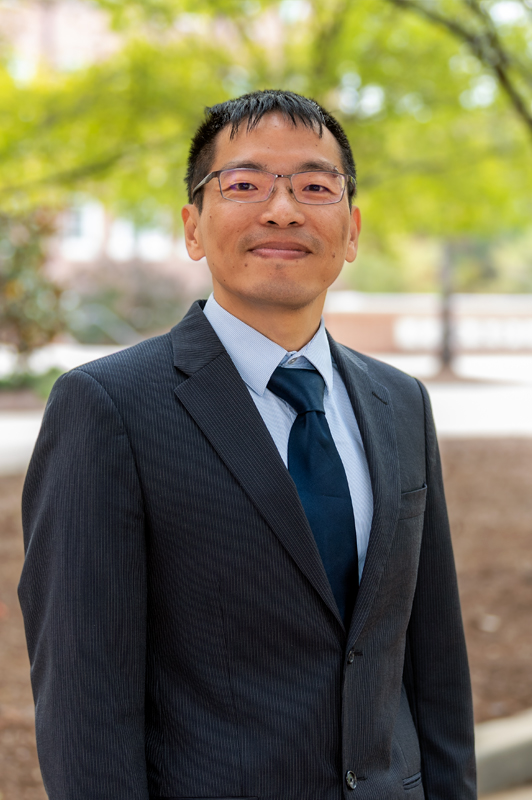
Leaders from industry, government and academia gathered at Auburn University March 3-4 for the Defense Industrial Base Digital Engineering Summit, a two-day event focused on strengthening the nation’s defense capabilities through digital engineering, workforce development and collaboration. The event was hosted and organized by Auburn University’s Department of Industrial and Systems Engineering and led by Edward Huang, the Hal N. and Peggy S. Pennington associate professor.
Held across campus venues, including the Brown-Kopel Engineering Student Achievement Center and the Shelby Center, the summit, moderated by Casey Eaton, industrial and systems engineering assistant professor, brought together representatives from more than 30 companies and agencies across nearly a dozen states to discuss how digital engineering, modeling and simulation can help modernize the defense industrial base.
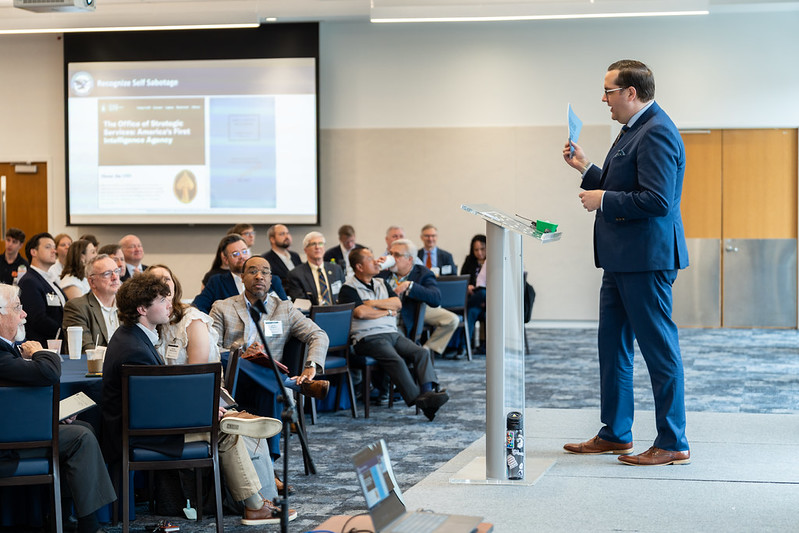
“Today we're welcoming visitors from more than 30 different companies and agencies in nearly a dozen states across the country to discuss this highly important topic of digital engineering for the defense industrial base,” said Steve Taylor, Auburn’s senior vice president for research and economic development, during opening remarks. “At the risk of stating the obvious, especially in light of current events around the world, it’s clear that our nation’s defense infrastructure is facing some serious challenges.”
Taylor emphasized the growing importance of emerging technologies such as artificial intelligence and model-based systems engineering in defense innovation.
“I hope you will all agree with me that digital engineering has to become the new norm in our discussion on how we design and manufacture and field and sustain the systems that will help our nation provide the necessary capabilities for our warfighters,” he said.
The summit opened with a keynote address from Daniel Hettema, director of Digital Engineering, Modeling and Simulation within the Office of the Under Secretary of War for Research and Engineering. Hettema discussed the Department of War’s strategy to accelerate acquisition and transformation through digital engineering approaches such as SysML v2, digital thread integration and hardware-in-the-loop testing.
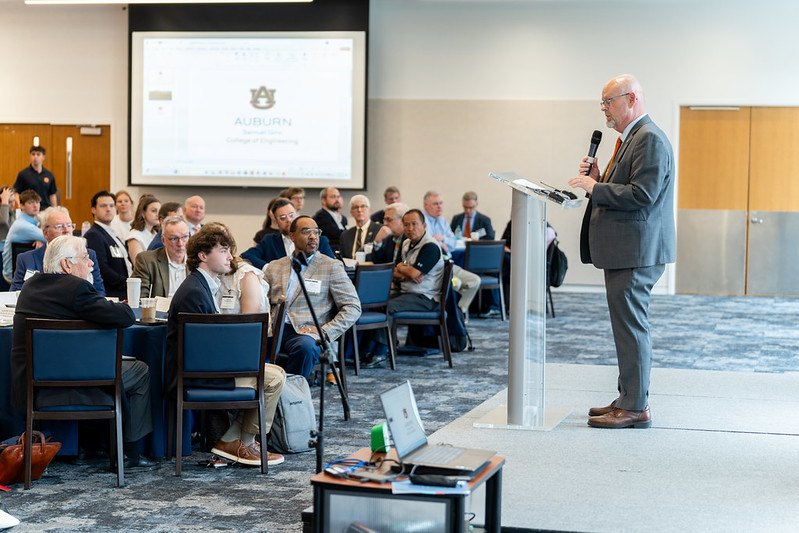
Later sessions explored the intersection of people, culture and technology in defense innovation. Darryl Howell, ’92 aerospace engineering and CEO of Powell Consulting Group (PCG), delivered a talk examining how organizations can integrate artificial intelligence with digital engineering while maintaining human judgment and accountability.
Participants also took part in a research poster session and toured several Auburn research facilities, including the Interdisciplinary Center for Advanced Manufacturing Systems, the National Center for Additive Manufacturing Excellence, Electronics Packaging Research Institute, the Auburn Human Systems Integration Center and the department’s experiential learning Tiger Motors Lab.
On the second day, faculty members highlighted Auburn’s digital engineering and workforce development initiatives. Huang presented an overview of curriculum related to model-based systems engineering, SysML v2 and digital engineering education, while students shared their experiences during a panel discussion. Roundtable discussions were also held, which were moderated by Christian Zamiela, industrial and systems engineering assistant professor.
Industry leaders noted the importance of strengthening the systems engineering workforce to support future defense programs.
“Army Aviation needs help in digital engineering and MBSE,” said Alex Boydston, digital engineering chief at CPE Aviation Engineering & Architecture. “We need help to ensure that true systems engineering is occurring. So, I applaud you immensely for this effort here and look forward to further engagements with Auburn University.”
The work being done at Auburn drew strong praise from summit participants.
“The Summit exceeded every expectation,” Howell said. “My government customer, Daniel Hettema, joined me for the trip, and he was genuinely amazed by what he experienced. He kept saying how the work led by Dean Mario Eden, Dr. Greg Harris and Dr. Huang is both grounded in real-world impact and truly groundbreaking in vision. He’s excited to return to the Pentagon and share what he learned.”

The summit concluded with remarks from Harris, chair of industrial and systems engineering, who emphasized the need for continued collaboration between universities, government agencies and private industry.
“I think having gatherings like this is really important, not only for academia to hear what industry and government need and want from us, but for you to understand some of the things we’re having to go against to provide you that output,” Harris said. “We’ve talked a couple of times about this being a supply and demand issue. We’re trying our best here to figure out ways to increase supply. That's really the only way to work our way out of the deficiency of systems engineers that we have today.”
Taylor said Auburn hopes the summit will serve as a foundation for future partnerships and research collaborations aimed at strengthening the nation’s defense capabilities.
“Here at Auburn, we are equipped to play a huge part in this transition for our country and the nation’s security,” Taylor said. “We hope that today you will leave here with a better understanding of how Auburn University can partner with you and your agencies to deliver solutions to our national security problems.”
Media Contact: ,
, carla@auburn.edu, 334-844-1404