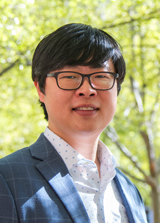
Associate professor of electrical and computer engineering wins 2026 IEEE INFOCOM Test of Time Paper Award
Published: Mar 17, 2026 8:35 AM
By Joe McAdory
 Yin Sun will be presented with the 2026 IEEE INFOCOM Test of Time Paper Award at its annual conference on May 19 in Toyko.
Too many updates. Not enough impact.
That’s the conclusion Yin Sun, associate professor in the Department of Electrical and Computer Engineering, made in his 2016 co-authored paper, “Update or Wait: How to Keep Your Data Fresh.”
Ten years later, that insight earned Sun the Institute of Electrical and Electronics Engineers (IEEE) INFOCOM 2026 Test of Time Paper Award, which will be presented May 19 in Tokyo. Test of Time Paper Awards recognize published research — 10 to 12 years in the past — “that have been the most cited and widely recognized to have a significant impact on the research community,” according to IEEE INFOCOM.
“This honor is a validation from peer researchers that the ideas we introduced 10 years ago have stood the test of time and helped shape how people think about data freshness,” said Sun, who was awarded a National Science Foundation Early Faculty CAREER Award in 2023 for his project, “Semantic and Goal-oriented Status Updating for Real-time Inference, Monitoring, and Decision-Making.”
Sun won the IEEE Communications Society William R. Bennett Prize and Best Paper in 2025 for his paper, “Timely Communications for Remote Inference.”
Age of Information. Internet of Things. Data freshness. Prioritizing significant data. These are the pillars of Sun’s research… and it all began during postdoctoral research at Ohio State.
“I was reading a paper on data freshness and realized there was more that could be done,” he said. “The work showed that sometimes you should wait before sending the next update, because two updates generated too close together don’t add much new information. However, it didn’t calculate what that waiting time should be. I saw that gap, and our paper set out to determine a precise optimal waiting time.”
What is the optimal waiting time? That depends.
“People assume the best strategy is to send updates as fast as possible, but that isn’t always true,” Sun said. “Freshness depends on how the network behaves. When service times are unpredictable or tend to fluctuate together, sending an update immediately can make the information older. The real question is how much new information the next update will carry. Sometimes the system needs a brief pause, so the next update is meaningfully different. That’s where the optimal waiting time comes from: balancing speed and usefulness.”
What began as research on data freshness has grown into a framework now used in control systems, signal processing, sampling and real time machine learning. Research builds upon research, Sun said.
Data freshness was so 2016. The new research frontier: data significance.
“As networks become more crowded and devices generate more data than they can possibly send, the next frontier isn’t keeping information fresh, but instead deciding which updates matter most,” he said. “That’s data significance. It raises new questions about how future systems will decide what to send, when to send it and how to prioritize meaning over volume. This has the potential to shape the next generation of intelligent systems.”
Media Contact: , jem0040@auburn.edu, 334.844.3447