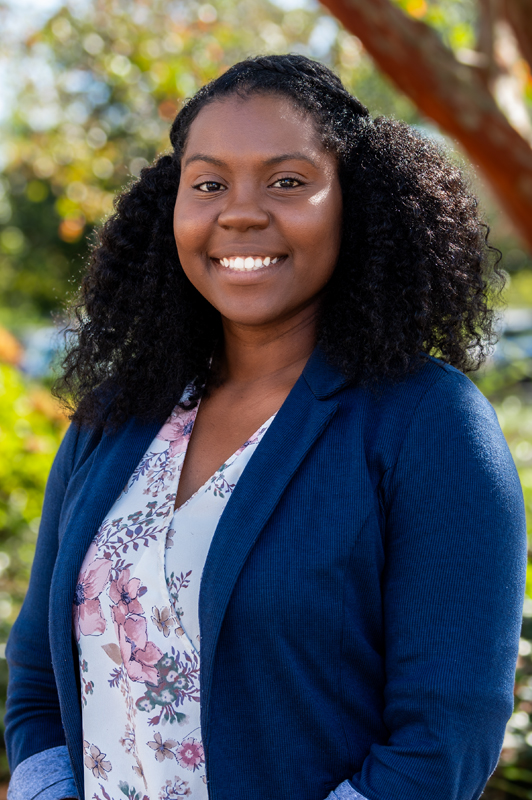
Assistant professor of chemical engineering among 30 U.S. scientists selected for NAE symposium in Hong Kong
Published: Mar 2, 2026 2:40 PM
By Joe McAdory
 Symone Alexander plans to share her research ideas at the National Academy of Engineering China-America Frontiers of Engineering Symposium, including mixed waste feedstocks, including the recovery of cellulose from agricultural waste and the extraction and utilization of biopolymers from food waste.
Symone Alexander, assistant professor in the Department of Chemical Engineering, is one of 30 U.S. engineers selected to attend the National Academy of Engineering’s China–America Frontiers of Engineering Symposium April 13–16 in Hong Kong.
The symposium will focus on advances in carbon capture, utilization and storage; the fusion of engineering science and traditional medicine; critical metals and materials separation and purification; and the co-design of intelligent, interdisciplinary energy systems. The program pairs U.S. and Chinese early-career engineers to encourage cross-disciplinary collaboration.
“For me, this is an opportunity to be in a room with people who are actively shaping energy systems and ask, ‘Where does my work fit?’ ‘How could the materials we’re developing contribute to those processes in a way that moves technology forward?” she said. “I want to learn what they see as their bottlenecks. Where are the inefficiencies? Where are the limitations? How can materials design be part of the solution? It pushes me into a space that’s adjacent to my research but not identical, and that’s important. When you’re slightly outside your core area, you start asking new and exciting questions about your own work.”
Alexander said the international dimension of the symposium adds another layer to the experience.
“When you think about global leaders in engineering research, the U.S. and China are some of the biggest players,” she said. “The idea that the National Academies from both countries are bringing early-career engineers together — that’s significant. Those are the kinds of conversations and collaborations that can shape the future of a research field.”
Alexander also plans to share her research ideas regarding mixed waste feedstocks, including the recovery of cellulose from agricultural waste and the extraction and utilization of biopolymers from food waste.
“They’re often discounted as too difficult, too inconsistent or too messy to work with,” she said. “But in our lab, we’ve shown that if you redesign the process around the feedstock instead of trying to force the feedstock into a traditional process, it can perform extremely well. It requires a shift in thinking. Instead of asking ‘how do we clean this to fit our system?’, we ask ‘how do we design the system to work with the resource?’
When asked about being selected as one of only 30 U.S. participants, she said, “You have to be invited by someone from the National Academy of Engineering, then you are selected from a pool of the invited applicants. My work pushes boundaries. When you step into a new space, you hear a lot of ‘that won’t work’ or ‘that’s too ambitious.’ To have the national academies say that this work is at the frontier of engineering — that’s validating. It tells me that the risks we’re taking and the unconventional directions we’re exploring matter. It makes me more passionate about the hard work my students and I are doing to address the global challenge of food and plastics waste.”
Media Contact: , jem0040@auburn.edu, 334.844.3447