

Two Auburn engineers advance to Feb. 27 Tiger Cage semifinals
Published: Feb 13, 2026 9:30 AM
By Joe McAdory
 Entrepreneurs advancing beyond the semifinal round will compete in the 12th Tiger Cage finals on Friday, March 25, for up to $135,000 in startup capital.

Ethan Page, a December mechanical engineering graduate, developed a device designed to prevent electrical outlet fires. Joseph Rusk, a junior in electrical and computer engineering, created a product that simplifies electronics prototyping. Both are among 11 teams who will compete in the Tiger Cage Student Business Idea Competition semifinals on Friday, Feb. 27 in Horton-Hardgrave Hall.
Page and Rusk impressed industry judges and advanced from the competition’s Jan. 30 quarterfinal round with their business ideas, Thermaguard and The Breadboard Company.
Presented by the New Venture Accelerator and Harbert College of Business, Tiger Cage provides months of coaching and mentoring to students on how to develop business plans, refine those plans and pitch ideas before industry judges or potential investors.
Select entrepreneurs will compete in the 12th Tiger Cage finals on Friday, March 25, for up to $135,000 in startup capital.
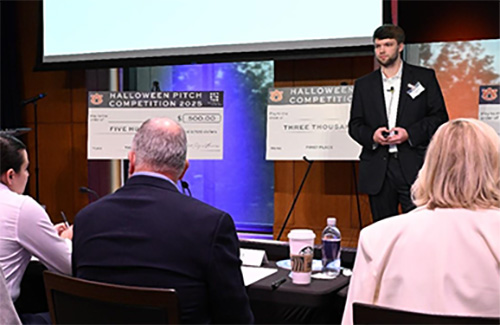
Page, an engineering intern at Whorton Engineering, Inc., in Anniston, earned third place at last fall’s Halloween Pitch Competition for Thermaguard, an apparatus for electrical outlets that detects overheating in and around the outlet.
“When the overheating is detected, the device alerts building occupants of the dangerous temperatures, which allows them to stop a fire from happening, escape the building, or call the fire department,” he said. “The device reacts faster than what is currently being used due to it triggering from overheating rather than smoke. The device is currently patent pending.”
Page, who will soon begin working toward his professional engineer license, developed the idea through a class project that required actuating a drawbridge with heat using shape memory alloy. The protective nature of fatherhood also kick-started the plan.
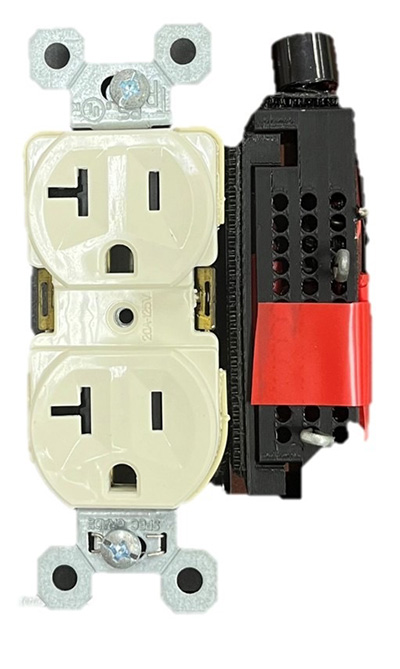
“This made me consider how additional applications that shape memory alloys could be used,” said Page, who submitted a non-provisional patent application on the device in 2024. “My two-year-old son was trying to get to or mess with an electrical outlet while I was thinking about shape memory alloy practicality and that is how this idea was formed.”
He credited Auburn’s rigorous engineering program for sharpening his entrepreneurial skill set.
“The Auburn Engineering program is challenging, and the professors do a great job of making exams, projects, homework and quizzes difficult,” he said. “This forces students into learning the material and the thought process needed to solve complex problems rather than students being able to memorize homework or study guide problems. If the professors and faculty did not challenge the students in this way, then students would never develop real problem-solving skills; they would just be memorizing how to solve one problem when every problem is unique. The difficulty and knowledge of the professors provided me with problem-solving skills that are not just applicable in the classroom but also in real world scenarios.”
Rusk’s venture, The Breadboard Company, aims to make learning electronics easier and more engaging for young students through hands-on kits and guided instruction.
“Our main product is our electronics starter kit,” said Rusk, who earned a combined $1,500 in the Auburn Ideas Jam and Halloween Pitch competitions last fall. “It teaches kids the basics of electronics and how different parts work in a fun and easy way, with simple step-by-step instructions similar to building with Legos, along with video tutorials that are both educational and entertaining.”
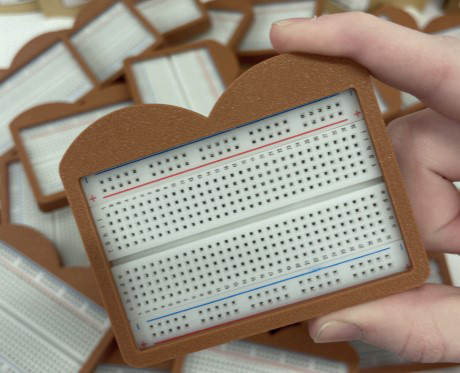
A breadboard tests electronic circuits by connecting components such as LEDs and motors so electricity can flow through them. Rusk designed his version to resemble a slice of bread, an idea he 3D-modeled and printed last summer.
He credited his Auburn coursework with helping turn the concept into a working product.
“My Auburn education has helped me expand on my creative ideas by giving me the skills to be able to make the things that I come up with,” he said.
Filling out the Tiger Cage semifinal field are Wesley Stallings (Builder Help) from the College of Architecture, Design and Construction, Isabella Barreiro (Chifforo) and Sophie Snyder (Sophie Sweets) from the College of Human Sciences, Moises Gonzales (Farm Hub) from the College of Sciences and Mathematics, and Olkaris Marandu (GloryEv), Caroline Lyberger (Emerald Tiger), Case Johnson (Hustle), Adam Cardini (SCAP Athletics) and Jacob Ninas (Side Kit) from the College of Business.
Media Contact: , jem0040@auburn.edu, 334.844.3447