Associate professor of electrical and computer engineering earns ADECA grant to advance 6G communications
Published: Feb 19, 2026 2:45 PM
By Joe McAdory
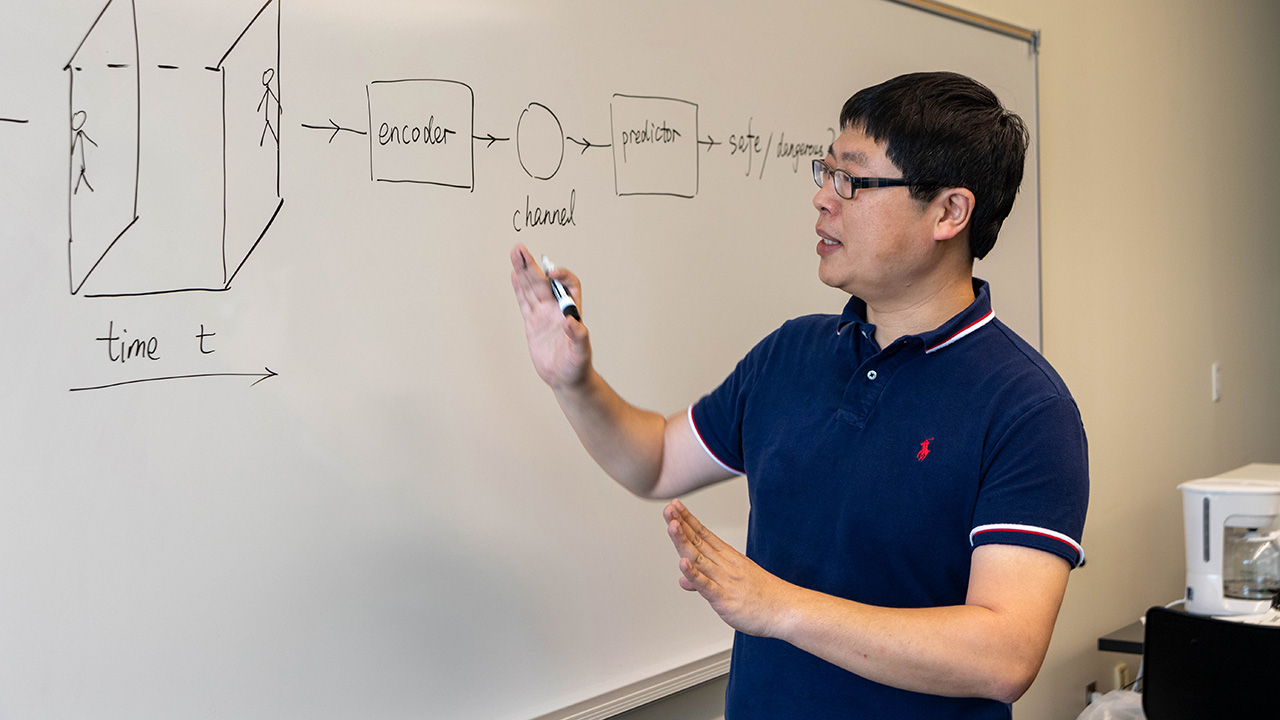 Yin Sun and graduate students are developing a pair of test beds to evaluate how time-sensitive communication performs in public and industrial environments.
Yin Sun is building wireless systems that prioritize significant data — including emergency alerts and crash warnings — a shift that could make future 6G networks faster, safer and more efficient.
Sun, the Godbold Associate Professor in the Department of Electrical and Computer Engineering, was awarded $125,000 by the Alabama Department of Economic and Community Affairs to advance his project, "Development of NextG Wireless Testbeds for Semantic and Goal Oriented Communication," with software support from tech giant NVIDIA.
"If you detect a dangerous situation but the information is already hours old, you can’t rescue anyone in time," Sun said. "That’s why the system must understand not just what the data says, but how quickly it needs to be delivered. Some information becomes meaningless the moment it’s stale, and our communication systems must be smart enough to recognize that."
Sun’s latest work builds off 2023 research, "Semantic and Goal-oriented Status Updating for Real-time Inference, Monitoring and Decision-Making," which not only developed theories and algorithms to optimize the timeliness of information in networked systems, but secured a National Science Foundation Early CAREER Award.
His recent ADECA grant catapults those ideas into real-world environments, allowing Sun and his team to test how time-sensitive communication performs when sensors, traffic and safety-critical decisions collide in unpredictable conditions.
Cornerstones of the project are two full-scale testbeds — experimental systems developed in his Shelby Center lab — that allow his team to evaluate how time-sensitive communication performs in public and industrial environments. The test beds combine artificial intelligence processing with software-defined radio systems that evaluate incoming sensors and camera data in real time, determine which information has the highest safety value and transmit only those critical signals while compressing or delaying less important data.
The first test bed, called SafeStep@AU, focuses on pedestrian safety at Toomer’s Corner, one of the busiest intersections in Auburn.
"We are analyzing traffic camera data to understand how pedestrians and vehicles move through the intersection to help us understand when too many people are in one place or when cars are behaving abnormally near crosswalks," he said. "The goal is to build a communication system that recognizes when a situation is becoming dangerous and immediately prioritizes the most important data — the kind that could prevent an accident."
The second test bed, AnomalyGuard, brings the same principles into an industrial environment, where sensors, robots and automated systems must react quickly to unexpected behavior.
"The system should behave so that when there is potential high-cost data, it suddenly starts to work and communicate a lot of its local information," Sun said. "When everything is normal, it reduces the workload."
In a factory or warehouse, networks would remain quiet during routine operations but become highly active the moment something looks unsafe.
"When I wrote the proposal for this ADECA grant, I noticed that only a few research groups in Alabama are working on 6G communications," he said. "We want to show the community that Auburn has this kind of capability in safety related communication systems."
Media Contact: , jem0040@auburn.edu, 334.844.3447