ISE professor receives grant for autonomous robotics research
Published: Jan 20, 2026 3:25 PM
By Carla Nelson
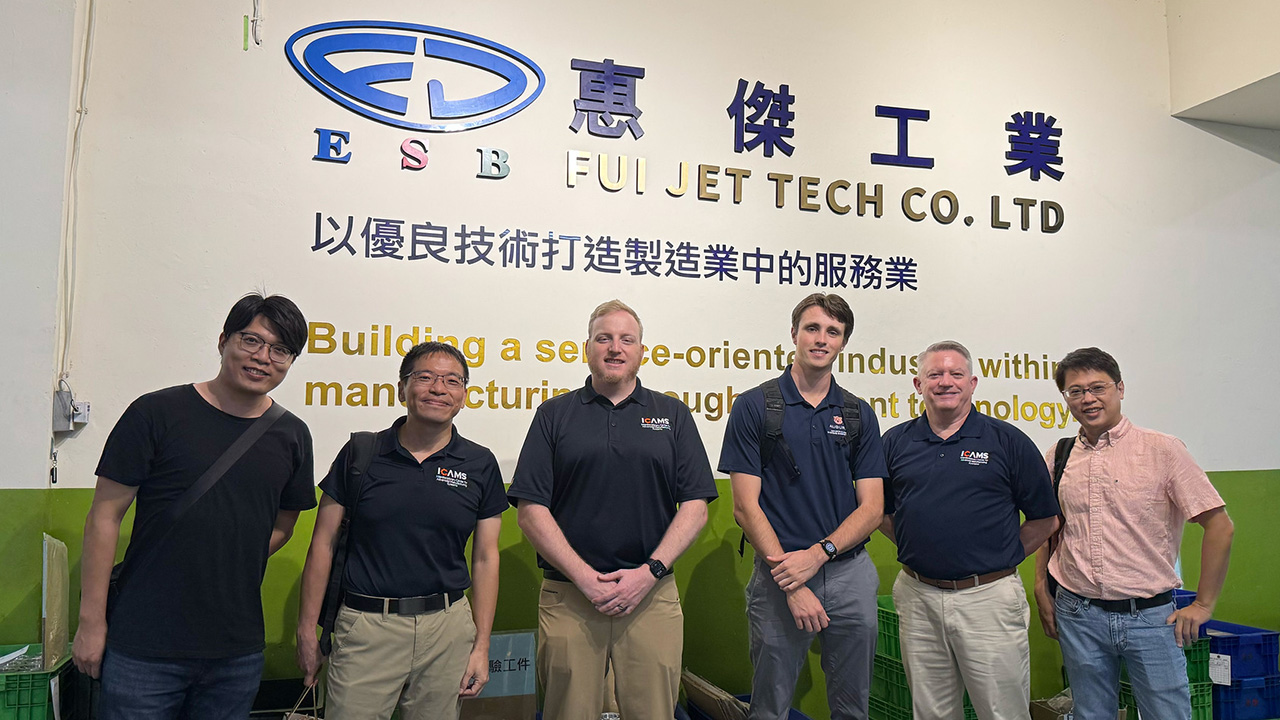 Faculty collaborations with Taiwan were further inspired by a recent visit by members of Auburn’s industrial and systems engineering faculty, who toured semiconductor manufacturers, robotics companies and universities known for innovation in CNC machinery, IoT integration, AI-driven manufacturing and advanced robotics.
Auburn University Assistant Professor of Industrial and Systems Engineering Christian Zamiela has received an NVIDIA Academic Grant to support research in autonomous robotics for semiconductor manufacturing, marking one of the first NVIDIA-funded research projects at Auburn led by a faculty member.
The project, “Sim-to-Real Deep Reinforcement Learning for Autonomous Robotics in Semiconductor Manufacturing,” was selected as part of NVIDIA’s global Academic Grant Program, which supports university-led research advancing artificial intelligence and high-performance computing.
The award provides two RTX PRO 6000 Blackwell Max-Q Workstation Edition GPUs, top-tier professional graphics processors built on NVIDIA’s Blackwell architecture, enabling high-fidelity simulation, accelerated reinforcement learning training and advanced AI development. The research focuses on simulation-to-reality, or Sim-to-Real, deep reinforcement learning to train autonomous mobile robots capable of adapting to complex, dynamic semiconductor factory environments.
“This support from NVIDIA helps advance artificial intelligence for systems engineering research in advanced manufacturing,” Zamiela said. “By integrating digital twins, artificial intelligence and semiconductor manufacturing, this work contributes to the development of more adaptive and intelligent factories.”
Using NVIDIA’s robotics and digital twin ecosystem, the project aims to develop self-organizing AI policies that align robot-level decisions with factory-wide performance metrics such as throughput, utilization and downtime reduction. By embedding system-level objectives directly into reinforcement learning training within data-rich simulations, the research seeks to overcome key bottlenecks in semiconductor manufacturing.
The project positions Auburn to expand its capabilities in designing and testing autonomous robotics for advanced manufacturing facilities.
The research includes collaboration with Edward Huang, Hal N. and Peggy S. Pennington associate professor of industrial and systems engineering, and Tzu-Li Chen of National Tsing Hua University in Taiwan, strengthening international partnerships.
Faculty collaborations with Taiwan were further inspired by a recent visit by members of Auburn’s industrial and systems engineering faculty, and researchers from the Interdisciplinary Center for Advanced Manufacturing Systems (ICAMS), who toured semiconductor manufacturers, robotics companies and universities known for innovation in CNC machinery, IoT integration, AI-driven manufacturing and advanced robotics. During the visit, researchers observed challenges related to robotic material handling across multiple stages of semiconductor production, including wafer fabrication, testing, cutting and palletizing.
“They showed us some of the challenges and bottlenecks in their system,” Zamiela said. “That’s what motivated us to pursue NVIDIA resources. Access to these GPUs allows us to use NVIDIA’s Omniverse platform to develop more photorealistic digital twins and integrate AI capabilities such as reinforcement learning.”
The GPUs support AI integration and large-scale simulation, enabling researchers to train AI models in virtual environments before deploying them in real-world factory settings.
“We perform the simulation and train the AI model, and once it performs well in the simulated environment, it can be transferred to the real world to carry out the same operations,” Zamiela said. “One of the major challenges with reinforcement learning is ensuring that improvements benefit the entire manufacturing system, not just one process. That’s why we train with system-level performance metrics in mind.”
Another challenge addressed by the project is the limited availability of real-world manufacturing data.
“In simulation, we can generate many different scenarios and train the system without disrupting or risking an expensive production line,” Zamiela said. “That significantly reduces cost while accelerating innovation.”
Media Contact: , carla@auburn.edu, 334-740-0221