Auburn engineers construct floating golf green at unique local venue
Published: Jan 12, 2026 1:45 PM
By Jeremy Henderson
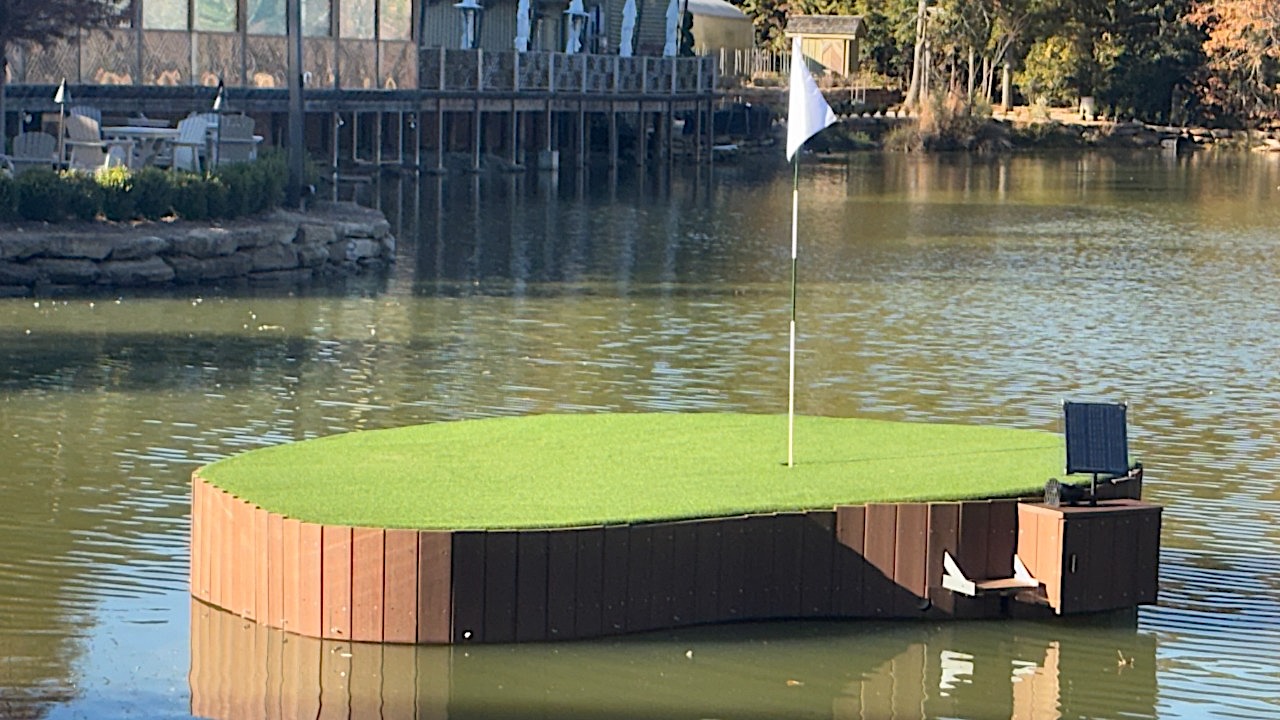 The custom-built floating chipping green at Botanic in Opelika was designed and built by Auburn engineering faculty and students. Modeled after the 8th hole of the Auburn University Club, the solar-powered installation features waterproof sensors and electronics that play the "War Eagle" fight song for every hole-in-one.
Thanks to a team of Auburn engineers, it's no longer "Have you been to Botanic yet?" It's "Have you seen the floating chipping green at Botanic yet?"
Design and construction of the custom-built installation provided a unique learning opportunity for students and faculty from multiple disciplines curious about the complexities of engineering, buoyancy and sustainable energy. The green has been anchored in the pond on the distinctive restaurant and gathering space's 12-acre Opelika property since November.
While floating chipping greens are slowly gaining popularity nationwide as social, so-called “off-course” golf amenities, no team member had actually seen one up close — let alone built one.
“This was a real-world engineering problem with no instruction manual,” said Chad Rose, assistant professor of mechanical engineering. “We had to think about waterproofing, solar power, anchoring, electronics and durability all at once. That's an invaluable for students because it mirrors what happens in industry.”
Dubbed “Botanic Island," the fully self-contained system features waterproof sensors, analog electronics and feedback mechanisms that register successful shots — all designed to withstand constant exposure to water and the elements.
Oh, and to play the "War Eagle" fight song for a hole-in-one.
Christian Brodbeck, director of engineering research operations, says the project's design constraints pushed the team to think outside the box.
“Nothing about this project was square or simple,” Brodbeck said. “We wanted it to look natural, with curves and topography, but everything also had to survive in the water long-term. Every step revealed challenges we hadn’t anticipated, and that’s where the learning really happened.”
Engineering associate Mal Jenkins led much of the green's fabrication and assembly.
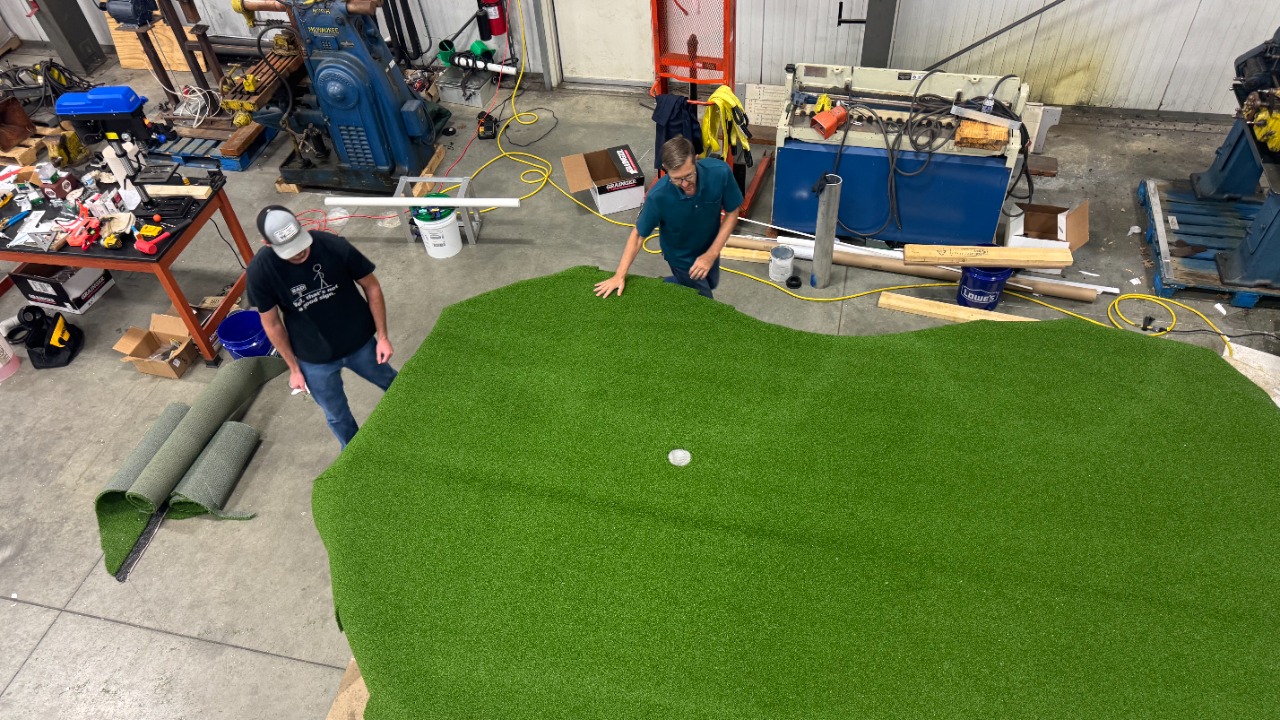
Jenkins worked closely with students and Lake Martin-based industry partner JSC Docks, which donated the dock framework and provided technical guidance.
“This took months of steady effort, from sourcing materials to shaping the green and finally installing it in the pond,” Jenkins said. “Seeing it float and function was pretty satisfying.”
Early conceptual sketches and layout guidance were provided by the team's resident golfer, Jerrod Windham, an associate professor in Auburn’s School of Industrial and Graphic Design, who helped shape the green’s form, orientation and visual appeal.
Tom Hill, who recently retired from his role as principal research engineer at Auburn’s National Center for Additive Manufacturing Excellence, was also instrumental in Botanic Island’s design. Hill developed the requisite CAD drawings, scaling the 8th hole of the Auburn University Club’s golf course as the model for the green's natural kidney bean shape.
“It's a great example of taking complex theoretical problems and solving them in ways that benefit our community,” says Mario Eden, dean of engineering. “It’s one thing to design a circuit in a dry lab. It’s another to build a self-sustaining system that has to live in a pond. We're always looking for ways to bridge the classroom and the real world. I'd say this is one of the cooler ones I've seen."
Media Contact: , jdh0123@auburn.edu, 334-844-3591