 Teaching has more or less remained the same over time: the transfer of knowledge from teacher to student. But it is always in a state of flux as well, particularly as new technologies are able to greatly expand fundamental techniques through the use of multimedia and computer-based instruction, as well as web and online learning, to name just a few of the more obvious. Auburn's engineering faculty has remained current in these changing teaching tools – two veteran teachers show us how.
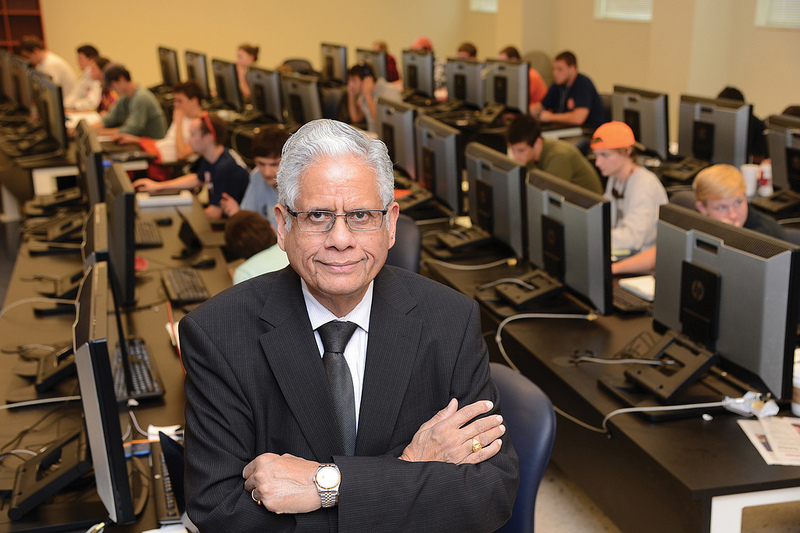
A dedicated teacher with decades of service, P.K. Raju, Thomas Walter professor in the Department of Mechanical Engineering, has not only seen the classroom move from blackboard to white, but has also been influential in the way that the engineering curriculum has evolved with new concepts, new technology – and new students.
"When I came to Auburn in the mid-eighties, the department head called me in, and gave me a syllabus and a textbook," Raju remembers. "He pretty much said, 'well, here you are, now go and teach it.'"
The teaching model, he jokes, was "the sage on the stage."
So much has changed since then.
"In a sense, what we teach is often the same material – after all, the laws of thermodynamics haven't changed – but the way in which we teach has changed dramatically, and it has done so as the result of research into teaching methods as well as teaching technology," Raju explains.
"I was part of a study conducted in 1996 led by William Walker, who was dean at the time, and Larry Benefield, who was then associate dean for academic affairs," says Raju. "We knew that up to 40 percent of our students dropped out between the freshman and sophomore years. And we knew that these students were academically strong, with good high school GPAs and strong test scores.
"What we found out was that many of our students didn't really see the relevance between the science, math and physics taught at the freshman level to real-world engineering."
Auburn's solution was to introduce classes that brought engineering to the freshman class, including a non-credit survey course that introduces students to all of the engineering curriculums, from aerospace to polymer and fiber and everything in between.
In addition, every department offers a two credit-hour course to introduce students to engineering. The Department of Mechanical Engineering introduces students to case studies and games in the course that it offers.
"The presentation of case studies has been particularly important," Raju notes. "We have used a wide range of them, including bringing in plant managers to talk to classes. What our students frequently learn is that there are conflicting solutions to real-world problems, and that engineering is often just one component of the whole – there are usually business questions that need to be answered as well, because there are generally dollar issues attached to the engineering problem at hand."
Raju also points to global education as part of the new learning paradigm.
"We are in such a global economy now, that we absolutely have to bring to our students a sense of what it is like to work in this arena," Raju observes. "We have sent some 40 students to India during the past six years, partnering with the Indian Institute of Technology. Students collaborate on projects that involve working with international corporations under the program, which is sponsored by the National Science Foundation."
Raju has also received grants from the National Science Foundation to develop teaching methods that rely on a wide range of technologies, including computer simulation, video and game-playing to teach engineering design.
"We have used these methods in conjunction with case studies, and have now taught more than 10,000 engineering students in partnership with other universities such as MIT and Georgia Tech," Raju notes. "At Auburn, we have engaged about 100 undergraduates, 40 master's students and eight doctoral candidates in the development of these novel instructional materials."
Raju says that generational and cultural differences, as well as differences in individual learning styles. need to be taken into consideration in teaching engineering students.
"We no longer have a generation of students that will simply sit in front of a blackboard in the classroom," Raju explains, adding, "We may be approaching the end of a generation that will be challenged in the class by watching PowerPoint presentations. Now we have to look at a greater level of computer interaction and game playing.
"Some students learn textually, that is, they literally have to have the words in front of them to understand engineering concepts. Others are very visual in their approach to learning, and have to have some degree of visual stimulation in order to understand the material."
As a teacher, he says, the bottom line is moving from the "sage on the stage" concept to one in which a teacher is more of a facilitator who gives students an opportunity to think and analyze, rather than memorize.
"There is much more research that needs to be conducted on ways to more fully engage our engineering students," Raju concludes. "I believe that Auburn is playing an important part in it, and will become better recognized as an innovator not only in engineering practice, but also in engineering education."
 A new take on teaching
Flip the classroom. What does it mean? An immediate thought is that the teacher is somehow seated in the back row while a student teaches a class from the podium. But that's not really it.
David Umphress, an award-winning faculty member in the Department of Computer Science and Software Engineering, likes to think of flipping the classroom as inverting the traditional process of learning while sitting in your seat and taking notes.
While there is no single, all-encompassing definition of the term, in the inverted, or flipped, classroom students are encouraged to learn outside the walls and take a more interactive, problem-solving approach during the hours they meet in class.
"Some faculty members have described their own experience as being as much a listener in class as a lecturer, and in some ways this captures the flavor of a flipped classroom," Umphress observes. "Sometimes, in class, I think of myself as more of a consultant than a teacher. That's how it feels."
One of the classes that Umphress teaches is software engineering for wireless devices, in which students learn to design Android apps. He typically plans a week with Monday and Wednesday classes treated as lectures where software concepts are described, often with videos and screen casts that capture and project what's on his computer in real time. On Friday, the class is flipped and the concepts that were learned earlier in the week are applied and mastered.
"We have some very specific objectives in this class, which lends itself to this approach," Umphress notes. "We look at it as directed problem solving with the goal of finding ways for users to interact with their Android devices."
He notes that Android platforms lend themselves to this kind of approach because they are programmed in Java, a readily available source code that is easy for students to work within a learning environment.
"You can only go through so much program code before your eyes begin to glaze," he jokes. "We have found this to be a very workable way of teaching because we are not reinventing code, but making incremental changes."
The approach in which Umphress has found success is to challenge his students with a large project, and to break it down into smaller components from week to week. He provides them with links related to the work, and lets them surf the web for solutions. He makes himself available to help students over the roadblocks that routinely occur during the process.
"This kind of strategy lets them research the problem and find out what they need to know about the code and how it is written," Umphress explains. "It is always my goal to get them to go through this process until something clicks, and they find a successful solution."
Umphress says that he has learned a lot during the process of flipping the classroom.
"It's not easy to do this," he comments. "There is a lot more preparation time involved with this approach, and you have to face the fact that some students are not culturally prepared to work in this way.
"Some students feel that you should talk in class, and work outside of it, which, again, is the traditional approach. They can feel as if they are put on the spot if they have to come up with the kinds of answers we are looking for in this new paradigm."
The hybrid, or blended, approach that Umphress favors helps to alleviate some of this feeling in students who are used to the traditional manner of teaching.
"I think that the greater expectations that we place on these students will result in better graduates, because when they are in the job force, they will be essentially following this model in their career."
[miniflickr photoset_id=72157638326098833&sortby=date-posted-asc&per_page=2]