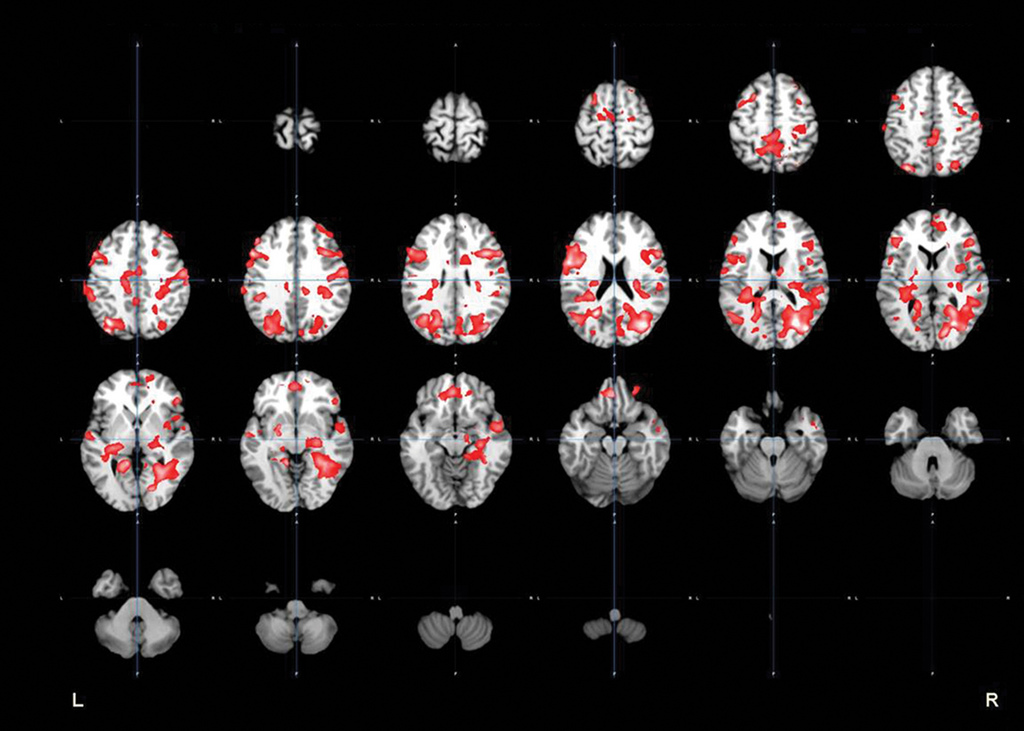
 Auburn University is joining forces with military researchers to study the structures and activity of the brains of soldiers returning from Iraq and Afghanistan in an effort to better understand post-traumatic stress disorder (PTSD) and post-concussion syndrome (PCS). The project brings together the Auburn University Magnetic Resonance Imaging (MRI) Research Center, the Department of Psychology in Auburn's College of Liberal Arts and the U.S. Army Aeromedical Research Laboratory in Ft. Rucker, Ala.
Faculty and graduate students in the departments of Electrical and Computer Engineering and Psychology are testing 160 soldiers – those with PTSD, those with PCS and healthy control soldiers. A percentage of the healthy control soldiers have been deployed to Iraq or Afghanistan, but do not have PTSD or PCS symptoms.
"We hope to use our results to test the efficacy of different treatments for people with PCS and PTSD," said Tom Denney, director of the MRI Research Center.
Capt. Michael Dretsch, chief of neuroscience applications with the Comprehensive Soldier and Family Fitness Program at the Pentagon, said he met Denney and Jeffrey Katz, director of the Cognitive and Behavioral Science program in the Department of Psychology, while he was stationed at the U.S. Army Aeromedical Research Laboratory at Ft. Rucker. Denney and Katz were presenting research there. Because of their shared research interests, Dretsch said he thought combining their work would be a great collaboration. They began working on grant proposals, and Dretsch was able to secure funding from the Military Operational Medical Research Program through the U.S. Army Medical Research and Materiel Command.
Participants in the study undergo MRI brain scans to analyze the structures of the brain, as well as the fiber tracts that connect those structures. In addition, each group participates in functional MRI scans, which measure brain activity while subjects are engaged in a specific task.
"There's a series of networks in the brain that are active, and there's a natural rhythm to the network in our brains," said Katz. "Various structures have more blood flow going to them at different times, and the brain oscillates in these different networks. The networks of people with psychological problems don't oscillate the same way. Nobody really knows what that means at this point — it is a hot topic of research."
Participants in the PCS or PCS healthy group are scanned while being presented with a series of military related pictures projected on a screen mounted inside the scanner. Some pictures are of disturbing events, animals and people, while some are ordinary, everyday objects. After the participant is presented with an image, he is asked to do one of three things: enhance, suppress or maintain his emotional response to the images. Katz said initial analyses are showing differences in brain activity during emotional regulation that may be related to the disease.
Participants in the PTSD or PTSD healthy group perform what is called a fear-conditioning task. During the scan, the participant is presented with a tone that is then followed by a burst of aversive white noise or a tone that is not followed by the noise. Using a track ball, participants continually report their expectancy of the noise's occurrence on a scale of 0-100. During the scan, skin conductance response – a method of measuring the electrical conductance of the skin, which is related to emotional response – is collected to assess learning.
"Our initial analyses are showing differences in brain activity in PTSD patients during threat-related responses and learning-related differences in the predictability of the threat," Katz said.
In addition, all participants undergo a resting state functional brain scan to reveal the connectivity of brain regions that are consistently found while the subject is at rest. Participants are instructed to clear their minds and lie still while not performing a specific task.
"Analyses will be conducted that compare the resting states of PCS, PTSD and healthy participants to test if differences exist across groups in the connectivity of the brain regions," Katz said.
The scans create a large data set that will be analyzed by Gopikrishna Deshpande, an assistant professor in the Department of Electrical and Computer Engineering, who works at the MRI Center.
"We're doing a 3D scan of the brain every two seconds for 10 minutes, getting gigabytes worth of data for each little bit of the brain," Denney said. "We have thousands of time series from each part of the brain that correlate with each other to see which ones work in a network or in concert with each other. Dr. Deshpande's expertise is taking these sets of data and reducing the information to something that tells us what parts of the brain are working in concert together in a network and how strongly related they are. We can measure the different types of networks."
Study participants also have their blood drawn for researchers to look for particular biomarkers that are related to PCS and PTSD. Researchers will conduct biochemical assays to better understand the relationships between the peripheral (blood plasma) protein molecules and lipid species and the outcomes of the brain scans and neuropsychological assessments. In addition, specific genes implicated in neurobiological processes and their role in neural functioning associated with PTSD and PCS will be explored.
"Ideally, we'd really like to understand what's taking place when a soldier is concussed – when you get a concussion, what changes take place?" Dretsch said. "And are there specific biomarkers – imaging biomarkers or blood-based biomarkers – which could better assess and diagnose what's happening with the soldier? This is a very unique study in that our sample size of soldiers is enormous compared to other studies which have previously been published. We have a lot of opportunities here to contribute to the body of research in psychological resilience, as well as the clinical psychopathology."
"Once you've established all of this with the military population, then you can start asking about treatment," Katz said. "You establish these tasks, scan the participants, then they go through treatment, which may be meditation, cognitive behavioral therapy or other forms of treatment. Then, you scan them at a later time and ask, 'Are they better able to perform these tasks?' to validate whether or not those therapies are working."
[miniflickr photoset_id=72157638326428184&sortby=date-posted-asc&per_page=1]