Editor's Note: When Jim Killian, who directs communications and marketing for the Samuel Ginn College of Engineering, was invited to join a media team covering students traveling to Bolivia, he was not sure what to expect — just that it wouldn't be a conventional assignment. A group of eight engineering students (and one in zoology) would be making the trip as part of a five-year commitment to help the residents of the small Andean village of Quesimpuco acquire sustainable, accessible technology. The following are some of his observations.
PLANNING FOR BOLIVIA IS NOT AN EASY SHOT. It's not really a tourist venue, at least not a mainstream one, and our destination was about as remote as it gets — a tiny Quechuan village in the southern section of the altiplano, the high plateaus that give way to the grey substance of the Andean mountains. It was chosen, according to Will McCartney, a biosystems engineering major on the student team, in part for that very reason — "We're not going to make it that easy on ourselves," he explained.
So my planning began a month before, starting with office visits to Steve Duke, a faculty member in the Department of Chemical Engineering who was coordinating the trip, and by reading through the thick, tabbed manual offered through SIFAT — Servants in Faith and Technology — who would help guide us. The students began their journey a full six months before, meeting formally on campus every week, and informally more often as the departure date drew near.
In addition to the logistics, they had to pull together plans and equipment for the two projects they would take to Quesimpuco — a bench-scale hydroponics demo and an irrigation survey. For most, it would be their first trip; two undergraduate students, McCartney and Travis Bugg, had gone before. Mary Robbins, a doctoral student in civil engineering had also made the trip. She would prove to be an incredible asset.
The trip began in the last week of Auburn's typically hot August, to a country just coming out of its winter season. Heeding the SIFAT manual, I packed in layers to the extent that my bag would allow, but then I wasn't too worried. I'm a fairly seasoned camper. I was also blissfully ignorant of what I would be facing in the mountains. It all turned out okay. I was also advised to bring lots of "sports" bars, a.k.a. candy bars, just in case — what? I didn't get fed? This turned out fine as well. Nobody starved.
We arrived in La Paz, Bolivia's administrative capital, just before dawn on a flight that left Miami at 10 p.m. the night before. It was light before we cleared customs, exiting the terminal to see mountains in the distance, including snow-capped Illimani at more than 21,000 feet. We were greeted by Isaac Paredes and Angel Roman, who work for SIFAT's sister organization, CENATEC — an acronym in Spanish for National Center of Technology for Integrated Development. They were joined by Freddy Churata, a ministry student, and Tommy Corson, SIFAT's executive director, who flew down separately, coming through Atlanta and Miami from his Lineville campus 70 miles north of Auburn.
We piled into two Nissan Patrols, four-wheel drive SUV'S that would take us through the altiplano at 12,000-14,000 thousand feet into the Andean divide. It would be an all-day trip lasting nearly 13 hours, maybe more. Even though daylight lingers in the mountains, it was dark when we got to Quesimpuco. It did not occur to me that our arrival would be anything but unnoticed, so it was a real surprise when a delegation of villagers came to greet us.
[miniflickr photoset_id=72157631952462015&sortby=date-posted-asc&per_page=50]
[continued]
We were introduced to our quarters, a bunkhouse that was also used by missionary teams and other village guests. It was divided into four small bedrooms, all double bunked, and a general purpose room for eating and meeting. A kitchen sat off to the side. After we stowed our luggage and camera equipment, we were each given a plate, a bowl, a cup, spoon and fork and told to keep up with them.
The following morning we awoke to independence day in Bolivia, and went into town for the first time. Quesimpuco is one of a string of small villages in the Chayanta Valley, and is comprised of a couple of hundred families clustered around a town square. Electricity was introduced to the city a couple of years ago and is used mainly for lighting. Cooking and heating are still done with charcoal, dung and scrub. Wood is scarce.
The climate is challenging for farmers. They rely on a short wet season to get their crops in, and have essentially one harvest. The Auburn students were looking at two areas to improve crop levels: the irrigation of a 40- to 80-acre area of terraces and a bench-scale hydroponics installation. They worked long and hard on both projects, building on the progress of earlier teams.
The hydroponics project required the construction of an approximately 8-foot long structure fed by a perforated PVC pipe running along the top. It ran water and nutrients into a row of plastic containers that were, in turn, perforated and allowed the row below to be watered, and so on through several levels. The nutrient-rich water was collected at the bottom of the structure so that it could be recycled.
The first run-through was planted in alfalfa, a crop common to the area, and used for both human consumption and livestock feed. The Quechua in the area also grow fava beans, potatoes, peas and wheat. It's an agrarian community where shepherds run flocks past terraced fields, as they have for centuries.
Four members of Auburn's student team worked on the bulk of the hydroponics project: Michael Ciuzio, a sophomore in mechanical engineering; Colton Martinez, a sophomore in chemical engineering; Logan Kennedy, a junior in biosystems engineering; and Micaela Sandoval, a junior in zoology and pre-vet. Their design of an indoor tray system was transformed into a working model over a period of a week, with village workmen assisting in the construction, using the kind of hollow brick masonry that is common to the area.
[miniflickr photoset_id=72157631952462015&sortby=date-posted-asc&per_page=50]
[continued]
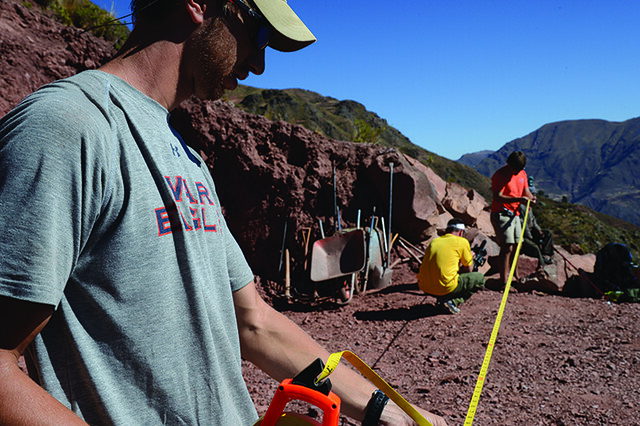
While they labored down a street just off the town center, the irrigation team went into the countryside with new technology, such as a GPS, old survey tapes and a simple transit and rod to measure elevations along the sometimes steeply raked terraces that the Quechua farm. Led by Robbins, the team included Bugg, a senior in civil engineering, McCartney, a senior in biosystems engineering, Whitney Brown, a junior in chemical engineering, and Michael Brennan, a sophomore in chemical engineering.
The local farmers have worked the area for centuries, and have developed a sophisticated series of small aqueducts that carry water from springs and a waterfall to some of the fields; however, there are not enough acres in irrigation. The student team focused on a more complete and useful survey of the area where the irrigation would be expanded, including a better characterization of flow rates from the water sources. Another aspect of the overall project was the construction of a water tank — the local farmers had spent the past six months or so leveling a pad into a hillside, where it would sit above the fields.
While the students ran their elevations and collected GPS points, the farmers blasted rock from the mountain, and pushed, rolled and carted rocks to form a stone wall around the lip of the pad. It was much like any other of the hundreds of rock walls built into the mountains, but it was amazing to see how it went together, with few wasted moves, and men who knew how to keep sight lines level without using anything but their eyes and their experience. The rocks pieced together like a puzzle with crush runs, not mortar, between the tiers.
A few months before departure, Brown told her aunt, Melissa Herkt, about her plans, and she became fascinated. A 1977 graduate in civil engineering and retired president and COO of Emerson Process Management, Herkt asked Duke, the group's faculty adviser, if she could join in the trip. Duke, who had already led two student teams into the area, was enthusiastic and welcomed her on board.
Herkt didn't just show up. When she got the go-ahead, she embarked on a strenuous two-month program to get in shape. A resident of Austin, Texas, she moved to Lake Tahoe for a month and walked four miles a day at the 7,000 foot elevation to get ready for the trip. Already in good shape, she jumped into weight management as well. When she arrived in Quesimpuco, she was as ready as anyone for the challenge. "I am a construction girl, and I can show these kids how to see things in a different light — as an experienced practicing engineer," she pointed out.
"These students have such energy, and they're so smart. I honestly don't remember being either when I was at Auburn," she adds with a laugh. "It was so nice to be accepted by them."
She had also spent a good deal of time in South America during her career, and carried with her a street-smart vocabulary in Spanish that helped her translate for the rest of the team. Back in the bunkhouse at night, she helped Robbins input data into the laptop to bring the survey into a useful model. She was quietly amazed, she said, how the student team made her a part of the everyday dialog without ceremony or boundary.
[miniflickr photoset_id=72157631952462015&sortby=date-posted-asc&per_page=50]
[continued]
At night the bunkhouse was the center of a wide range of activity. Some of the students took the time to work through what they had learned that day, as their projects moved forward, and made plans for the next day — what to keep, what to modify, what to push for, and even what to give up as unworkable. Some team members took time to rest or read. The media team, which in only a day or two had been absorbed into the students' lives, made notes, planned the next day's video shots, or sorted through digital photo files.
The media team from Auburn's Office of Communications and Marketing consisted of Mike Clardy and Kevin Fichtner, who worked together as a video team; myself and Jeff Etheridge, who took digital photos; and Camille Barkley, who assisted in bringing the media tasks together. We were joined in the bunkhouse by Benjo Paredes, his son Isaac and Ivan Roman, who served as the group's hosts for the week. Ivan works with Corson on the SIFAT team as its Latin America coordinator. Their deep knowledge of the area made them an inseparable part of the Auburn team.
In what can only be another story, Corson, the son of missionaries who worked in the Amazon basin of Bolivia decades earlier, met Parades when he was a displaced, would-be silver miner turned cocoa farmer who was also a firebrand Marxist. Now in his seventies, Parades' politics have been weathered by time and circumstance, and his reputation is that of a revered community leader. Respected wherever he walked, it seemed even the smallest child knew there was a larger life behind the soft, searching eyes.
Corson heads SIFAT while Benjo and Isaac manage the Bolivian counterpart CENATEC, which is roughly the same in terms of purpose. The idea behind both is to bring, and leave behind, the kinds of technology that the people of the Potosí, the region where Quesimpuco is located, can use in daily life. As Corson explains, it means not bringing tractors into a place where there are no garages and no parts; and not bringing in structures, equipment and processes that require trips to stores in places where there are none.
It requires, he explains, listening to what the people need, and not telling them what they want. The student team understood this before going in, but appreciated it all the more as they undertook their projects. What they learned, said one, was to develop a cultural sensitivity to meet their needs in a sustainable and collaborative way. In the end, it's a lot tougher than bringing a tractor in.
"Having lived and worked in Latin America, I have seen a world where people just don't have a lot," Herkt remarked. "The people here are not lazy, in fact they work so hard. They just don't have a lot to work with. They raise kids, they laugh and play, and it's all so difficult, and at the same time, so simple from a western point of view. Should we feel sorry?
"We Americans are constantly in search of things. The real keys are food, water and shelter . . . after that, what do we really need? The people here have survived, and thrived for hundreds of years. As the students — and myself — have worked here, we have come to a beginning in understanding the culture, and the technology that can be introduced here in a way that will be a real benefit."
[miniflickr photoset_id=72157631952462015&sortby=date-posted-asc&per_page=50]
[continued]
Indeed, that was one of the lessons that the Auburn students took home with them — to recognize that their own priorities were not always the same as those of the Quechua they had come to serve — that sometimes they met, and sometimes they didn't.
"You can't go to Lowe's for a piece of PVC — most of the everyday materials you see here are local, in an economy that is for the most part not based on money," one team member remarked. "It is also humbling to realize we're students, and that we will fail in some of our attempts."
Duke adds, "What we're doing here is important . . . we are teaching students who are not yet engineers how to become engineers, and it's not like getting an A or a B or a C; the people who live here are going to depend on the solutions our students find to these engineering problems. Food security is a real issue here."
And so the week goes, as the hydroponics unit and the field surveys take shape. The astonishment of the first couple of days in the Andes has led to a slow awakening of some of the patterns of life in Quesimpuco: gathering the harvest in the day, watching the morning and evening "commute" of the herders as they seek forage for their sheep and goats. Surely the shepherds' lives will be easier when their day is less disturbed by visitors like us — whom they don't call westerners but northerners.
At the end of the last day, gifts and honors are distributed in the bunkhouse. Suddenly you realize that the people you have been working with all week — such as Casimiro, a Quechua who heads a 40-man village water association — are friends now, gathered around a table that is sometimes separated by language, but never by spirit.
We leave at three in the morning, the last opportunity to see stars spilling into the southern sky. We crawl past the brown adobe houses with their small windows, the switchbacks in the road so tight that we see headlights from our other vehicles on the road as often as we see taillights. At 14,000 feet, the car struggles like it is out of breath. There are a few drifts of snow, and the temperature is in the mid-teens in the early mountain air.
A couple of hours south of La Paz a throttle cable goes out on one of the SUV's carrying us back. Not a problem for Isaac and Benjo, who pull a couple of extra cables out of a box of spares. Aided by Huber Ramos, who is also affiliated with CENATEC, they find that neither one fits. But a little bit of filing here, and some crimping there, and we are back on the road with a working fix. Illimani comes back into view along the dusty road, and La Paz again shows itself. Nobody has had a shower for a week, and now they're just ahead.
But then nobody really seems to care that they missed these western comforts. Nobody got dirty so much as they became, in a way, much fresher and ready to face a new day, and to make a new bridge across cultures that don't usually meet. In a real way this Auburn team was able to do just that. In the week they worked in Quesimpuco, they were not just students, but guests and partners, teachers and learners, builders and engineers.
They were something else as well — the face of Auburn.
[miniflickr photoset_id=72157631952462015&sortby=date-posted-asc&per_page=50]