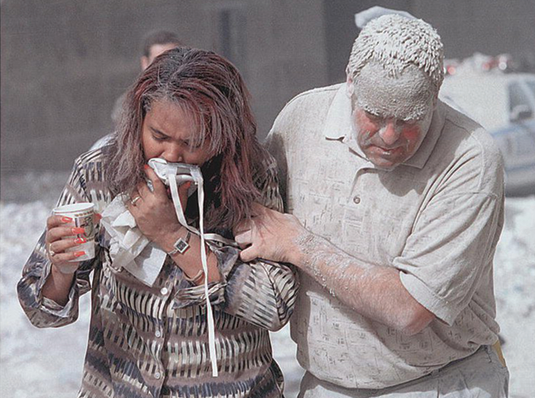
The world can be a dangerous place. And anyone who doubts that we could be safer or more secure in it — in our homes, schools, offices and in our skies — should simply look to the headlines.
In September, the U.S. solemnly remembered the tenth anniversary of our country's worst homeland attack since the bombing of Pearl Harbor. And while politics and religion and war are typically matters in which we are all individually invested, how we solve our problems — problems of safety, tools and technology that protect us — are challenges often left to engineers.
During the years since 9/11, the ways and means by which many engineers address those challenges have evolved with the times, and with changes in policy, our interests and our needs. How and why funding reaches certain projects is a science in and of itself, but the catastrophic events of September 11, 2001, have shown us that we still have a number of areas where we lack sufficient defenses and that research being conducted at the university level may offer the next generation of protection.
THE "T" FACTOR
Chemical engineering faculty member Mario Eden will tell you that chemical process design has not fundamentally changed during the past 10 years. But he will also tell you that the logistics involved with producing chemicals has caused us to face unprecedented challenges where the potential for a terrorist threat is concerned.
Eden's area of expertise — high-value chemicals, renewable fuels and sustainable energy — was not new following 9/11, but the impact of the attacks on his work, and his field, is a real one. Though it is a result of strained relations in the Middle East more than the tragic loss of American lives, the impact of national security on his research area has affected design, accessibility and safety, as well as renewed American interest in generating chemicals from domestic resources.
"We began thinking about the safety of storing large amounts of flammable liquids and hazardous materials," says Eden. "Now, you have to consider security threats, whereas before you primarily dealt with issues of environmental compliance. For design, we end up asking questions like, 'Should there be less solvent,' because of those safety concerns."
Eden says that he feels this evolution of his research area was most likely inevitable, but that September 11 was a catalyst for safety and security becoming a top priority in research. It also shaped a new element researchers were forced to consider when developing chemical processes: a terrorist attack.
INFORMATION ASSURANCE AND COLLABORATION
Rodney Robertson, a 1980 electrical engineering graduate, is the executive director of Auburn University's new Huntsville Research Center. His more than 30 years of work in federal science and engineering programs has offered him an inside look at the challenges we face as a nation in making our world — and the things in it — faster, stronger, lighter, less expensive and more secure.
As the former director of the U.S. Army Space and Missile Defense Command's technical center, he understands the importance of secure communications and the role that protected information exchange plays not only in our military actions but also our day-to-day lives.
"There is a general feeling in the defense community that the next big attack will be cyber," says Robertson. "As a result, we are seeing increased funding for research to enhance the security of our communication, transportation, power, water and sanitation systems, health systems, banking systems and computer systems."
[miniflickr photoset_id=72157627852275685&sortby=date-posted-asc&per_page=20]
[Continued]
Auburn alumna Leslee Belluchie, a 1983 graduate in mechanical engineering, agrees. "Ten years ago, cyber security wasn't a term that everyone used," says Belluchie. "Today, we are all thinking about it and talking about it. There is an overwhelming focus on it and the need to stay ahead of the curve."
Belluchie has spent her career providing support to the Department of Defense and the intelligence community. From her early days as a project engineer to her current role as co-owner of a private equity fund, she has been involved in our nation's security infrastructure for nearly 30 years.
Like millions of Americans, she watched in horror as the events of 9/11 unfolded in front of her. But unlike many others, she had a bird's eye view of the devastation from her high-rise apartment overlooking the Pentagon.
"I couldn't go home that first night," she says. "But, for nights following 9/11, I watched the Pentagon burn from my window and couldn't believe what was happening."
By September 12, the focus of her work had already begun to change.
"The amount of activity and the need for expertise and speed of deployment ramped up immediately," she says. "Everything accelerated. Our work became much more defined and incremental with an emphasis on protecting and defending our infrastructure. It was all about speed, speed, speed . . . for our country and for our soldiers."
Back on Auburn's campus, the university has continued aligning its interests in conducting research and hiring faculty who can carry out this kind of work, identifying key research areas that meet this priority.
"We have seen a change in the focus of the requests for proposals with an emphasis on layers of security," says Ralph Zee, associate dean for research in the College of Engineering. "It includes work on better physical barriers, improved sensors and network security like hardened concrete, bullet proof materials, information assurance and cyber security."
In order to meet this demand, researchers have embraced the collaborative approach to discovery and innovation, inviting colleagues from around the country to offer their expertise on projects that could be easily enhanced by another set of hands and an additional mind at work.
"Another change, which reflects congressional oversight on research after 9/11, is increased emphasis on collaborative work, both in house and across institutions," says Martha Taylor, assistant vice president for research in Auburn's Office of the Vice President for Research. "A requirement was added to many requests for proposals (RFPs) asking researchers to describe the broader impacts of the funding. It naturally led to collaborative efforts that increase the footprint of the work, so now we are seeing fewer numbers of single researcher awards."
Eric Imsand and Drew Hamilton, faculty members in computer science and software engineering, have been commuting to military bases across the country, instructing week-long digital forensics classes to wounded warriors who are looking to transition into new careers.
Their workforce training initiative is a collaborative project with Mississippi State University and Tuskegee University and is funded by the National Science Foundation, as well as the National Security Agency's National Information Assurance Education and Training Program. The project will also support outreach activities at minority institutions, including North Carolina Agricultural and Technical State University and Western New Mexico University.
Imsand and Hamilton's course provides servicemen with skills in digital forensics. Class participants learn how to trace email and Internet activities, recover deleted files from hard drives and find hidden data on digital devices, among other exercises.
This summer, they traveled to Eglin Air Force Base in Niceville, Fla., to instruct their sixteenth course in the past two years.
"Our country has a real shortage of people who can do this type of work [digital forensics], and most law enforcement agencies at the state and local level are faced with the new challenge of not having enough people to do it," says Imsand. "Now, we have wounded warriors who fully intend to serve their country — who are already motivated to do so — and who are making career transitions."
[miniflickr photoset_id=72157627852275685&sortby=date-posted-asc&per_page=20]
[Continued]
Sitting in a classroom, in battle dress uniform, Air Force veterans blend easily with one another as they listen to instructors and take notes on laptop computers. The soldiers' personal and medical needs are not identical, though their uniforms seem to match. What makes them similar is their desire for new skills and professional opportunities. It is not easy to see that Staff Sergeant Dave Flowers, pictured left center, has a prosthetic leg under his camo pants. Flowers' story begins in Afghanistan, where he was part of a team tasked to dispose of a munitions dump. After he stepped on a landmine, he looked down to find that his right leg was gone and his left was shattered.
Flowers admits that he was "computer illiterate" when he began the digital forensics course, but says by the end of the week he was conducting simulations that he can use in his military job.
"We do weapons raids where we might find computers and cellphones," says Flowers. "If I expand upon information I learned in this class, I could direct people in the field on how to extract information from those devices back on base."
THE ERA OF AWARENESS
After September 11, Bruce Tatarchuk recalls an intense blip of panic followed by a rush of outside interest in his research area. Tatarchuk, a faculty member in chemical engineering, has been studying air filtration materials for nearly 30 years and says that even with a flood of new interest after 9/11, there haven't been major scientific breakthroughs since the twin towers fell.
"It changed public awareness about research like ours," says Tatarchuk. "Suddenly, everyone was talking about WMDs, TICS and TIMS — toxic industrial chemicals and materials — anti-terror technologies, and people wanted to get involved in keeping us safe."
For Tatarchuk, the best line of defense for a first responder is an efficient filter. Ten years ago, when the haze began to clear, images of first responders caked in dust were hard to bear.
Later, stories began to surface about 9/11 heroes who struggled to breathe during search and rescue, even while wearing masks meant to protect their lungs from hazardous substances.
Tatarchuk's technology offers protection by using microfibrous materials that catch harmful substances at the molecular level. His research asks the question, "How do you make a filter that stops harmful contaminants?" But it also asks, "How do you dispose of that filter," "How do you make that filter work in hospitals, schools and homes," and "How can we make this technology readily available and affordable?"
Treating the cause, rather than the symptoms, is a main focus of Tatarchuk's work, though no one could have predicted the degree to which first responders and victims would face physical exposure to a highly toxic dust caused by two buildings collapsing.
"We realized [after 9/11] that first responders aren't just firemen and police," says Tatarchuk. "So many people rushing to help are civilians, like you and me. They have no training, but also no equipment to protect them."
During the past 10 years, Tatarchuk's lab has been busy developing high-efficiency filters that can remove gasses from fuel cell systems and the next generation of gas masks for the U.S. military, but he feels that the more pressing threat to American safety is energy security and healthcare issues associated with breathing unsafe air.
"We need newer and better microfibrous materials now more than ever," he says. "We need cleaner air that can be filtered for less money. The high energy costs associated with running an inefficient HVAC system are astronomical, but we can solve those problems with new filtration, by cleaning up the air. And those same technologies have anti-terrorism applications."
PROTECTION OUTSIDE AND IN
James Davidson, faculty member in the Department of Civil Engineering, has been working in the protective structures field since 1996, shortly after the Khobar Towers bombing in Saudi Arabia.
"The Khobar Towers incident demonstrated to the civil engineering community that they must do a better job at designing and constructing buildings that our servicemen live and work in, so they are protected from attacks," says Davidson.
That terrorist bombing — which killed 19 U.S. servicemen and injured more than 300 others — led Davidson to the Air Force Research Laboratory, U.S. Army Engineer Research and Development Center and the National Science Foundation to work on developing new ways we can remain safe indoors, no matter what is going on outside.
"When an explosion occurs outside of a building, the injuries and deaths are generally not due directly to the explosion," he adds. "Instead they are caused by secondary effects of the building components that break apart and are propelled at high velocities by the blast shock wave."
On September 11, 2001, Davidson again wondered how he and other structural engineers could better protect buildings from external explosions.
"It raised two questions about building design and construction," says Davidson. "Are current U.S. fire codes sufficient, and should we have more robust structural design requirements to prevent progressive collapse, so one failed building component will not result in the instability of an entire structure?"
We know now that the collapse of the twin trade center towers was not due directly to the impact and explosion of an airliner, but as Davidson indicates, by the extreme heat that softened the structural steel frame.
"Once the upper portion of those buildings began to collapse, the remaining structure could not sustain the force," Davidson adds. "Parts of the Pentagon had been reinforced a few years prior to 9/11, which likely did save lives."
[miniflickr photoset_id=72157627852275685&sortby=date-posted-asc&per_page=20]
[Continued]
Davidson says that as a result of September 11, the structural engineering field expanded and the Department of Defense was pressured to open up to university and private sector individuals and organizations, so they could take advantage of protective structures knowledge within the industry.
"Prior to 9/11, the protective structures research community was relatively small and most work was directed to the Department of Defense," says Davidson. "September 11 made structural engineers realize that it may be necessary to consider blast design for many other categories of structures. Other areas in our industry, like earthquake engineering, started getting involved with blast loads."In the same way, polymer and fiber engineer Gwynedd Thomas is designing stronger materials that can protect us from the neighborhood street corner to the battlefield.
For Thomas, the horror of 9/11 was deeply personal, as it was for many Americans, but what followed in the months and years was her dedication and determination to protect us.
Her research with lightweight ballistics protection and composite materials is used to develop body armor for U.S. troops, including the Army's Air Warrior upgrade project from 2002-2006, as well as armor for vulnerable aircraft, such as the V-22 Osprey, and armor to protect American forces from deadly IEDs and land mines. According to military statistics, nearly 70 percent of all casualties in the Iraqi conflict have been caused by roadside bombs.
Thomas and colleague David Walrath at the University of Wyoming's Department of Mechanical Engineering are working with Kennon Products, Inc. of Sheridan, Wyo., a manufacturer of protective equipment and coverings for aviation and military applications, to develop vehicle armor that provides military personnel greater protection against those bombs.
"The designs that we are developing for explosion and ballistic protection will offer solutions for all of our military services and will provide an increased degree of safety for American men and women in combat," says Thomas.
Her work is proving vital to developing new armor that can withstand blasts better than the standard hardened steel that U.S. military vehicles currently use.
VULNERABILITY AND AN AGENDA
Maria Auad was working with a CalTech consortium on a military project involving liquid crystal polymers on the morning of 9/11/2001. She had been conducting research in the U.S. for a year.
Back then, she never expected that how and where those projects occurred might look different as a result of one September day.
"After 9/11, there was an explosion of new research and development technologies," says Auad. "Agencies that traditionally fund these projects, like the Department of Commerce, Department of Defense, Navy and Army, modified their focus areas in response to new threats and vulnerabilities."
Auad believes that the formation of the Department of Homeland Security is a clear response by the U.S. to those challenges, drawing on the intellectual and technological capabilities of scholars, scientists and technologists to keep Americans safe.
"There's no question that this event has changed America in so many ways, and research universities have not been immune to the consequences we have experienced," says Auad. "In fact, they have been impacted significantly. The national research agenda has changed post-9/11 and made protecting the security of citizens a top priority and a major challenge."
In a matter of hours, policy makers and American citizens alike began to realize that terrorists could threaten a number of areas, such as the economy and public trading, biosecurity, infrastructure for transportation and electrical systems, radioactive materials, communication and information exchange.
"September 11 affected us in a number of ways," says Taylor. "The biggest change was a move from RFPs for fundamental or early stage research to those for research that provided a solution to a specific problem."
[miniflickr photoset_id=72157627852275685&sortby=date-posted-asc&per_page=20]
[Continued]
One effect being felt in labs across Auburn's campus, including Auad's, is the decrease in an international graduate student population that supports much of the university research enterprise. "The new screening systems now in place and the new U.S. citizenship requirement for high priority research areas have created major impediments," says Auad. "International educational competition will decrease the availability of scientific talent even further. With too few students, research momentum will be difficult to maintain."
Without that momentum, universities across the country will face an even greater degree of competition for quality graduate and doctoral students, as well as lab technicians and support staff, many of whom are paid through research grants and are highly skilled in particular areas. The potential for a decline in enrollment could hit a university's budget as hard as its research space.
"There has been a big impact in the area of export control," says Taylor. "These regulations have been on the books for a long time, but 9/11 forced a realization that simply educating someone about how to do something could endanger our nation's security."
In addition to reducing the degree to which international graduate students can work in key research areas, 9/11 also called into question some basic assumptions about how American universities operate.
"While we still welcome individuals from around the world to live and learn, we are required to tell them that there may be certain projects on which they will not be allowed to work," Taylor adds. "It has impacted the way universities view themselves and their approach to openness in higher education."
From a technologist's perspective, Auad says she has questions about where we stand after the 9/11 attacks.
"The country has spent billions of dollars on technology upgrades to detect and neutralize new threats," she adds. "Have we invested it wisely? Are the technologies and resources being deployed effectively? What more can be done?"
TEN MORE YEARS
Time does not stand still, even on a college campus. Here at Auburn, faculty are no less devoted to their work and engineering challenges than they were in 2001. In 10 more years, no doubt, the academic research environment will have evolved even further from what we know today.
As opportunities grow for government, academia and industry to work together, Auburn faculty and engineers around the country continue to improve upon their projects. Who can say where their ideas will take them tomorrow.
From the heavily observed to the relatively unknown, engineering educators face the unprecedented challenge of generating interest in and respect for new technologies that can keep us safe, whether at home, or at work, or at war.
At the same time, they must remain invested in teaching eager engineering students how to improve our nation's best defenses, as well as how to ask themselves broader questions about security, protection and the certainty of an unpredictable future.
Someone once said that safety never takes a holiday; neither do engineers.
Contributed by Cheryl Cobb, Beth Smith and Morgan Stashick
[miniflickr photoset_id=72157627852275685&sortby=date-posted-asc&per_page=20]