

Auburn materials engineers make high-profile breakthrough in nanophotonics
Materials Engineering
By Jeremy Henderson
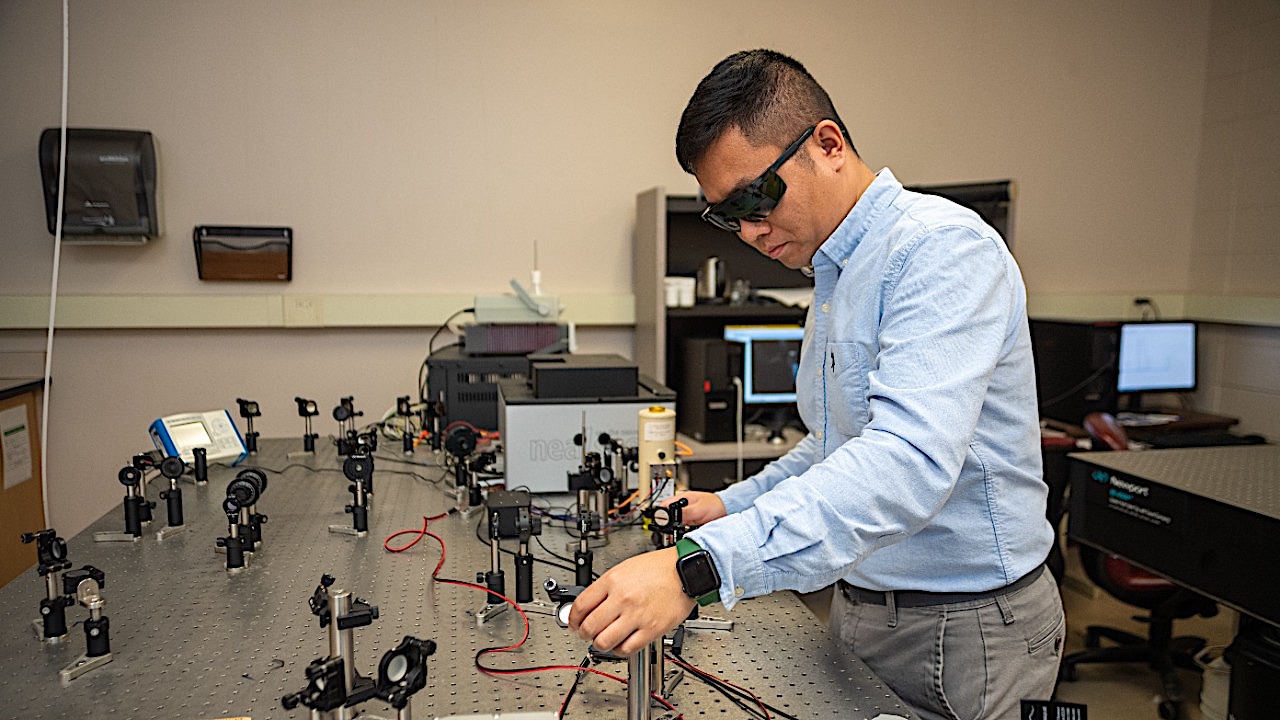
Siyuan Dai leads an Auburn materials engineering team whose breakthrough nanophotonics research was recently published in the prestigious journal Nature Communications.
Auburn Engineering researchers are advancing the emerging field of nanophotonics by discovering a new way to control light at the nanoscale — a breakthrough that could support next-generation optical and quantum technologies.
Supported by the National Science Foundation, a team led by Siyuan Dai, the McWane Associate Professor in the Department of Mechanical Engineering, has developed a method to manipulate polaritons — quasiparticles that combine light and matter — within ultra-thin materials.
The approach uses van der Waals terraces, or nanoscale step structures, to convert one type of light wave into another, allowing researchers to direct how light moves through materials only a few atoms thick.
“Our work shows, for the first time, that we can intentionally convert one wave into another, creating new ways to route and process light on extremely small scales,” Dai said.
Previously, different nanoscale light waves behaved independently, limiting their usefulness. Dai’s team discovered that these step-like edges can act as precise converters, scattering light in ways that change its behavior.
Using advanced infrared imaging, the researchers observed these transformations at resolutions as small as 10 nanometers.
The findings, published in Nature Communications, demonstrate new control over light–matter interactions and provide a foundation for applications in optical circuits, sensing technologies and quantum systems.
“It was exciting to directly image how these light waves change when they encounter the step structures,” said doctoral candidate Byung-Il Noh.
Researchers