

Assistant professor of chemical engineering earns $875K DOE Early Career Award to advance membrane-based lithium separation research
Chemical Engineering
By Joe McAdory
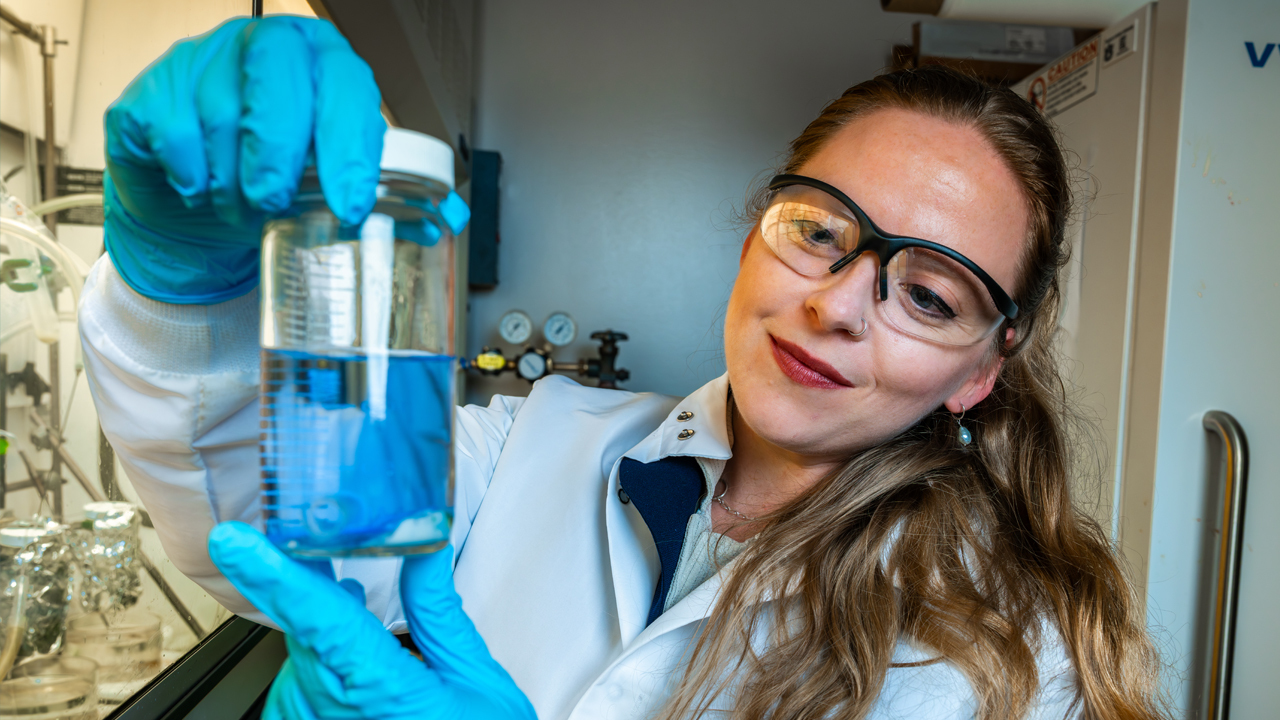
Can lithium and other critical materials be selectively extracted from chemically complex water solutions without relying on slow, energy-intensive methods? Yes, and Cassandra Porter, assistant professor in the Department of Chemical Engineering, has the membranes to prove it.
Porter was granted a five-year, $875,000 U.S. Department of Energy Early Career Award for her project exploring how membrane chemistry and operating conditions control ion selectivity under real-world conditions.
By making it easier to separate lithium and other critical materials from water, Porter’s work could help lower the cost and improve the reliability of materials that power batteries, electronics and energy storage systems.
“When we talk about separating charged species like ions, the first question you have to ask is how are they different from each other,” Porter said. “Then you leverage that difference. Ions are similar in size and often have similar charges, so what you can exploit becomes very limited.”
Her project aims to push past those limits. “This research can evolve into looking at other charged species we can recover, such as uranium, copper, gold and yttrium,” she said. “It’s about securing energy pathways that are sustainable and recycling materials, because the planet is not unlimited in its resources.”
“You can come up with all sorts of energy solutions, but you need to make them transportable. That’s what batteries do. They let you store energy and take it wherever it’s needed,” she added.
Researchers